Process Enumeration - EnumProcesses
Enumerating processes using the EnumProcesses WinAPI.
Jump to Section (8)
Learning Objectives
0/2 doneIntroduction
One way to perform process enumeration was previously demonstrated in the process injection module that used CreateToolHelp32Snapshot. This module will demonstrate another way to perform process enumeration using EnumProcesses.
It's important for malware authors to be able to implement a technique within their malware in several ways to remain unpredictable in their actions.
EnumProcesses
Start by reviewing Microsoft's documentation on EnumProcesses. Notice that the function returns the Process IDs (PIDs) as an array, without the associated process names. The problem is that only having PIDs without the associated process names makes it difficult to identify the process from a human perspective.
The solution is to use the OpenProcess, GetModuleBaseName and EnumProcessModules WinAPIs.
-
OpenProcesswill be used to open a handle to a PID withPROCESS_QUERY_INFORMATIONandPROCESS_VM_READaccess rights. -
EnumProcessModuleswill be used to enumerate all the modules within the opened process. This is required for step 3. -
GetModuleBaseNamewill determine the name of the process, given the enumerated process modules from step 2.
EnumProcesses Advantage
Using the CreateToolhelp32Snapshot process enumeration
method, a snapshot is created and a string comparison is performed to
determine whether there the process name matches the intended target
process. The issue with that method is when there are multiple instances
of a process running at different privilege levels, there's no way to
differentiate them during the string comparison. For example, some svchost.exe
processes run with normal user privileges whereas others run with
elevated privileges. There is no way to determine the privilege level of
svchost.exe during the string comparison. Therefore the only indicator as to whether it's privileged is if the OpenProcess call fails (assuming that the implementation is running with normal user privileges).
On the other hand, using the EnumProcesses process
enumeration method provides the PID and handle to the process, and the
objective is to obtain the process name. This method is guaranteed to be
successful since a handle to the process already exists.
Code Walkthrough
This section will explain code snippets that are based on [Microsoft's example of process enumeration.
PrintProcesses Function
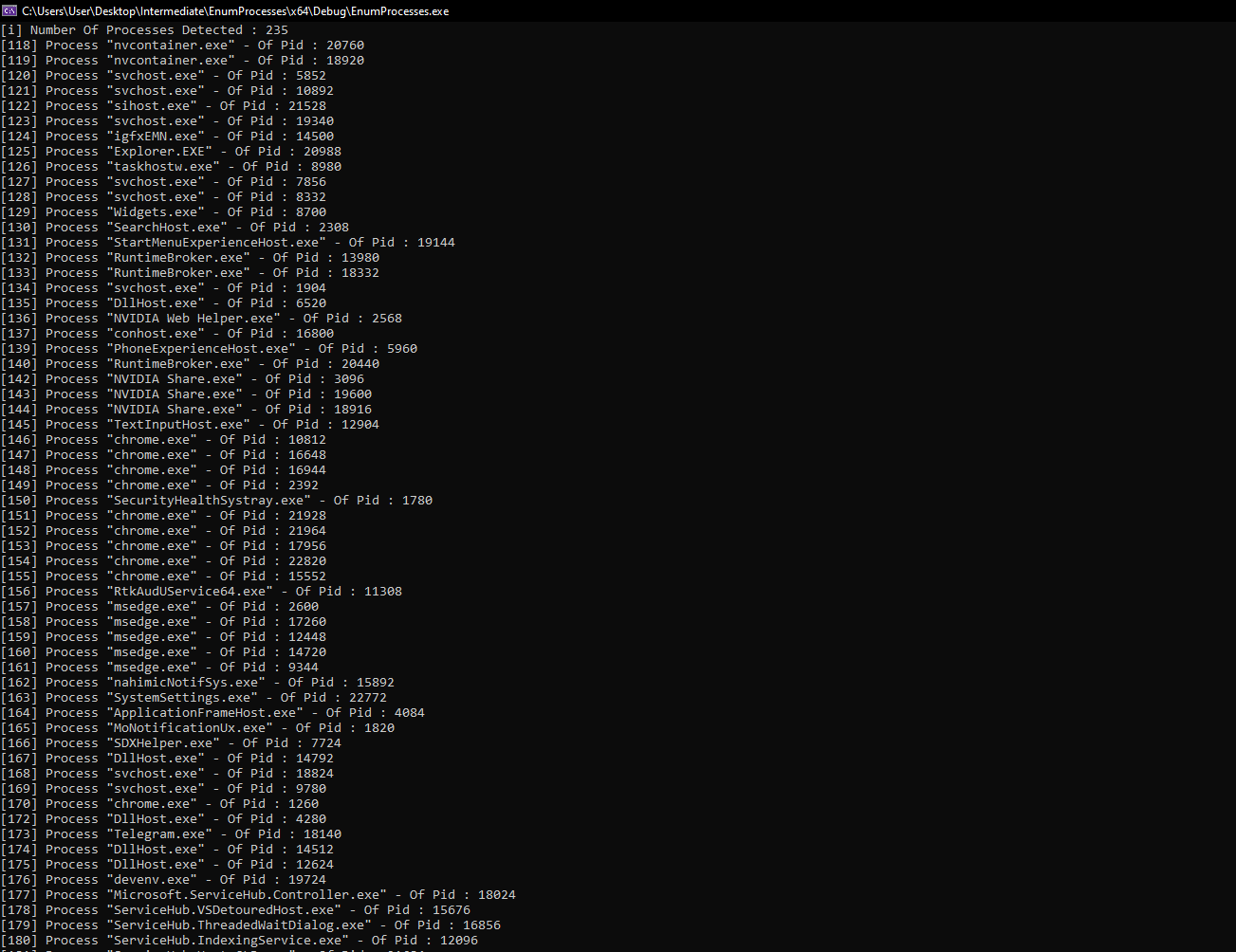
PrintProcesses is a custom function that prints the
process name and PID of the enumerated processes. Only processes running
with the same privileges as the implementation can have their
information retrieved. Information about elevated processes cannot be
retrieved, again, assuming the implementation is running with normal
user privileges. Attempts to open a handle to high-privileged processes
using OpenProcess will result in ERROR_ACCESS_DENIED error.
It's possible to use OpenProcess's response as an
indicator to determine if the process can be targeted. Processes that
cannot have a handle open to them cannot be targeted whereas the ones
with a handle successfully opened can be targeted.
BOOL PrintProcesses() {

	DWORD		adwProcesses	[1024 * 2],
			    dwReturnLen1		= NULL,
			    dwReturnLen2		= NULL,
			    dwNmbrOfPids		= NULL;

	HANDLE		hProcess		= NULL;
	HMODULE		hModule			= NULL;

	WCHAR		szProc			[MAX_PATH];

	// Get the array of PIDs
	if (!EnumProcesses(adwProcesses, sizeof(adwProcesses), &dwReturnLen1)) {
		printf("[!] EnumProcesses Failed With Error : %d \n", GetLastError());
		return FALSE;
	}

	// Calculating the number of elements in the array
	dwNmbrOfPids = dwReturnLen1 / sizeof(DWORD);

	printf("[i] Number Of Processes Detected : %d \n", dwNmbrOfPids);

	for (int i = 0; i < dwNmbrOfPids; i++) {

		// If process is not NULL
		if (adwProcesses[i] != NULL) {

			// Open a process handle
			if ((hProcess = OpenProcess(PROCESS_QUERY_INFORMATION | PROCESS_VM_READ, FALSE, adwProcesses[i])) != NULL) {

				// If handle is valid
				// Get a handle of a module in the process 'hProcess'
				// The module handle is needed for 'GetModuleBaseName'
				if (!EnumProcessModules(hProcess, &hModule, sizeof(HMODULE), &dwReturnLen2)) {
					printf("[!] EnumProcessModules Failed [ At Pid: %d ] With Error : %d \n", adwProcesses[i], GetLastError());
				}
				else {
					// If EnumProcessModules succeeded
					// Get the name of 'hProcess' and save it in the 'szProc' variable
					if (!GetModuleBaseName(hProcess, hModule, szProc, sizeof(szProc) / sizeof(WCHAR))) {
						printf("[!] GetModuleBaseName Failed [ At Pid: %d ] With Error : %d \n", adwProcesses[i], GetLastError());
					}
					else {
						// Printing the process name & its PID
						wprintf(L"[%0.3d] Process \"%s\" - Of Pid : %d \n", i, szProc, adwProcesses[i]);
					}
				}

				// Close process handle
				CloseHandle(hProcess);
			}
		}

		// Iterate through the PIDs array
	}

	return TRUE;
}
GetRemoteProcessHandle Function
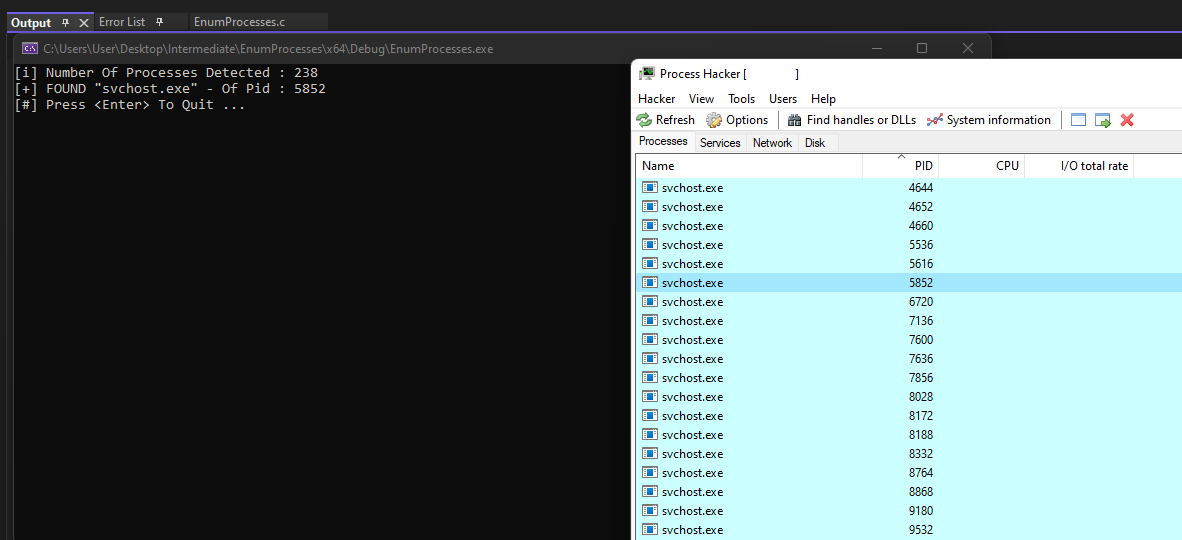
The code snippet below is an update to the previous PrintProcesses function. GetRemoteProcessHandle will perform the same tasks as PrintProcesses except it will return a handle to the specified process.
The updated function uses wcscmp to verify the target process. Furthermore, OpenProcess's access control is changed from PROCESS_QUERY_INFORMATION | PROCESS_VM_READ to PROCESS_ALL_ACCESS to provide more access to the returned process object.
BOOL GetRemoteProcessHandle(LPCWSTR szProcName, DWORD* pdwPid, HANDLE* phProcess) {

	DWORD		adwProcesses	[1024 * 2],
			    dwReturnLen1		= NULL,
			    dwReturnLen2		= NULL,
			    dwNmbrOfPids		= NULL;

	HANDLE		hProcess		= NULL;
	HMODULE		hModule			= NULL;

	WCHAR		szProc			[MAX_PATH];

	// Get the array of PIDs
	if (!EnumProcesses(adwProcesses, sizeof(adwProcesses), &dwReturnLen1)) {
		printf("[!] EnumProcesses Failed With Error : %d \n", GetLastError());
		return FALSE;
	}

	// Calculating the number of elements in the array
	dwNmbrOfPids = dwReturnLen1 / sizeof(DWORD);

	printf("[i] Number Of Processes Detected : %d \n", dwNmbrOfPids);

	for (int i = 0; i < dwNmbrOfPids; i++) {

		// If process is not NULL
		if (adwProcesses[i] != NULL) {

			// Open a process handle
			if ((hProcess = OpenProcess(PROCESS_QUERY_INFORMATION | PROCESS_VM_READ, FALSE, adwProcesses[i])) != NULL) {

				// If handle is valid
				// Get a handle of a module in the process 'hProcess'.
				// The module handle is needed for 'GetModuleBaseName'
				if (!EnumProcessModules(hProcess, &hModule, sizeof(HMODULE), &dwReturnLen2)) {
					printf("[!] EnumProcessModules Failed [ At Pid: %d ] With Error : %d \n", adwProcesses[i], GetLastError());
				}
				else {
					// If EnumProcessModules succeeded
					// Get the name of 'hProcess' and save it in the 'szProc' variable
					if (!GetModuleBaseName(hProcess, hModule, szProc, sizeof(szProc) / sizeof(WCHAR))) {
						printf("[!] GetModuleBaseName Failed [ At Pid: %d ] With Error : %d \n", adwProcesses[i], GetLastError());
					}
					else {
						// Perform the comparison logic
						if (wcscmp(szProcName, szProc) == 0) {
							wprintf(L"[+] FOUND \"%s\" - Of Pid : %d \n", szProc, adwProcesses[i]);
							// Return by reference
							*pdwPid		= adwProcesses[i];
							*phProcess	= hProcess;
							break;
						}
					}
				}

				CloseHandle(hProcess);
			}
		}
	}

	// Check if pdwPid or phProcess are NULL
	if (*pdwPid == NULL || *phProcess == NULL)
		return FALSE;
	else
		return TRUE;
}
PrintProcesses - Example
GetRemoteProcessHandle - Example
Companion Project & Source Code
4 readable source/config files extracted directly from the archive
// @NUL0x4C | @mrd0x : MalDevAcademy

#include <Windows.h>
#include <stdio.h>
#include <Psapi.h>


#define TARGET_PROCESS L"svchost.exe"

BOOL GetRemoteProcessHandle(IN LPCWSTR szProcName, OUT DWORD* pdwPid, OUT HANDLE* phProcess) {

	DWORD		adwProcesses		[1024 * 2],
				dwReturnLen1		= NULL,
				dwReturnLen2		= NULL,
				dwNmbrOfPids		= NULL;

	HANDLE		hProcess			= NULL;
	HMODULE		hModule				= NULL;

	WCHAR		szProc				[MAX_PATH];

	// Get the array of pid's in the system
	if (!EnumProcesses(adwProcesses, sizeof(adwProcesses), &dwReturnLen1)) {
		printf("[!] EnumProcesses Failed With Error : %d \n", GetLastError());
		return FALSE;
	}

	// Calculating the number of elements in the array returned
	dwNmbrOfPids = dwReturnLen1 / sizeof(DWORD);

	printf("[i] Number Of Processes Detected : %d \n", dwNmbrOfPids);

	for (int i = 0; i < dwNmbrOfPids; i++){

		// If process is NULL
		if (adwProcesses[i] != NULL) {

			// Opening a process handle
			if ((hProcess = OpenProcess(PROCESS_ALL_ACCESS, FALSE, adwProcesses[i])) != NULL) {

				// If handle is valid
				// Get a handle of a module in the process 'hProcess'.
				// The module handle is needed for 'GetModuleBaseName'
				if (!EnumProcessModules(hProcess, &hModule, sizeof(HMODULE), &dwReturnLen2)) {
					printf("[!] EnumProcessModules Failed [ At Pid: %d ] With Error : %d \n", adwProcesses[i], GetLastError());
				}
				else {
					// if EnumProcessModules succeeded
					// get the name of 'hProcess', and saving it in the 'szProc' variable
					if (!GetModuleBaseName(hProcess, hModule, szProc, sizeof(szProc) / sizeof(WCHAR))) {
						printf("[!] GetModuleBaseName Failed [ At Pid: %d ] With Error : %d \n", adwProcesses[i], GetLastError());
					}
					else {
						// Perform the comparison logic
						if (wcscmp(szProcName, szProc) == 0) {
							// wprintf(L"[+] FOUND \"%s\" - Of Pid : %d \n", szProc, adwProcesses[i]);
							// return by reference
							*pdwPid		= adwProcesses[i];
							*phProcess	= hProcess;
							break;
						}
					}
				}

				CloseHandle(hProcess);
			}
		}
	}

	// Check if pdwPid or phProcess are NULL
	if (*pdwPid == NULL || *phProcess == NULL)
		return FALSE;
	else
		return TRUE;
}


BOOL PrintProcesses() {

	DWORD		adwProcesses		[1024 * 2],
				dwReturnLen1		= NULL,
				dwReturnLen2		= NULL,
				dwNmbrOfPids		= NULL;

	HANDLE		hProcess			= NULL;
	HMODULE		hModule				= NULL;

	WCHAR		szProc				[MAX_PATH];

	// get the array of pid's in the system
	if (!EnumProcesses(adwProcesses, sizeof(adwProcesses), &dwReturnLen1)) {
		printf("[!] EnumProcesses Failed With Error : %d \n", GetLastError());
		return FALSE;
	}

	// calculating the number of elements in the array returned
	dwNmbrOfPids = dwReturnLen1 / sizeof(DWORD);

	printf("[i] Number Of Processes Detected : %d \n", dwNmbrOfPids);

	for (int i = 0; i < dwNmbrOfPids; i++) {

		// a small check
		if (adwProcesses[i] != NULL) {

			// opening a process handle
			if ((hProcess = OpenProcess(PROCESS_QUERY_INFORMATION | PROCESS_VM_READ, FALSE, adwProcesses[i])) != NULL) {

				// If handle is valid
				// Get a handle of a module in the process 'hProcess'.
				// The module handle is needed for 'GetModuleBaseName'
				if (!EnumProcessModules(hProcess, &hModule, sizeof(HMODULE), &dwReturnLen2)) {
					printf("[!] EnumProcessModules Failed [ At Pid: %d ] With Error : %d \n", adwProcesses[i], GetLastError());
				}
				else {
					// if EnumProcessModules succeeded
					// get the name of 'hProcess', and saving it in the 'szProc' variable
					if (!GetModuleBaseName(hProcess, hModule, szProc, sizeof(szProc) / sizeof(WCHAR))) {
						printf("[!] GetModuleBaseName Failed [ At Pid: %d ] With Error : %d \n", adwProcesses[i], GetLastError());
					}
					else {
						// printing the process name & its pid
						wprintf(L"[%0.3d] Process \"%s\" - Of Pid : %d \n", i, szProc, adwProcesses[i]);
					}
				}

				// close process handle
				CloseHandle(hProcess);
			}
		}

		// Iterate through the PIDs array
	}

	return TRUE;
}


int main() {

	DWORD		Pid				= NULL;
	HANDLE		hProcess		= NULL;

	if (!GetRemoteProcessHandle(TARGET_PROCESS, &Pid, &hProcess)) {
		return -1;
	}

	wprintf(L"[+] FOUND \"%s\" - Of Pid : %d \n", TARGET_PROCESS, Pid);

	//PrintProcesses();

	printf("[#] Press <Enter> To Quit ... ");
	getchar();

	return 0;
}
Full Archive Manifest (5 files inside .zip)
- EnumProcesses/EnumProcesses.sln
- EnumProcesses/EnumProcesses/EnumProcesses.c
- EnumProcesses/EnumProcesses/EnumProcesses.vcxproj
- EnumProcesses/EnumProcesses/EnumProcesses.vcxproj.filters
- EnumProcesses/EnumProcesses/EnumProcesses.vcxproj.user